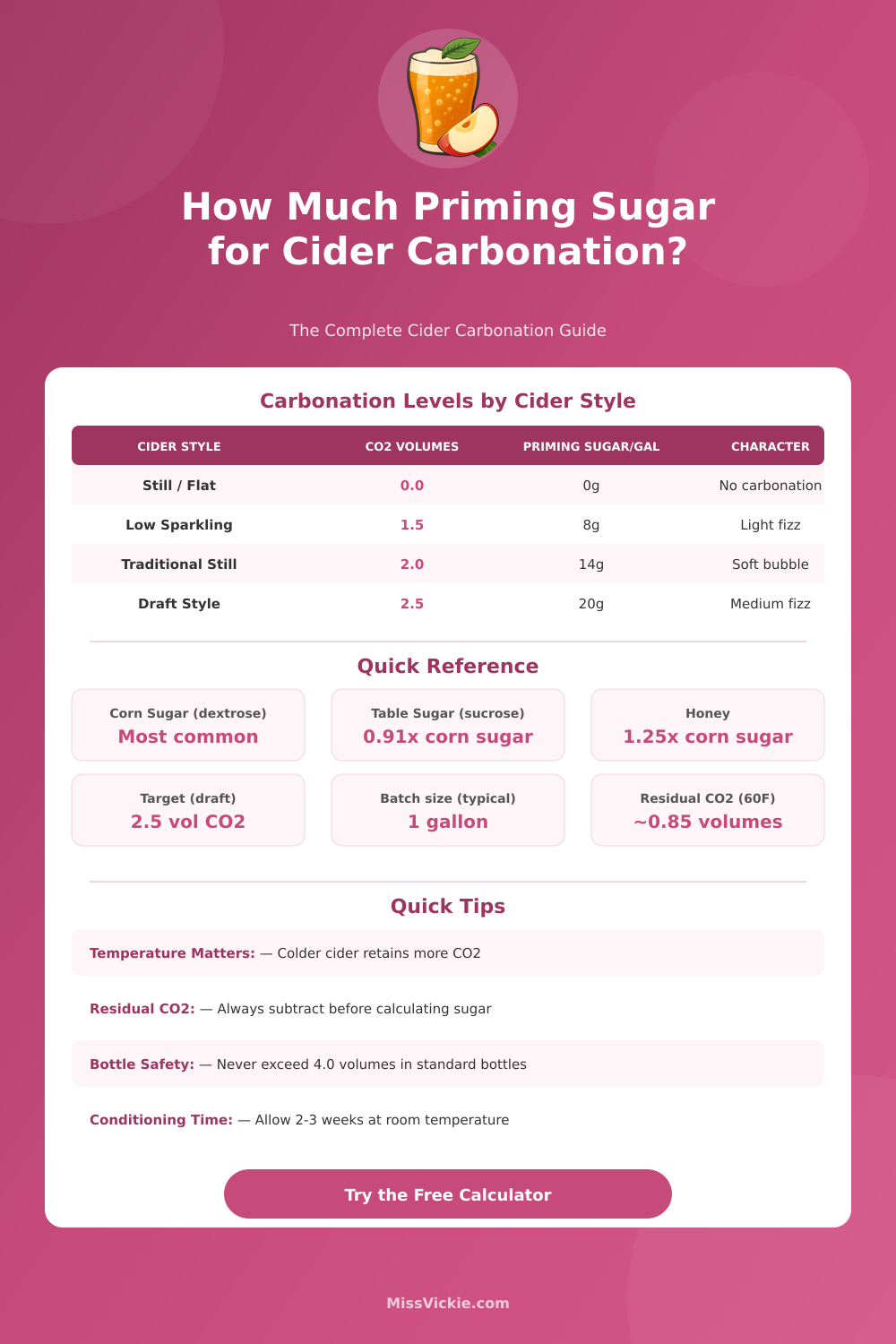
🍹 Cider Carbonation Calculator
Calculate priming sugar or forced CO2 needed for perfectly carbonated cider
| Temperature | Residual CO2 (vol) | Notes |
|---|---|---|
| 35°F (2°C) | 1.27 | Near freezing, very cold ferment |
| 40°F (4°C) | 1.17 | Refrigerator temperature |
| 45°F (7°C) | 1.06 | Cold cellar |
| 50°F (10°C) | 0.97 | Cool basement |
| 55°F (13°C) | 0.89 | Cellar temperature |
| 60°F (16°C) | 0.82 | Cool room |
| 65°F (18°C) | 0.76 | Typical fermentation |
| 70°F (21°C) | 0.70 | Room temperature |
| 75°F (24°C) | 0.64 | Warm room |
| 80°F (27°C) | 0.59 | Very warm |
| Sugar Type | Amount (oz) | Amount (grams) | Notes |
|---|---|---|---|
| Corn Sugar (Dextrose) | 0.96 oz | 27g | Most predictable, 100% fermentable |
| Table Sugar (Sucrose) | 0.87 oz | 25g | Slightly less, inverts during ferment |
| Honey | 1.20 oz | 34g | Adds subtle honey aroma |
| Dry Malt Extract | 1.22 oz | 35g | Adds light malt character |
| Maple Syrup | 1.44 oz | 41g | Adds maple notes, variable sugar |
| Batch Size | Sugar (oz) | Sugar (grams) | Sugar (tsp) |
|---|---|---|---|
| 1 quart (0.25 gal) | 0.24 oz | 7g | 1.4 tsp |
| 1 gallon (3.8 L) | 0.96 oz | 27g | 5.5 tsp |
| 2 gallons (7.6 L) | 1.92 oz | 54g | 11 tsp |
| 3 gallons (11.4 L) | 2.88 oz | 82g | 16.5 tsp |
| 5 gallons (18.9 L) | 4.80 oz | 136g | 27.5 tsp |
| 10 gallons (37.9 L) | 9.60 oz | 272g | 55 tsp |
You maybe would not know that, but cider (that fresh), fruity drink from the tap at your local pub; is simply fermented apple juice It enjoys big popularity through United Kingdom, especially in the West Country and in Ireland. The numbers are wild: United Kingdom is world leader about cider-consumption per person and the biggest producer globally. Order it cooled at good pub, and you will find something genuinely refreshing, fruity and clean.
Here people commonly mix everything. Cider and beer? They are two different things.
What Cider Is and How to Enjoy It
Beer comes from grains, mostly barley, although oats, wheat, rye, rice and corn also enter the mix. Cider on the other hand comes directly from apples. Funny, it is more alike to wine than to beer.
Actually, when it hits a certain alcohol level in United Kingdom, the law classifies it as wine.
The limit between cider and apple juice confuse many, but there is an easy way identify them. Cider is made from whole apples, with seeds and skin, and is barely filtered. It stays almost puree.
Apple juice? It is strongly filtered and crystal clear. Here is a fast test: raise the bottle against light.
If you see through to the back label, that is juise. If the liquid seems cloudy or opaque, you have cider.
CAMRA has their definition of what is “real cider” or perry. According to them, it must ferment from whole juice of freshly pressed apples or pears, no concentrated or chaptalised juices allowed. Chaptalised is a particular production method.
The traditional mode is like that of champagne and sparkling ciders, and many producers still use it today.
Excellent ciders from good orchards are not meant for substitute beer. Their alcohol is too strong for a full pint. Serve cider more as wine, that is the style.
Pour six to eight ounces, especially if it reaches eight percent ABV. That amount leaves space for a second serving without overdoing it. Yes, sixteen ounces is possible, but it can feel heavy because of the power of many quality ciders.
Moreover, space at top helps smell the aromas. A standard 125-gram serving has around 70 calories, while a cup of apple cider is close to 117. One tip: if your cider stayed in the refrigerator, take it out 15 minutes before pouring, to reach ideal temperature.
Cider is also great for cooking. Add sweet cider in sauerkraut with pork chops, and after 8 to 12 minutes you have a wonderful dish. Recipes for pulled pork commonly require two cups of cider.
You can prepare a slowcooker with nine medium apples (mix varieties), orange, three cinnamon sticks and whole nutmeg. For homebrewing use a basic cider yeast, leave it to ferment completely, later sweeten by means of xylitol for delicious results.