
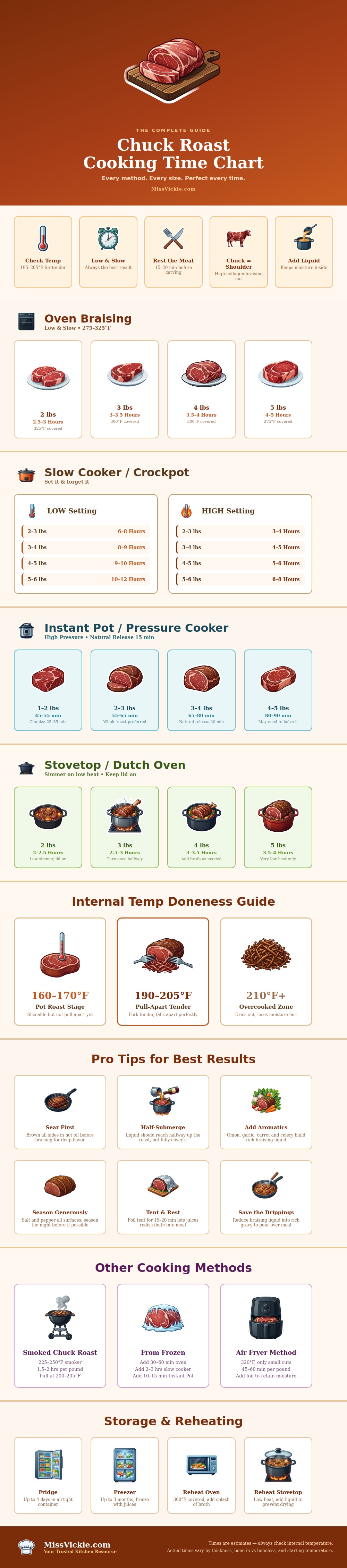
I know a lot of people has had chuck roast turn out too tough even if they cook it for hours. Why? Because although they get it hot enough in the middle eventually, they don’t take it up high enough in the first place. They pull it out of the oven thinking it’s done, but can feel resistance as they try to cut into it with a fork.
Why? Because they’re thinking about time instead of temperature. As chart shows, time is less important then the thermometer reading. It’s not just heating it through; you want it to break down structure of meat. The cow’s shoulder (where Chuck originates), is a workhorse muscle and full of collagen. Collagen become gelatin when heat are applied over time, resulting in rich textures. Early removal will result in tough-to-chew meat, as the collagen remains intact.
Why Your Chuck Roast Is Tough and How to Fix It
Ideally, cook it until internal temperature reaches between 195 and 205 degrees Fahrenheit. That’s where it starts breaking down and gets tender enough for a fork. A slight variance in temperature make all the difference in texture. How long something takes isn’t really about clock, it’s more about the internal temperature, but that’s only part of the story.
For a three or four pound cut, oven braising (at about 300 degrees) is good. There’s plenty of time for heat to work through without toughening exterior. Two pounds might do it in two and a half hours; five pounds could be closer to five. That just depends based off the volume-to-surface ratio. A bigger piece have a lot less surface area compared to its volume, so you have to wait longer until interior gets soft.
It wouldn’t help if you hurry things along: Meat doesn’t respond to hurry. The slow cooker offers steady low-heat goodness, breaking down connective tissue and rendering fat. At the lowest setting, the liquid will stay at a gentle simmer and break things down. On high, you’ll have your dish in half the time (e.g., four hours instead of eight), but you’re losing out on some of the gentler cooking process. Quick? Yes. Forgiving? Not so much.
If you go with the pressure cooker, you’re trading time for intensity. The steam generates heat fast, pushing quickly through meat, which shortens a four hour recipe to just one. Afterward, let the meat sit, its fast rise requires time to settle.
To get good results, let the meat rest once it’s cooked. That gooey collagen has filled gaps between muscle fibers with flavorful moisture. When you cut straight into beef, that juice will escape down onto board instead of remaining within meat. Cover the roast with foil for 15 minutes to allow fiber to relax and soak back up juices. Voila! A juicy slice of meat, not a dry one.
One key is to really season meat heavily beforehand. At beginning, salt leaches moisture from meat, but then throughout the extended cooking time, it pulls that moisture further inward, seasoning the meat. Use lots of black pepper too. Also. Browning the exterior first forms delicious crust on surface that infuses flavor in the braising liquid. While it’s simmering away (with garlic and onions and some broth), all those other tastes soak deeply inside beef, so the resulting stew doesn’t feel like layers of different flavors but instead tastes well-blended.
To make ahead, the roast is easy to store after cooking. Leftovers will keep in refrigerator for up to four days and freeze for up to three months. To reheat, warm gently on stovetop or in oven with a splash of broth added so that meat does not dry out. The next-day leftovers are often even more delicious as the flavors meld together.
It is more about duration than a specific time. Learning to cook a chuck roast means learning how it feels and what temperature it has to be in order to stop cooking, not when to pull it out. Actualy, you should of learned this sooner. The panic subsides and you let go. Letting go of time lets you enjoy reaching that moment. When it’s done, you know because you can feel it. It gives way then, and that’s the right time to enjoy it.