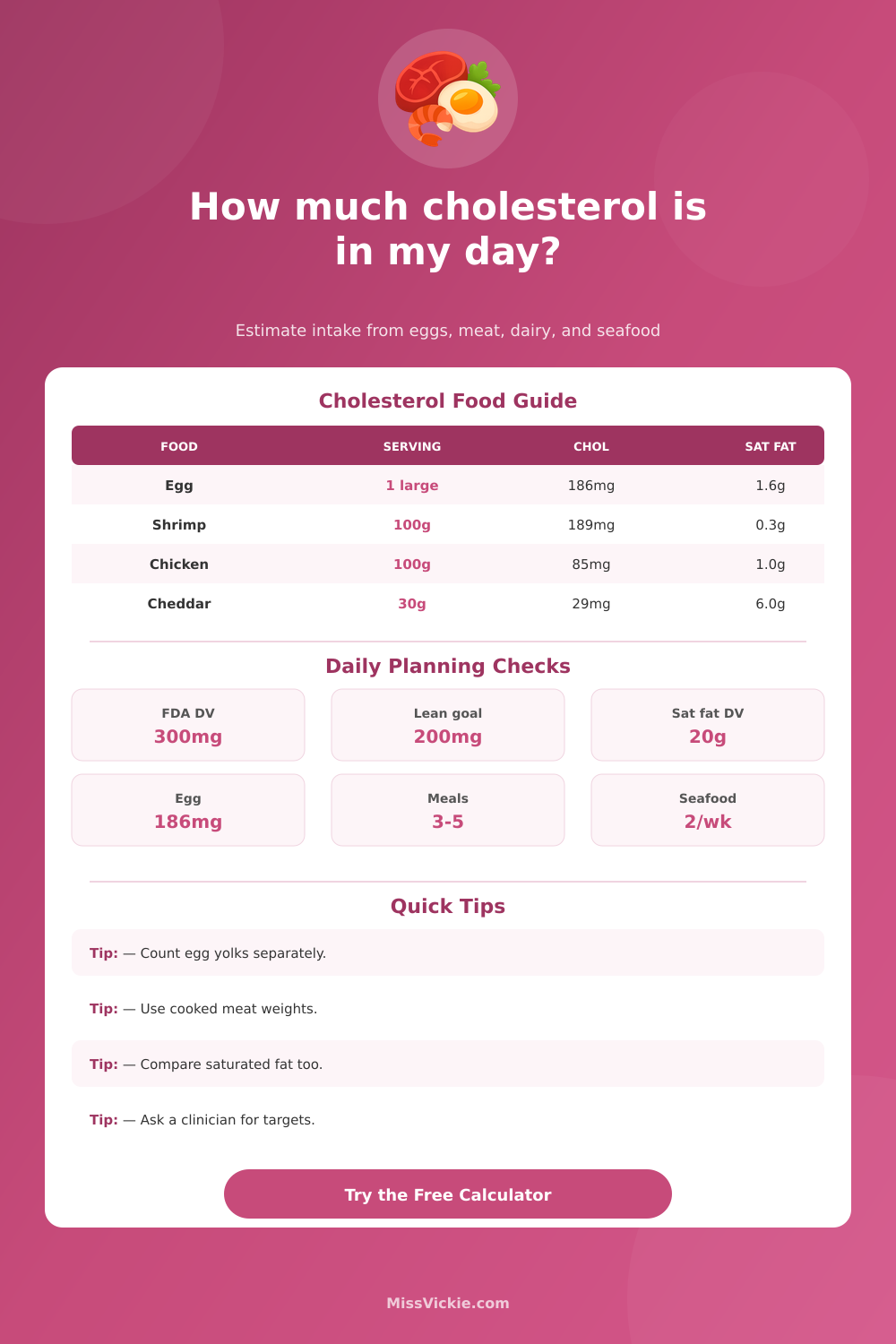
Eggs, meat, seafood, dairy, serving size, daily target, meals, and saturated fat
Cholesterol Intake Calculator
Estimate daily dietary cholesterol from common foods, then compare the total with a chosen planning target and a companion saturated fat estimate.
Choose a common day of eating, then adjust the food mix. This calculator is for general nutrition planning only.
Food Source Breakdown
Most cholesterol is in the yolk; egg whites are nearly cholesterol-free.
High cholesterol, but usually very low in saturated fat.
Lean poultry keeps saturated fat lower than many rich meats.
Similar cholesterol to poultry, with more saturated fat depending on cut.
Moderate cholesterol and usually favorable unsaturated fat profile.
Cholesterol is modest, but saturated fat can add up quickly.
The saturated fat companion number is the bigger watch point.
Nonfat versions add little cholesterol or saturated fat.
| Egg Food | Serving Used | Cholesterol | Saturated Fat |
|---|---|---|---|
| Whole large egg | 1 egg | 186 mg | 1.6 g |
| Egg white | 1 large white | 0 mg | 0 g |
| Extra yolk | 1 yolk | 184 mg | 1.6 g |
| Two-egg breakfast | 2 whole eggs | 372 mg | 3.2 g |
| Meat Or Poultry | Serving Basis | Cholesterol | Saturated Fat |
|---|---|---|---|
| Chicken breast, cooked | 100 g | 85 mg | 1.0 g |
| Turkey breast, cooked | 100 g | 75 mg | 1.0 g |
| Lean beef, cooked | 100 g | 90 mg | 5.0 g |
| Pork loin, cooked | 100 g | 80 mg | 2.5 g |
| Lamb, cooked | 100 g | 97 mg | 6.5 g |
| Pork sausage, cooked | 100 g | 74 mg | 8.0 g |
| Seafood | Serving Basis | Cholesterol | Saturated Fat |
|---|---|---|---|
| Salmon, cooked | 100 g | 63 mg | 1.1 g |
| Shrimp, cooked | 100 g | 189 mg | 0.3 g |
| Tuna, cooked or canned drained | 100 g | 45 mg | 0.3 g |
| Cod, cooked | 100 g | 55 mg | 0.1 g |
| Sardines, canned drained | 100 g | 142 mg | 1.5 g |
| Dairy Or Added Fat | Serving Used | Cholesterol | Saturated Fat |
|---|---|---|---|
| Skim milk | 1 cup | 5 mg | 0.1 g |
| 2 percent milk | 1 cup | 20 mg | 3.1 g |
| Whole milk | 1 cup | 24 mg | 4.6 g |
| Nonfat Greek yogurt | 170 g | 10 mg | 0.1 g |
| Cheddar cheese | 30 g | 29 mg | 6.0 g |
| Butter | 1 tablespoon | 31 mg | 7.2 g |
| Heavy cream | 2 tablespoons | 40 mg | 7.0 g |
| Planning Target | Daily Cholesterol | 3 Meals | 4 Meals |
|---|---|---|---|
| Lower planning target | 150 mg | 50 mg/meal | 38 mg/meal |
| Heart-conscious target | 200 mg | 67 mg/meal | 50 mg/meal |
| FDA Daily Value reference | 300 mg | 100 mg/meal | 75 mg/meal |
| Above-label comparison | 400 mg | 133 mg/meal | 100 mg/meal |
You can use this calculator to track the amount of dietary cholesterol you consume, as well as to track the amount of saturated fat you consume. Dietary cholesterol is found in many foods. Dietary cholesterol is found in foods such as egg, shrimp, and meat.
The amount of dietary cholesterol that is on your plate may change due to the way that the food is trimmed or cooked. Each of these calculator allows you to enter the details of the food that you eat, and then to perform mathematical calculations based off those entries. Cholesterol is found in eggs, and nearly all of the dietary cholesterol in an egg is located in the yolk of the egg.
Use the Calculator to Track Cholesterol and Saturated Fat
As a result, people often eat only the egg whites to minimize there intake of dietary cholesterol. Seafood contains dietary cholesterol, but the levels of dietary cholesterol in different type of seafood can vary. For example, shrimp contains a high amount of dietary cholesterol relative to seafood like salmon or cod.
The dietary cholesterol that you consume from eating seafood is related to the number of meal that you eat that contain seafood each week. Meat contains dietary cholesterol. Additionally, meat also contains saturated fat.
For example, lean cut of meat contain less saturated fat then sausage or cuts of meat like ribeye. The calculator that estimates the amount of dietary cholesterol that you consume also calculates the amount of saturated fat that you consume from the meat that you eat. Dairy products also contain dietary cholesterol and saturated fat.
For example, if you consume a small amount of butter or cheese daily, those foods can contribute to significant amount of dietary cholesterol and saturated fat to your diet. The calculator ask for the number of servings of food that you consume each day. By entering the number of servings of food each day, the calculator is able to determine the amount of dietary cholesterol and saturated fat that you consume each day.
This calculator also includes an extra category for foods like bacon or ice cream. This extra category allow individuals to include foods that they may consume only once or twice per week to there total dietary cholesterol and saturated fat intake. You can transform the total dietary cholesterol that you consume into a per-meal number by dividing the total dietary cholesterol intake by the number of meals that you consume each day.
This figure can help individuals to decide what type of food that they would like to cook for there next meal. The calculator also includes a target dropdown menu that allows individuals to compare there total dietary cholesterol intake to a reference value. For instance, the calculator can compare the dietary cholesterol that is calculated to a target of 300 milligram of dietary cholesterol per day, or to a target of 200 milligrams of dietary cholesterol per day.
The result of the calculation will display whether or not the individual meets there desired target for dietary cholesterol intake. However, this result is only an estimate of that intake, and should not of be used to make any medical diagnoses regarding the health of the individual. Reducing dietary cholesterol intake can be done by making small changes to the food that is consumed.
For instance, instead of using one whole egg, it is possible to use only the egg yolk to prepare dish like scrambled eggs. Additionally, instead of eating sausage, it is possible to eat chicken breast. Additionally, it is possible to limit the portion size of cheese that is consumed.
Saturated fat is another important consideration, as well. For instance, foods like butter contain both dietary cholesterol and saturated fat. Thus, the impact of dietary cholesterol and saturated fat from foods like butter will have a more larger impact upon the individual’s diet than food that contains only dietary cholesterol.
Additionally, the way in which the meat is cooked will impact both the dietary cholesterol and the saturated fat that is consumed by the individual. For instance, you can drain cooked meat to remove the rendered fat that is contained in the meat. Additionally, cooking in oil rather than butter will also reduce the amount of saturated fat that is consumed by the individual.
Both of these changes is considered in the calculator. The trim selector in the calculator allows individuals to change the amount of saturated fat that is consumed by the individual each day. However, the dietary cholesterol that is consumed will still depend upon the weight and type of food that is entered into the calculator.
The calculators average the dietary cholesterol and saturated fat amounts that are consumed each week into amounts per day. Thus, if an individual consumes seafood or cheese only a few times each week, the calculators will divide the amount of dietary cholesterol or saturated fat that is contained in those foods by 7 to determine the average daily amount of that type of dietary cholesterol or saturated fat that is consumed. The tables that is provided on this page provide information regarding various types of meat, and the amount of dietary cholesterol and saturated fat that is found in each type of meat.
These tables can be used to compare two different package of the same type of meat, for instance, to determine which package contains more dietary cholesterol and saturated fat than the other. These tables are provided to allow individuals to understand how each food impacts the dietary cholesterol and saturated fat amounts that are consumed, and to provide a tool for individuals to confirm the information from the calculator. Though the amount of dietary cholesterol and saturated fat that is calculated by these calculators may be helpful to provide individuals with an estimate of the amount of those nutrients that they consume each day, it is important to understand that the result are only estimates.
For instance, the portions of food that are prepared in restaurants may be much larger than the weights of the food that are entered into the calculators. Additionally, it may be difficult to know the amount of food that is consumed if that food is shared among other individuals. Thus, while the result of the calculation is not an exact measurement of the amount of dietary cholesterol and saturated fat that is consumed, it is still a helpful tool that allows individuals to understand the impact of their diet.
Using this calculator regularly will help individuals to develop an understanding of the amount of dietary cholesterol and saturated fat that their diet contains, and that intuitions will help individuals to gain a better understanding of there dietary cholesterol and saturated fat consumption.