Chicken Wings Per Pound Calculator
Estimate how many chicken wings are in a pound, how many pounds to buy, cooked yield, party servings, cooking shrinkage, and sauce amount for split wings, whole wings, drums, flats, baked wings, fried wings, smoked wings, and more.
🍗 Wing Party Presets
Pick a common wing scenario, then fine-tune section type, raw or cooked weight, appetite, cooking method, shrinkage, sauce, and party buffer.
⚖ Wing Count Inputs
Wing plan ready
The calculator will estimate wing count, servings, sauce, and cooked yield.
Wing Count Breakdown
Cook And Sauce Plan
📊 Wings Per Pound Serving Grid
Best for dinner plates, roasting, and guests who expect large pieces.
The common mix of drumettes and flats used for buffalo wings.
Usually smaller and saucier, so the count per pound runs higher.
Use for large drums, jumbo flats, and restaurant-style baskets.
Wing size varies by supplier. Use this grid as a planning baseline, then count one weighed pound from your package if precision matters.
📘 Wing Section Count Table
| Wing section type | Typical raw weight each | Estimated pieces per pound | Common use |
|---|---|---|---|
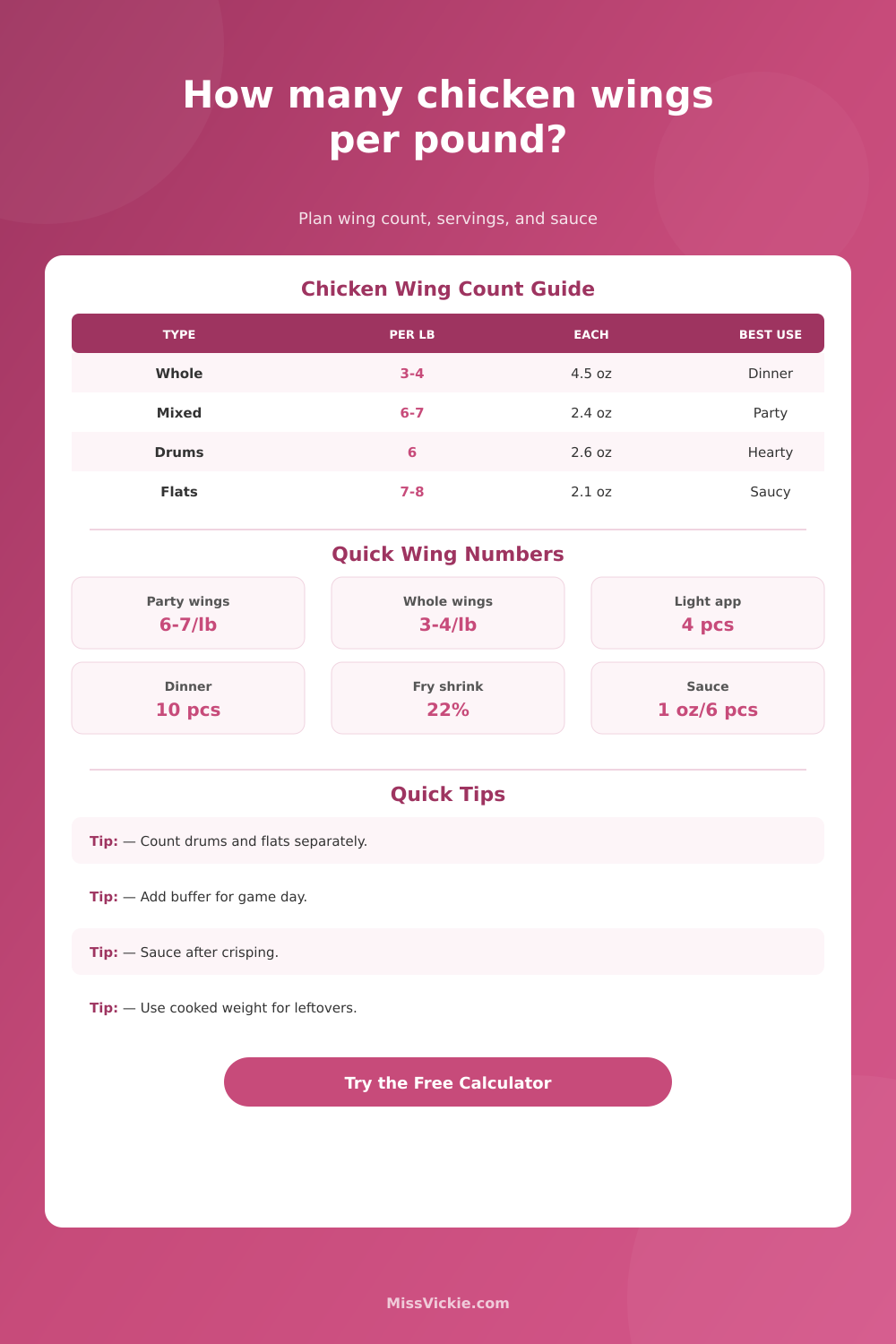
| Whole wings, tip attached | About 4.5 oz / 128 g | About 3.6 whole wings | Dinner plates, roasted wings, smoked whole wings. |
| Whole wings, tip removed | About 3.8 oz / 108 g | About 4.2 wings | Whole-wing baskets without the skinny tip. |
| Split party wings, mixed | About 2.4 oz / 68 g | About 6.7 pieces | Buffalo wings, party trays, mixed drums and flats. |
| Drumettes only | About 2.6 oz / 74 g | About 6.2 pieces | Meatier appetizers and kids plates. |
| Flats or wingettes only | About 2.1 oz / 60 g | About 7.6 pieces | Saucy platters and flat-only orders. |
| Jumbo split wings | About 3.1 oz / 88 g | About 5.2 pieces | Large baskets, smoked wings, hearty dinners. |
| Small split wings | About 1.8 oz / 51 g | About 8.9 pieces | Buffets, appetizers, and extra-crisp frying. |
| Boneless wing bites | About 1.2 oz / 34 g | About 13.3 bites | Boneless chicken bites; count is not bone-in wing count. |
🔥 Raw To Cooked Shrinkage Table
| Cooking method | Typical shrinkage | Cooked yield from 5 lb raw | Planning note |
|---|---|---|---|
| Bake or roast on sheet pan | About 20% | About 4 lb cooked | Good all-purpose estimate for crisp oven wings. |
| Air fry in baskets | About 21% | About 3.95 lb cooked | Small batches can dry slightly more if cooked long. |
| Deep fry or shallow fry | About 22% | About 3.9 lb cooked | High heat renders skin and fat quickly. |
| Smoke then crisp | About 26% | About 3.7 lb cooked | Longer cook times reduce moisture before crisping. |
| Grill over indirect heat | About 24% | About 3.8 lb cooked | Open airflow and flare-ups can increase shrink. |
| Saucy braise or slow cooker | About 14% | About 4.3 lb cooked | Covered cooking retains more liquid but skin is softer. |
🍽 Party Serving Count Table
| Event size | Light appetizer | Standard wing meal | Sports party buffer |
|---|---|---|---|
| 4 people | 16 to 20 pieces, about 3 lb split wings | 36 to 44 pieces, about 6 to 7 lb | 44 to 52 pieces, about 7 to 8 lb |
| 8 people | 32 to 40 pieces, about 5 to 6 lb | 72 to 88 pieces, about 11 to 13 lb | 88 to 104 pieces, about 13 to 16 lb |
| 12 people | 48 to 60 pieces, about 8 to 9 lb | 108 to 132 pieces, about 16 to 20 lb | 132 to 156 pieces, about 20 to 24 lb |
| 25 people | 100 to 125 pieces, about 15 to 19 lb | 225 to 275 pieces, about 34 to 42 lb | 275 to 325 pieces, about 42 to 49 lb |
| 50 people | 200 to 250 pieces, about 30 to 38 lb | 450 to 550 pieces, about 68 to 83 lb | 550 to 650 pieces, about 83 to 98 lb |
The table uses mixed split party wings at about 6.7 pieces per raw pound. Whole wings need more pounds for the same piece count.
🌶 Sauce Amount Table
| Sauce style | Approx sauce per 6 split wings | Approx sauce per pound raw | Best timing |
|---|---|---|---|
| Dry rub or naked wings | 0 cup sauce | 0 cup sauce | Season before cooking or finish with dry rub. |
| Light toss | About 1 tablespoon | About 1 tablespoon | Toss lightly after crisping so skin stays snappy. |
| Classic buffalo coating | About 2 tablespoons | About 2 tablespoons | Toss hot wings, then serve extra sauce separately. |
| Extra saucy wings | About 3 tablespoons | About 3 tablespoons | Use for rice bowls, party trays, or saucy plates. |
| Sticky glaze or BBQ finish | About 2 1/2 tablespoons | About 2 1/2 tablespoons | Brush near the end to avoid burning sugars. |
| Multiple sauce split | About 2 tablespoons total | About 2 tablespoons total | Divide cooked wings into bowls before tossing. |
🔎 Common Wing Count Comparisons
Enough for one hearty snack plate or two light appetizer portions.
Typical mixed split wings cover about five to eight appetizer servings.
Good for a small sports party when sides and dips are on the table.
Fewer pieces per pound, but each piece eats more like a dinner portion.
💪 Nutrition Snapshot Per 6 Split Wings
Nutrition changes with wing size, cooking method, breading, sauce, oil pickup, and edible meat yield. The calculator is for portion planning, not medical nutrition advice.
💡 Wing Planning Tips
That’s how it starts, with some frozen chicken wings; and ends with this: How many should I leave? How do I get from here to there? Often we don’t know.
The problem is that not all chicken wings is created equal. Some are bigger and some are smaller. Some have more bones and others has fewer. Some are juicier while others are drier. This depends on season and the supplier.
How to Calculate the Right Amount of Chicken Wings
Without a plan, your guesswork will land you in one of only two places: either you’ll run out of wings too soon (too few), or you’ll end up wasting leftover food (too many).
The answer is math. The variable inputs uses simple math. Another factor is what you are cutting. Drumettes weigh less than split flats, which weigh less than a whole wing plus tip. And how do they break down? Whole wings has about three to four pieces per pound.
Does that matter? It does when it comes to plating. How much food you see can change how much people think there is. Is it six big whole wings? That’s cool looking. Or are there ten little ones, with each being a split wing? Looks like more food. The calculator takes into account what cut you select. Just input the number of guests and it calculates average weights. No need to try to remember right portion size.
Chicken loses weight as it cooks. When you cook chicken, water will boil away. How much? That depends on the cooking method. Typically, cooking on a sheet pan (roasted/baked) yields about a 20% loss of weight. Deep fried food lose moisture and fat very quickly; expect a 22% loss. Smoking is a slower process; so a 26% loss isn’t uncommon.
If you buy by raw weight and want cooked weight, you’ll be coming up short. To compensate for the lost moisture, you has to buy extra pounds.
There’s one more variable: Sauce. Never sauce your wings until they’re crisp. Early saucing will steam them and ruin there texture. Crisp up the chicken, then sauce.
Use too much sauce and your wings gets soggy and hard to eat. Use too little and you’ll have dry spots. Two tablespoons of sauce per six split wing is a general rule. That’s enough to coat the chicken well but doesn’t make it wet. This reference table makes it clear. You would of didnt have to test how much sauce to use by trying it with all your furnitures.
The type of party affects how much food is needed. People will consume fewer wings if there’s an appetizer spread. People will eat more if it is a main course. If it’s a sports event, things differs. Competition, adrenaline, alcohol… These tend to bump up intake different than typical dinner amounts.
It is wise to add some buffer. For most get-togethers, adding 10-15% extra should of be fine (to account for unexpected guests plus those who’d like seconds).
The details matter. The plan matters. You desire crispy, piping hot, well-covered birds that are waiting for hungry bellied friends to arrive. You don’t want to be scrambling to defrost frozen packages during halftime.
By separating out the appetite factor from the cooking factor and the cut factor, it takes away any stress. Get exactly what’s needed. Cook up in batches. Use the proper amount of sauce. When the time comes, there is no scrambling; platters of food are just emptied rapidly, leaving the host as cool as a cucumber.
It all starts with knowing what to measure. After that, it’s execution, execution, execution.