Chicken Wings Deep Fry Time Calculator
Estimate deep fry time for chicken wings using wing size, drumette and flat mix, batch weight, oil temperature, fresh or frozen state, coating, fryer load, double fry method, crispness target, and safe internal temperature.
🍗Fried wing presets
Choose a common wing setup, then fine tune the oil temperature, coating, batch load, starting state, double fry choice, and crispness target.
⚖Units
🔥Wing batch and oil setup
🍳Starting state, coating, and crispness
Estimated wing fry plan
Wing fry breakdown
Use an instant-read thermometer to verify poultry safety.
✅Deep fry checkpoints
Check the thickest drumette without touching bone.
A balanced temperature for cooking through and browning.
Many fried wings eat better above the minimum temp.
Rack resting keeps the crust from steaming underneath.
📊Wing time reference table
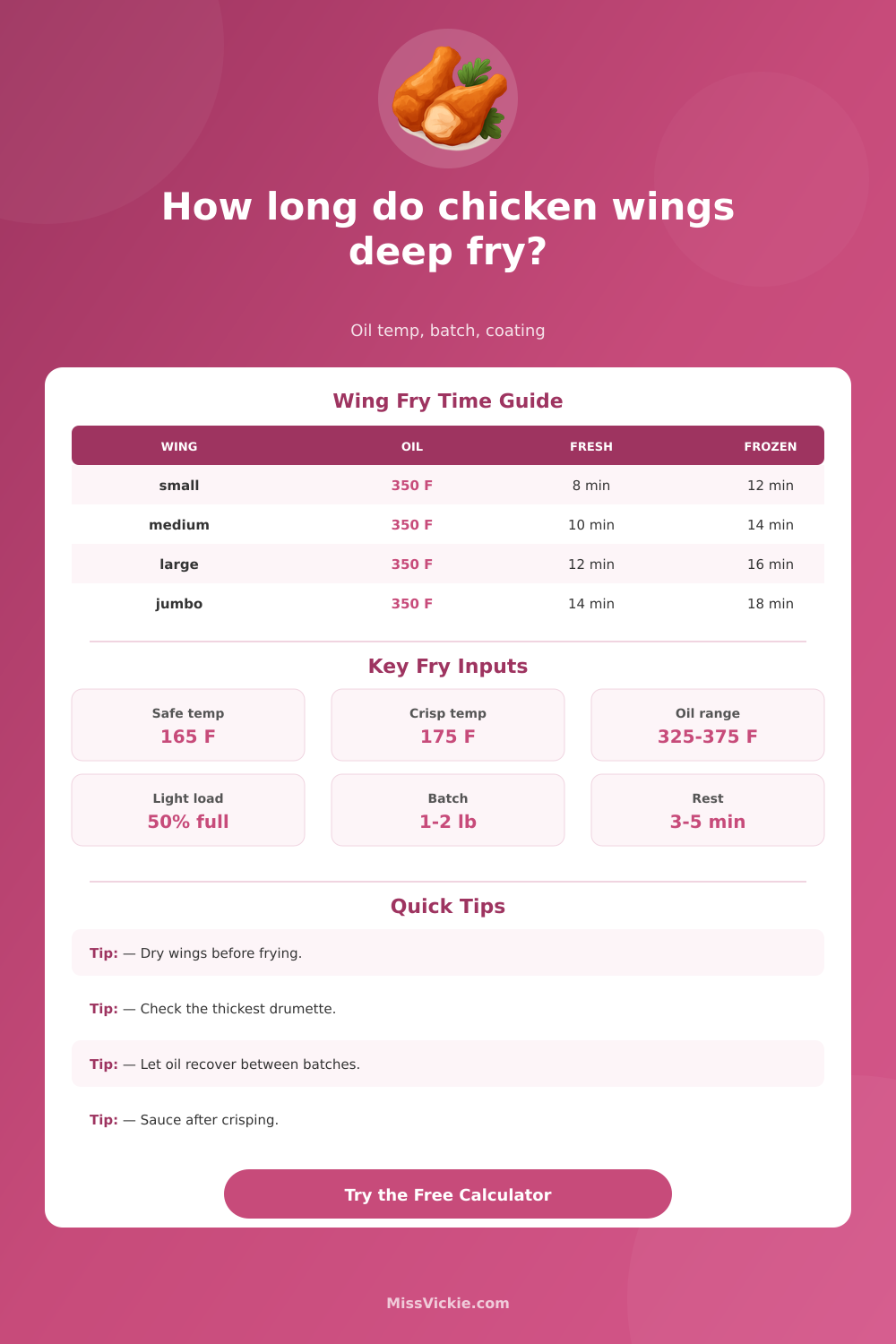
| Wing setup | Oil temperature | Fresh or thawed time | Frozen raw time | Best check point |
|---|---|---|---|---|
| Small split flats and drumettes | 350°F / 177°C | 7 to 9 minutes | 11 to 13 minutes | Thickest drumette at 165°F minimum |
| Medium split wings | 350°F / 177°C | 9 to 11 minutes | 13 to 15 minutes | Juices clear and center at 165°F or hotter |
| Large split wings | 350°F / 177°C | 11 to 13 minutes | 15 to 18 minutes | Drumette center reaches target temperature |
| Jumbo drumette-heavy batch | 340 to 350°F / 171 to 177°C | 13 to 16 minutes | 18 to 21 minutes | Probe more than one large drumette |
| Double-fried crisp wings | 325°F then 375°F | 7 to 10 plus 2 to 4 minutes | Not ideal from frozen | Reach safe temp before final crisping |
🧾Coating and fryer load adjustments
| Variable | Typical effect | Time adjustment | Texture note |
|---|---|---|---|
| Naked or dry-rubbed wings | Fastest browning | Baseline | Best for tossing in sauce after frying |
| Flour coating | Protects skin and browns steadily | Add about 1 minute | Let the coating hydrate before frying |
| Starch dusting | Very crisp shell | Add 0 to 1 minute | Great for sauce-ready wings |
| Wet batter or heavy breading | Slower heat transfer | Add 2 to 4 minutes | Watch color before the meat is done |
| Full fryer basket | Oil temperature drops sharply | Add 2 to 5 minutes | Stir gently so pieces do not stick together |
💡Wing frying notes
Safety: Fried chicken wings need an internal temperature of at least 165°F. For crisp texture, many cooks take wings to 175 to 185°F.
Oil recovery: If the oil falls below 325°F after loading, expect a longer fry and a softer crust. Fry smaller batches for cleaner results.
Chicken wings are a subject of contention… Fried in deep fryer, that is. How do you get meat juicy without overcooking it while also having crispy skin? That requires a little something more than flavor; it’s all about timing.
Timing has a few factor that many folks aren’t thinking about once they begin their frying. Why the wing size? Because a bigger drumette transfers heat further then a tiny flat, and even though your basket appear filled, it might have some faster-cooking wings alongside slower-cooking ones. Enter: the calculator’s request for a guess of the mix of flats-to-drummies and their average size. It adjust the timing to match so you don’t undercook big ones.
Why Timing Is Important for Frying Chicken Wings
The other variable is the oil temp. If the oil is too hot, it will brown the exterior rapidy but not allow the interior to cook through as long as it should. If you use low heat, it takes longer for food to cook through and may leave meat dry with pale looking skin. If your starting temperature is ten degrees higher or lower than the mark, it change how long it takes for the food to reach a safe internal temperature. This is why this calculator asks what your oil temperature was at the start.
Coatings complicate things: Wet ones (like batter) and/or those that hold moisture prolong cooking; ice in wings turns to steam in hot oil, which cools down fat. That’s why a tool must accounts for such a delay and any added weight from coating. It also need to consider that a light starch crisps up quicker than a wet batter, though both need enough time for meat itself to cook through.
The timing shifts again depending on fryer load and the double-fry approach. For both cases, crowding the basket will quickly lower oil temp. The calculator adjust by extending estimate and prompting you to give oil time to recover between batches. If using a double-fry approach, this divide the work into two pass (a gentle first, followed by a hot finish). Instead of displaying a single total time, output is split into sections for each step.
Looking at reference table shows how these variables play out across typical set-ups. Compare a crowded basket vs. A light load, or heavy breaded items against naked wing. These estimate aren’t guarantees; they’re simply starting points.
A word about using it: It’s never going to take the place of testing most meaty part of the drumette with a probe thermometer. There will always be surprises (the bigger wings that throw you off, or slower-cooling oil) despite careful guessing. You should of checked them. But once you figure out what your preferred texture is and target temperature, math is gone.
Now you just need to worry about grabbing those wings when they’re ready. Not when the timer says they should be.