🍗 Chicken Thighs Per Person Calculator
Plan thighs, weight, yield, and leftovers for plated meals or crowd trays
| Meal Type | Base Cooked Oz | Meal Factor | Best Fit |
|---|---|---|---|
| Weeknight dinner | 5.8 oz | 0.94x | Fast plates |
| Baked tray | 6.1 oz | 0.98x | Oven meals |
| Braised comfort meal | 6.6 oz | 1.03x | Saucy dishes |
| Picnic spread | 7.0 oz | 1.06x | Outdoor tables |
| BBQ plate | 7.5 oz | 1.10x | Cookout menus |
| Meal prep boxes | 5.2 oz | 0.88x | Portioned lunches |
| Buffet line | 8.1 oz | 1.14x | Self-serve crowds |
| Family style | 6.9 oz | 1.00x | Shared platters |
| Game day party | 8.4 oz | 1.18x | Snack-heavy tables |
| Holiday table | 8.7 oz | 1.22x | Big special meals |
| Cut Style | Bone Share | Yield Use | Planning Note |
|---|---|---|---|
| Boneless thighs | 0% | Best for tight portioning | Fast to scale |
| Bone-in thighs | 100% | Needs more raw buy weight | Best for crispy skin |
| Mixed tray | 50% | Midway between both cuts | Good for mixed trays |
| Very large thighs | 100% | Use the low end of yield | Heavier pieces need more buffer |
| Small thighs | 0-50% | Use the high end of yield | Smaller pieces stretch farther |
| Appetite | Sides | Portion Factor | Thighs per Guest |
|---|---|---|---|
| Light | 4-5 sides | 0.88x | 0.9-1.1 |
| Standard | 2-4 sides | 1.00x | 1.1-1.4 |
| Hearty | 1-3 sides | 1.18x | 1.4-1.7 |
| Big eater | 1-2 sides | 1.30x | 1.6-2.0 |
| Leftovers Target | Extra Buy | Best Use | Reheat Fit |
|---|---|---|---|
| 0% | No buffer | Exact dinner | Best served fresh |
| 10% | Small cushion | One extra tray piece | Good for lunch |
| 15% | Comfort buffer | Second-helping room | Strong meal prep fit |
| 20% | Packout buffer | Next-day boxes | Great for reheating |
| 30% | Heavy buffer | Big family stash | Use when feeding workers |
When planning a meal that include chicken thighs, the weight and yield of the thighs must be considered to ensure that there is enough food for all individual who will be eating. Chicken thighs can be prepared in two way: with the bones of the thigh or without the bones. Thighs that contains the bone of the chicken will result in less edible meat than thighs that are deboned.
This is simply because the bone do not contain meat and will be removed when the cook prepares the chicken. A six-ounce bone in chicken thigh may only provide four ounces of cooked meat. In the same weight, a boneless chicken thigh will provide more edible meat than a bone-in thigh.
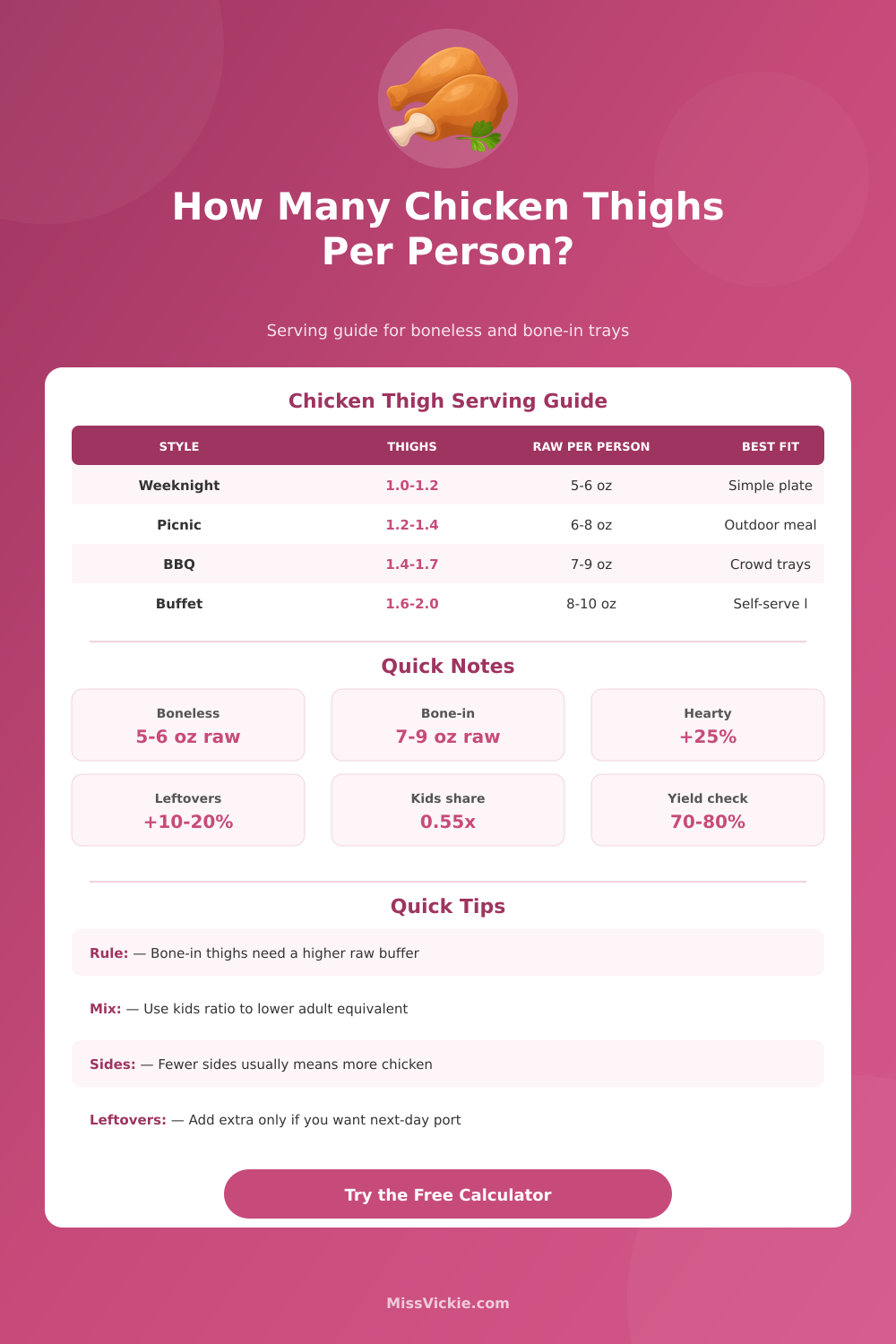
How Many Chicken Thighs Per Person
It is important to account for the yield of bone-in chicken thighs when planning the meal. If you dont account for the yield of the thighs, there could be insufficient chicken thighs for all the guests who is to eat. Beyond the weight and yield of chicken thighs, the host must also consider the appetite of the individuals when planning the meal.
Some people will eat less chicken thighs than others. A light eater may only consume one chicken thigh if there are several side dish. A hearty eater may consume two chicken thighs if there are few side dishes.
It is also likely that children will eat fewer chicken thighs than adults. Therefore, the host should plan the number of chicken thighs for children to ensure that there is enough for the adults. If the side dishes will be substantial, fewer chicken thighs will be necessary for each guest.
For a standard meal, five to six ounces of cooked chicken thighs are necessary per person. For a buffet style meal, eight to nine ounces of cooked chicken thighs will be necessary per person as individuals tend to serve themselfs more food at a buffet. The number of side dishes that will be served will also impact the number of chicken thighs that is needed for the meal.
If there are many side dishes, one chicken thigh may be enough for each guest. However, if there is only one side dish, more chicken thighs will be necessary for each guest. Planning for the possibility of leftovers will also allow for the creation of a complete meal.
A buffer of ten or twenty percent of the total number of chicken thighs can be planned for this purpose. Planning for leftovers is a helpful strategy in the preparation of chicken thighs as the chicken thighs will remain moist when reheated. One of the most common mistakes when preparing chicken thighs is purchasing the thighs based off the number of pieces of chicken thigh that are in the package at the supermarket.
The weight of the thighs will likely not be the same for each thigh in the package. It is important to weigh the thighs while they are raw to ensure that each thigh weigh the same amount. For instance, each thigh should of weigh between six and seven ounces if they are bone-in chicken thighs.
When planning the meal, remember that chicken thighs will shrink during the cooking process. The yield of the thighs will shrink to between seventy and eighty percent of the original weight. Therefore, the cook must cook the thighs carefuly to avoid overcooking the thighs.
The type of event that will be hosted will also have an impact on the number of chicken thighs that are required for the meal. For game day parties, more chicken thighs will be required due to the eating of numerous snack. During the holidays, more chicken thighs will be required as individuals tend to eat more at holiday meals.
If you are preparing a meal that will be prepared in advance and the portions will be smaller, fewer chicken thighs will be required as there will be more leftovers throughout the week. Lastly, the number of chicken thighs that contain the bone will appear larger than boneless chicken thighs; however, they will provide less meat. The host should account for the preparation of the meal to ensure that there are enough chicken thighs for the guests.
By weighing the chicken thighs and accounting for the yield of the thighs, the host can prepare enough chicken thighs to feed all of the guests at the party.