Chicken Per Person for Stir Fry Calculator
Calculate raw chicken per person for stir fry by diners, cut, cooked yield, vegetable ratio, rice or noodle pairing, sauce coating, wok batch size, marinade absorption, appetite, and leftover buffer.
Choose a real stir fry scenario, then adjust the diners, chicken cut, vegetables, sauce, carb pairing, wok load, marinade, appetite, and leftovers.
Chicken Amount For Your Stir Fry
Use the cards and breakdown to portion chicken, vegetables, sauce, and wok batches.
Portion Breakdown
Stir Fry Add-Ins
These are cooked chicken targets before cut yield, marinade absorption, trim allowance, and leftover buffer are applied.
| Chicken cut | Typical cooked yield | Best stir fry use | Raw amount for 4.5 oz cooked |
|---|---|---|---|
| Boneless breast strips | About 74 percent | Lean rice bowls, quick sear | About 6.1 oz raw |
| Boneless thigh pieces | About 78 percent | Juicy high heat stir fry | About 5.8 oz raw |
| Chicken tenders | About 76 percent | Fast weeknight slicing | About 5.9 oz raw |
| Ground chicken | About 82 percent | Lettuce cups and fried rice | About 5.5 oz raw |
| Bone-in trimmed meat | About 58 percent | When trimming from bone-in packs | About 7.8 oz raw |
| Pre-cooked chicken | About 95 percent | Added near the end to warm | About 4.7 oz cooked |
| Serving setup | Chicken factor | Cooked carb per diner | Why it changes the portion |
|---|---|---|---|
| Steamed rice bowl | Standard | About 6 oz | Rice supports a normal chicken serving. |
| Noodle stir fry | Slightly lower | About 7 oz | Noodles make the dish more filling. |
| Chicken fried rice | Lower | About 8 oz | Chicken is mixed through the rice. |
| Low carb vegetables | Higher | About 3 oz | More chicken carries the meal. |
| No rice or noodles | Highest | None | Protein and vegetables become the full plate. |
| Appetizer portion | Lowest | About 2 oz | Small plates need less chicken. |
| Home pan or wok | Raw chicken per batch | Sauce level per diner | Cooking note |
|---|---|---|---|
| 10 inch skillet | 0.75 to 1 lb | 0.8 to 1.1 oz | Cook chicken in two thin layers if needed. |
| 12 inch skillet | 1 to 1.25 lb | 1.1 to 1.5 oz | Leave open pan space for browning. |
| 14 inch wok | 1.5 to 2 lb | 1.1 to 2 oz | Preheat well and toss quickly. |
| Large flat griddle | 2 to 3 lb | 1.5 to 2 oz | Good for party batches and trays. |
| Diners | Standard breast raw | Balanced raw vegetables | Classic sauce |
|---|---|---|---|
| 2 diners | 0.8 to 1 lb | 0.8 to 1 lb | About 1/4 cup |
| 4 diners | 1.5 to 1.8 lb | 1.4 to 1.8 lb | About 1/2 cup |
| 6 diners | 2.2 to 2.7 lb | 2.1 to 2.7 lb | About 3/4 cup |
| 8 diners | 3 to 3.6 lb | 2.8 to 3.6 lb | About 1 cup |
| 12 diners | 4.5 to 5.4 lb | 4.2 to 5.4 lb | About 1 1/2 cups |
| 20 diners | 7.5 to 9 lb | 7 to 9 lb | About 2 1/2 cups |
Standard breast, balanced vegetables, small leftover buffer.
Boneless thighs with noodles and classic sauce.
Higher chicken target with vegetable-forward sides.
Lower chicken share because rice is mixed through.
How much chicken do you get when you buy it? For most folks, answer to that question is “not nearly as much as I’d like.” So what do we do? We throw in two pounds of breast meat, add some broccoli, and hope no one goes home hungry.
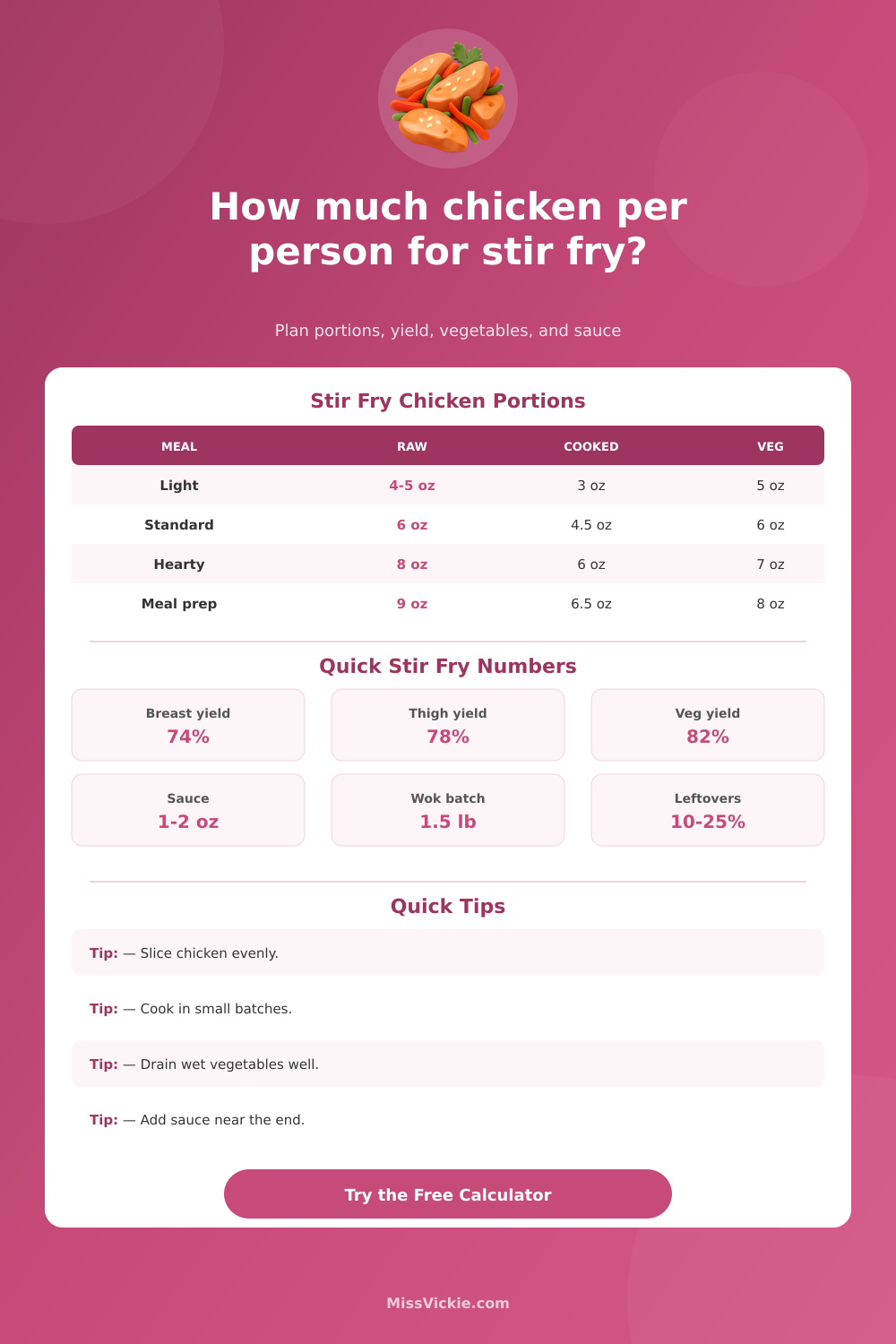
Here’s the thing: When raw chicken cooks, it shrinks. Because the water inside the fibers of breast meat evaporate during cooking, about twenty-six percent of its original weight get lost. Thighs hold on to more fat and moisture; they shrink a bit less. Planning dinner according to raw weight leave your plate looking small, not like something to eat.
Plan Your Chicken Dinner Perfectly
After you input your info, the calculator does the arithmetic, so there’s no need to guess whether the leftover buffer covers everyone’s second helping or just your own guilt. Then it converts actual amount of protein you get per pound to shopping list quantities.
You pick the cut because boneless strips behave different than ground meat or thick tenderloins. A breast cooks quickly; it’s firm and lean, perfect for searing over some rice. But you can’t go crazy in the pan or the thing will dry out. On the other hand, thighs is juicier and more forgiving, good for something heavy where you don’t mind letting a little liquid soak into meat and bring along flavor. No matter what you’re craving, the tool factors in your cut choice and adjusts the raw purchase weight so that you’ll walk away with an equal amount of edible protein.
When it comes to balancing a stir fry, most home cooks don’t know how important the vegetables is. Veggies add crunch and volume. This lets you cut back on meat without feeling like you’re eating something light. Also, in my opinion, there is generally an equal amount of raw vegetables to the meat in a stir fry. When cooked, these veggies will give up some of their water and then create steam which can help cook your noodles/rice beneath them (if it’s a bowl).
For low-carb versions made with cauliflower rice, this means you’ll want even more chicken and denser veggie such as carrots to fill the void left by missing starch. Without that carb base, the calculator will increase portion size of the meat since you have to get more fullness from chicken.
That’s why sauce serves double duty: It flavors but also binds. The seared meat is coated in a shiny layer, increasing the texture difference with surrounding soft veggies. And when there’s too much sauce (well), that’s soup time. Stir fry becomes steamed chicken, not browned chicken. The tool calculates how much sauce goes into the pan, depending on your preference for coating, from a glaze-on-light side to a drench-on-like-you’re-at-Chinese-take-out heavy coating. More sauce means more bulk and weight, which can hide shortfalls in amount of meat. How you see the amount of sauce changes, too, even if amount of protein stays the same. That’s especially true for a sticky sauce like hoisin, or a thicker one like a cornstarch slurry.)
The problem: Cooking in batches is non-negotiable for good texture but often ignored for convenience. Most people assume that because they’re using a big pot (or maybe even a wok) their pan must be spacious enough for whatever ingredients they want to cook. But most home kitchens don’t have a pan that’s big enough to fit all your food simultaneously. For instance, if you throw two pounds of raw chicken into a 12-inch pan, it immediately lowers the temperature. The meat will start to give off juices before you can evaporate them. This leaves you with a pale, steamed mess instead of nicely browned, seared goodness.
Why do we do this? Because batching isn’t convenient; you need to cook things in small amounts so each batch gets the right amount of heat. To prevent you from accidentally ruining your meal (and having to clean up extra pans later!), the calculator will break down your total raw weight into reasonable batches depending on size of your usual cooking equipment. This way, if you’re serving a group, you’ll either need to use several pans at the same time or make another round of cooking! However, you won’t needlessy crowd your pan by trying to save time and end up ruining the texture of your meal.
Now, when I have leftovers (and someone always wants to take some home!), it’s not an afterthought. Because of this ten to twenty percent buffer, I account for uneven pieces, trim loss, and enthusiastic eaters. It becomes a meal prep option I know would of worked out. It’s about more than feeding people; it’s about feeding them in a way that makes the effort worth it: consistently and texturally.
When you perfectly plan for the amount of chicken you need to cook, you stop guessing at the grocery store and start cooking with intention. The switch from estimating to calculating impacts how the whole dish comes together, creating a balance on your plate, each component getting its due respect.