Chicken Leg Cooking Time Calculator
Estimate drumstick or leg quarter cooking time from method, oven or grill heat, piece size, marinade, skin crispness, batch load, target temperature, and rest.
🍗 Chicken Leg Presets
Start with a common chicken leg setup, then adjust size, heat, marinade, skin goal, crowding, and pull temperature for your actual pan or grill.
⚖ Leg and Heat Inputs
Your Chicken Leg Timing Plan
Estimated cook time, pull temperature, turn schedule, and resting window.
Timing Breakdown
Batch Details
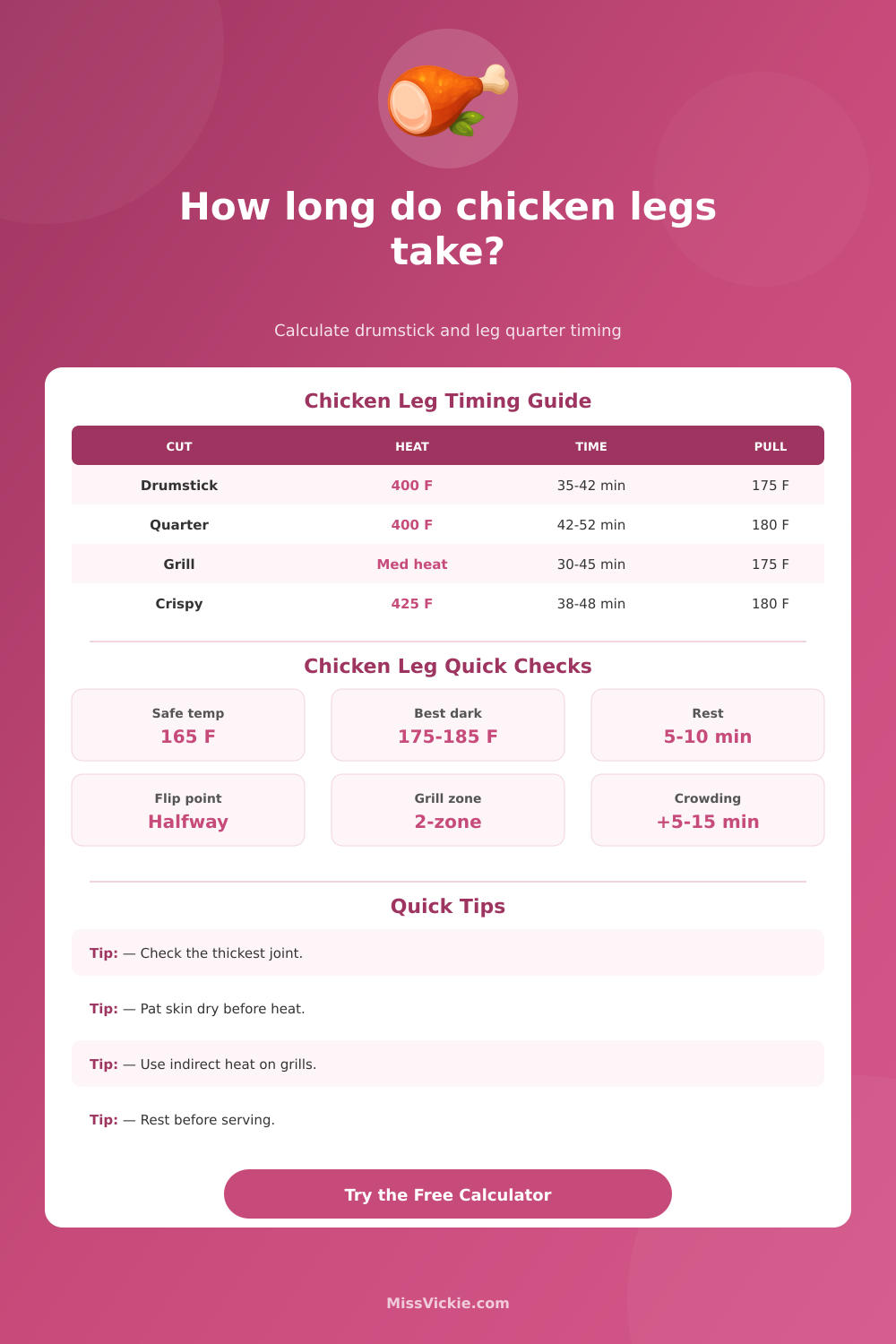
📊 Chicken Leg Quick Reference
📘 Method Comparison Grid
Reliable for batches, but needs space and a dry surface for better skin.
Air moves under the legs, helping skin render without flipping as much.
Best for smoky flavor; keep the lid closed and finish over direct heat.
Longer gentle heat, followed by a hot finish to tighten and crisp the skin.
🌡 Oven and Grill Timing Table
| Cut and Setup | Heat | Typical Time | Best Pull Range | Notes |
|---|---|---|---|---|
| Small drumsticks, open spacing | 400°F oven | 32 to 38 min | 172 to 178°F | Turn once if browning is uneven. |
| Average drumsticks, sheet pan | 400°F oven | 36 to 44 min | 175 to 182°F | Dry seasoning crisps faster than wet marinade. |
| Jumbo drumsticks | 400°F oven | 42 to 52 min | 178 to 185°F | Check beside the bone, not just the meaty end. |
| Leg quarters | 400°F oven | 43 to 55 min | 180 to 185°F | The hip joint is usually the slowest spot. |
| Indirect grill drumsticks | 375 to 425°F | 30 to 45 min | 175 to 185°F | Move over direct heat only at the end. |
| Sauced BBQ legs | 375 to 400°F | 38 to 50 min | 175 to 185°F | Brush sauce during the last 8 to 12 minutes. |
🔥 Heat, Crispness, and Sauce Table
| Goal | Best Heat | Time Effect | Skin Strategy | Watch Point |
|---|---|---|---|---|
| Tender skin | 350 to 375°F | Adds 8 to 15 min | Use steady moderate heat. | Skin may stay pale. |
| Golden and juicy | 390 to 410°F | Baseline | Pat dry and space pieces. | Rotate crowded pans. |
| Crisp finish | 425 to 450°F | Often 3 to 6 min faster | Rack or final hot blast helps. | Sugars can darken quickly. |
| Sticky BBQ glaze | 375 to 400°F | Adds 3 to 6 min | Sauce late, then set glaze. | Move away from flare-ups. |
| Smoke-roast | 275 then 425°F | Adds 18 to 30 min | Smoke first, crisp last. | Rub can darken before skin crisps. |
🧂 Marinade and Batch Load Table
| Condition | Add Time | Why It Changes | Best Adjustment |
|---|---|---|---|
| Dry brine or spice rub | 0 to 2 min | Surface stays dry, skin browns quickly. | Rest uncovered in fridge if possible. |
| Oil marinade | 1 to 4 min | Oil helps browning but surface moisture remains. | Drain and blot excess marinade. |
| Yogurt or buttermilk | 4 to 8 min | Wet coating slows evaporation and crisping. | Scrape off heavy pockets before roasting. |
| Sweet BBQ sauce | 3 to 6 min | Sauce is added late to avoid burning. | Cook mostly plain, glaze at the end. |
| Crowded sheet pan | 5 to 12 min | Steam builds and oven recovery slows. | Use two pans or rotate halfway. |
| Two full oven racks | 8 to 15 min | Airflow drops around the legs. | Swap racks and verify every pan. |
🍽 Serving and Yield Table
| Chicken Leg Cut | Raw Size | Cooked Yield | Serving Estimate | Useful Check |
|---|---|---|---|---|
| Small drumstick | 3 to 4 oz | 70 to 74% | 2 per adult | Thermometer near bone. |
| Average drumstick | 4 to 5.5 oz | 70 to 74% | 1 to 2 per adult | Meaty end plus joint. |
| Jumbo drumstick | 6 to 8 oz | 68 to 72% | 1 per adult | Bone side can lag. |
| Whole chicken leg | 8 to 12 oz | 66 to 71% | 1 per adult | Thigh joint is slowest. |
| Leg quarter | 10 to 16 oz | 64 to 70% | 1 hearty serving | Check where thigh meets drum. |
Time estimates are planning ranges. Bone-in chicken should be verified with an instant-read thermometer, especially with large quarters, wet marinades, crowded trays, or uneven grills.
💡 Chicken Leg Timing Tips
Dark meat is not white meat; that’s why you need to treat chicken legs separately. Use higher heat, a longer cooking time, and a slightly higher target temp. And don’t forget about the biology of the joint: you’re after crispy skin and meat that slips off the bone. But how long? How hot? Do I need more time because there are 6 drumsticks instead of 4 on a pan? What effect does the sweet glaze have on timing?
The calculator above takes care of math for your particular situation, without having to guess about any variables. A lot of folks think the reason they cook their chicken up to 165 degrees is because it’s considered safe. That’s true, but at 165 degrees you often pull leg quarters, or thighs and drumsticks that is stringy.
How to Cook Chicken Legs Perfectly
This is dark meat. There is more connective tissue (collagen) in dark meat, which require a long cooking time to turn into gelatin. So most cooks shoot for 175-185 degree internal temperatures. It doesn’t seem like much of a difference, but it makes a big diffrence in texture. So if you want your estimate to show tenderizing not just keeping something safe to eat, set higher target temp on the tool.
The way you position the chicken also affects the rate of heat transfer. If roasted on a wire rack, the air circulates under skin. This helps melt the fat more evenly and allows air to crisp the bottom side without turning it over. Pieces next to each other trap moisture between them, steaming the inside different than roasting it. Seasoning can’t save soggy skin. Spacing and batch load affect cook time, as well. A full oven will take longer than an empty one. When items is closer together, they steam instead of roast. The calculator takes these factors into account.
Temperature isn’t everything. It’s also about how much room the heat has to do its job. Another critical factor is how moist it is. Refrigerator-cold chicken will have a harder time than the outside meat getting up to temperature in the middle of bone. Twenty minutes of tempering helps close that gap.
Buttermilk and other wet marinades not only impart flavor but contribute moisture, which has to be cooked off before the exterior can crisp. Rubs using oil or dry brines let the skin get browner more quickley. In exchange, you may lose a couple of minutes of cook time. Or, you may gain some time by accepting slightly longer cooking for better marinade penetration. Each condition changes your timeline as shown in reference table.
Grill it: Grilled food adds more factors (heat zones, flare-ups). Indirect heat is great for a slow cook, but has no browning ability; direct heat browns fast, but may burn on the outside while still raw inside. Two-zone means indirect first then direct to finish… Ideal. Your chosen method will be factored into calculation (regular grill, smoker-roaster combo, oven with convection turned on). Also, how often you flip impacts how dry the surface gets.
Don’t skimp on resting time. If your recipe calls for resting, don’t skip it. The reason is twofold: First, it gives the juices inside the meat time to flow back to center of muscle fibers and not seep out when you slice it open. Second, it’s accounting for what we call “carry-over cooking”, the slight increase in temperature that occurs once something comes off the grill. Not enough? The center is undercooked. Too much? The exterior is overdone. Plan for the rest time.
When it comes to cooking chicken legs, you don’t need to be precise; rather, you just need to know some of the physical factors. Then again, knowing how the factors (heat, moisture, density) works together means no more guesses, and control over the result. And each time it’s the same thing, crisp skin, tender meat, no guesswork.