🍗 MissVickie chicken calculator
Chicken Doneness Temperature Calculator
Match safe internal temperatures by cut, fold in bone-in carryover, and keep rest timing honest for breasts, thighs, drumsticks, wings, and whole birds.
Each preset loads a real chicken scenario, fills the fields, and recalculates the pull temp, finish temp, and safety gap in one click.
Use the thermometer reading at the thickest point, then var the calculator convert weight, thickness, and rest into a realistic carryover model.
The calculator converts metric inputs internally, then shows the finish math against safe poultry targets and method carryover.
Full Breakdown
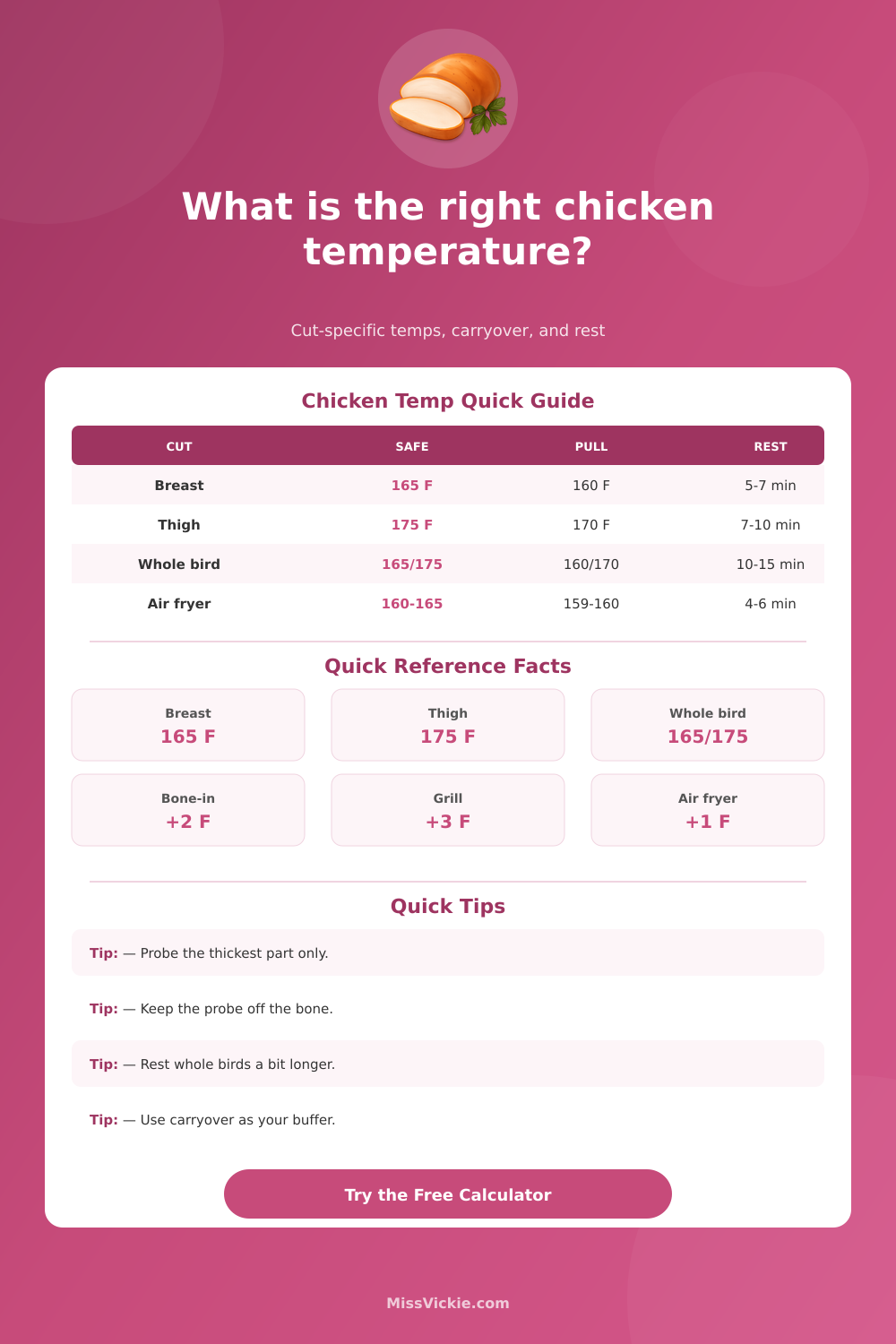
Use these as the baseline targets before carryover, rest, and method adjustments nudge the final pull temperature lower.
| Cut | Safe F | Pull F | Rest |
|---|---|---|---|
| Breast | 165 F | 160 F | 5-7 min |
| Thigh | 175 F | 170 F | 7-10 min |
| Drumstick | 175 F | 170 F | 7-10 min |
| Whole bird | 165/175 | 160/170 | 10-15 min |
Bone mass and cooking method change how much heat stays in the meat after you pull it from the heat source.
| Build | Carry | Pull shift | Why it changes |
|---|---|---|---|
| Boneless | +0 F | None | Fastest finish |
| Bone-in piece | +2 F | -2 F | More thermal mass |
| Split bird | +3 F | -3 F | Thicker center |
| Whole bird | +4 F | -4 F | Two target zones |
Oven, grill, air fryer, pan, and smoker all leave a different amount of residual heat in the meat.
| Method | Gain | Rest | Best use |
|---|---|---|---|
| Oven | +2 F | 5-7 min | Even roast heat |
| Grill | +3 F | 5-8 min | Fast browning |
| Air fryer | +1 F | 3-4 min | Small cuts |
| Pan | +2 F | 4-5 min | Cutlets and tenders |
A good reading comes from the thickest point, away from the pan, tray, or bone that can skew the number.
| Spot | Where to read | Pass when | Why it matters |
|---|---|---|---|
| Breast | Thickest center | 165 F | Lean meat dries fast |
| Thigh | Deepest mass | 175 F | Dark meat needs more heat |
| Whole bird | Breast and thigh | Both targets | Zones finish at different speeds |
| Wings / legs | Thick side | 165-175 F | Small pieces vary a lot |
Compare the way heat behaves so you can choose the right carryover assumption for your chicken batch.
Steady heat, reliable rest window, and easy whole-bird control.
Hotter surface browning with a slightly bigger carryover bump.
Small cuts cook fast and cool off quickly after the basket opens.
Cutlets and tenders hold less heat than a whole roast chicken.
Cooking chicken correctly require an understanding of how the temperature of the chicken change after you stop cooking the chicken. The change in temperature after cooking is called carryover cooking. Carryover cooking occur because the heat from the cooked chicken continues to remaining inside the chicken after it is removed from the heat source.
If you dont account for this phenomenon, the chicken may become dry or overcooked. The different part of the chicken require different internal temperatures to ensure optimal taste and texture because the compositions of the different parts of the chicken are different. Chicken breasts has very little fat, so they can easily become dry if the internal temperature of the chicken breast exceed 165 degrees Fahrenheit.
Let Chicken Rest and Check Its Temperature
Chicken thighs and chicken drumsticks contain more connective tissue and fat than chicken breasts so they requires an internal temperature of approximately 175 degrees Fahrenheit for tenderness. The connective tissue in the thighs and drumsticks requires a higher cooking temperature so that it melt during the cooking process. To measure the internal temperature of the chicken safely, you must insert the thermometer into the thickest part of the chicken.
Inserting the thermometer into the chicken is essential to measuring the internal temperature of the chicken. However, you must ensure that the thermometer does not touch a bone within the chicken. The metal bone will conduct heat more better than the chicken meat so the temperature reading will be inaccurate if the probe comes in contact with the bone.
Using a meat thermometer correctly ensures that the chicken reaches the necessary internal temperature and does not become undercooked or overcooked. Cooking methods influences the carryover cooking of the chicken. For instance, grilling the chicken over intense heat will lead to a greater increase in the internal temperature of the chicken than if you cooked the chicken in an air fryer.
The size and the weight of the chicken also play a role in the carryover cooking of the chicken. The larger the size or weight of the chicken, the more the internal temperature of the chicken will increase after being removed from the heat source. It is essential to allow the chicken to rest after removing it from the heat source.
Allowing the chicken to rest permits the even distribution of heat within the chicken. The even distribution of heat allow the internal temperature to rise to the target safe temperature. If you dont allow the chicken to rest, the heat will not distribute even, and the chicken will not reach the safe internal temperature.
Many people make mistake when preparing chicken. One of the most common mistakes is using timers to monitor the cooking of the chicken instead of using meat thermometers. The timers for cooking the chicken are not as accurate as using a meat thermometer to monitor the internal temperature.
Using a meat thermometer allow for better control of the cooking process. Additionally, people also tend to probe the bone with the meat thermometer instead of the thickest part of the chickens meat. Lastly, people often do not allow the chicken to rest for long enough after removing it from the heat source.
Mathematical models can be used to calculate the expected increase in the internal temperature of the chicken while resting. These models use the weight and thickness of the chicken to calculate the rise of the internal temperature of the chicken. Using this mathematical model, you can remove the chicken from the heat source earlier to allow the chicken to reach the proper internal temperature after resting.
For instance, if the calculated mathematical model indicate the temperature of the chicken breasts will increase five degrees during the resting period, you should of remove the chicken breasts from the heat when the internal temperature reads 160 degrees Fahrenheit instead of 165 degrees Fahrenheit. To prepare chicken correctly and allow it to reach the proper internal temperature without being dry, monitor the internal temperature of the chicken, ensure each part of the chicken reach the proper internal temperature, and allow the chicken to rest after removing it from the heat source. Following these steps will allow the chicken to reach the proper internal temperature without becoming dry.