
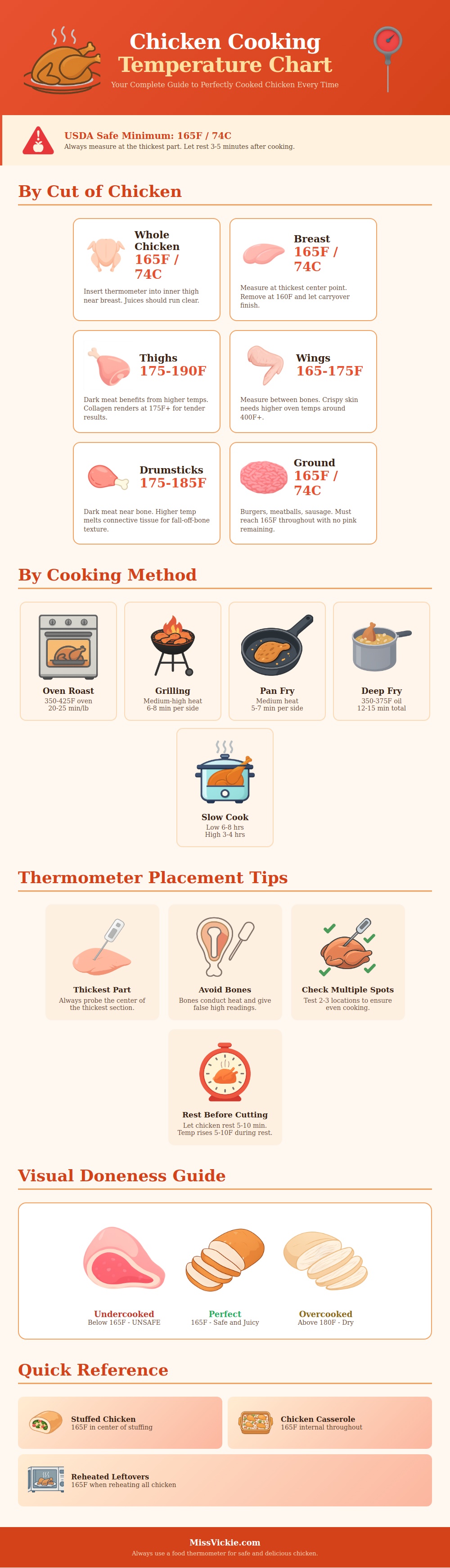
Find the right internal heat for chicken is the base for not burning it The USDA and FDA agree on 165°F as basic advice, and that counts for whole bird, separate parts as breasts or thighs or ground meat. Then dangerous bacteria die immediately, which makes it a simple rule to remember and use.
But here things get tricky. Temperature and time work together to kill bacteria. You can leave chicken at 145°F for about 8.5 minutes to reach the same bacterial death as 165°F. At 155°F ten minutes does the trik.
Right Temperature for Safe, Juicy Chicken
Big bits as whole breasts stay warm enough at 155°F or 160°F to be entirely safe.
The problem is that many folks overcook chicken because of fear, so a thermometer is important. No one wants to chew dry, rubbery meat. For white meat, especially breasts and wings.
165°F often goes too far. I found that taking the breast at around 150°F and letting it rest some minutes gives an ideal result: safe, juicy and delicious. At 155°F to 158°F the heat finishes the job while everything stays moist.
Dark meat thighs are a different story. They taste better at a bit higher heat, between 170°F and 180°F (around 85°C metric). Calibrate your thermometer exactly, that is a must for everything to work.
For oven temperature there is no one rule for everything… It depends on the goal. You can roast between 325°F and 450°F. At 425°F you get nice browning with golden-brown skin.
For thighs 375°F to 400°F are perfect, and at 375°F they end in about 45 minutes. 400°F works well for every cut. Only avoid under 325°F during roasting.
Leave the chicken at room heat for 15 minutes before you cook. That saves time to reach target internal heat, because the center is not iced from the fridge. And please, preheat the oven well.
Putting chicken in an unprepared oven causes uneven cooking, with parts dry as bone and others pink. After it is done leave it rest at least five minutes before you cutit.