How Much Chicken Broth For Chicken Noodle Soup Calculator
Estimate chicken broth for chicken noodle soup by servings, bowl size, noodle type, chicken amount, vegetables, simmer loss, salt level, and leftover plans.
Pick a realistic soup plan, then adjust the broth, noodles, chicken, vegetables, and holding buffer for your pot.
Full Broth Breakdown
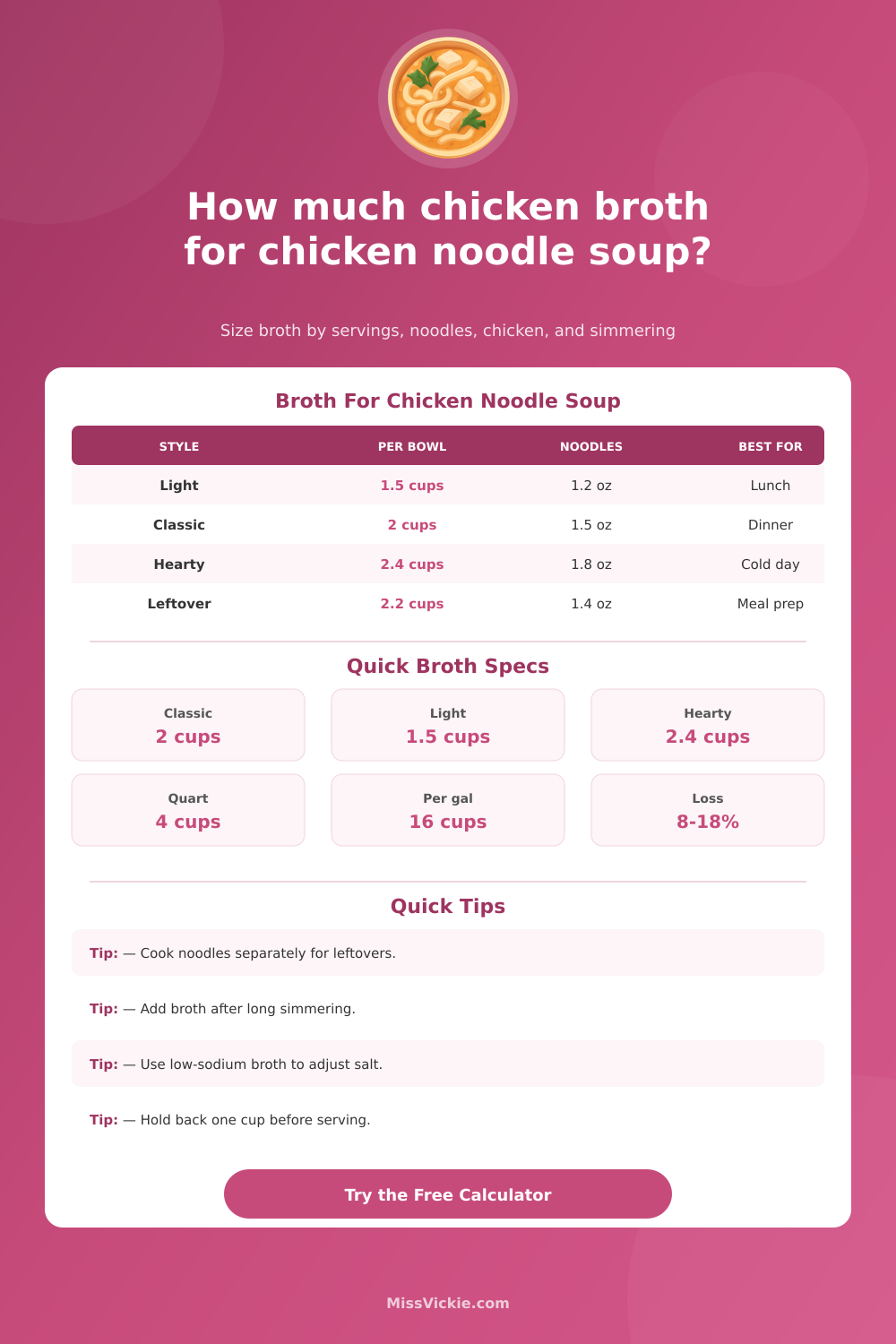
| Soup Style | Finished Soup Per Serving | Broth Share | Best Use |
|---|---|---|---|
| Light and brothy | 1.5 to 2 cups / 355 to 475 ml | About 82% broth | Lunch cups, sick-day soup, lighter bowls |
| Classic chicken noodle | 2 cups / 475 ml | About 75% broth | Balanced chicken, noodles, carrots, and celery |
| Noodle-heavy | 2 to 2.5 cups / 475 to 590 ml | About 68% broth | Kids' bowls, thick family soup, short simmering |
| Leftover-friendly | 2 to 3 cups / 475 to 710 ml | About 80% broth | Meal prep where noodles keep absorbing liquid |
| Noodle Type | Dry Amount Per Bowl | Broth Absorption | Cooking Note |
|---|---|---|---|
| Wide egg noodles | 1.25 to 1.75 oz / 35 to 50 g | Moderate to high | Add near the end so they stay tender, not swollen |
| Orzo or pastina | 1 to 1.4 oz / 28 to 40 g | High | Stir often because small pasta thickens broth fast |
| Rice noodles | 1 to 1.5 oz / 28 to 43 g | Low to moderate | Soak or cook separately for clearer broth |
| Cooked separately | 1.25 to 1.75 oz / 35 to 50 g dry equivalent | Very low in pot | Best for leftovers and reheating |
| Group Size | Finished Soup Goal | Classic Starting Broth | Quart Cartons |
|---|---|---|---|
| 4 servings | 8 cups / 1.9 L | 9 to 10 cups / 2.1 to 2.4 L | 3 cartons gives a buffer |
| 6 servings | 12 cups / 2.8 L | 14 to 15 cups / 3.3 to 3.6 L | 4 cartons is practical |
| 12 servings | 24 cups / 5.7 L | 28 to 31 cups / 6.6 to 7.3 L | 7 to 8 cartons |
| 25 servings | 50 cups / 11.8 L | 58 to 64 cups / 13.7 to 15.1 L | 15 to 16 cartons |
| Broth Type | Typical Sodium Per Cup | Flavor Strength | Salt Strategy |
|---|---|---|---|
| Unsalted chicken broth | 40 to 90 mg | Clean but mild | Salt in stages after chicken and noodles are added |
| Low-sodium broth | 450 to 570 mg | Balanced for most soups | Taste before adding bouillon or seasoning salt |
| Regular broth | 800 to 900 mg | Full and salty | Dilute with water or unsalted stock if reducing |
| Bouillon or base | 700 to 1100 mg | Concentrated | Measure carefully and add herbs before more base |
Makes about two classic bowls after noodles and chicken are added.
Enough starting broth for roughly six to seven dinner bowls.
Per serving is a classic amount before they swell in the pot.
Extra broth keeps tomorrow's soup from turning too thick.
The amount of broth that will be include in the chicken noodle soup is a critical factor in the recipe. The amount of broth that you use will determines the texture and flavor of the soup that is produced. If too little broth is used, the noodles will absorb all of the broth and the soup will taste like a casserole.
If too much broth is used, the broth will be thin and have a weak flavor due to the broth being distribute throughout a large volume of liquid. Each of the variables of the recipe will impact the amount of broth that will remain in the pot after the soup simmers, cooks, and evaporates. A variety of different variable will impact the amount of broth that will remain in the pot.
How Much Broth to Use in Chicken Noodle Soup
The amount of noodles that are to be used will impact the amount of broth due to the way in which the dry noodles will absorb the broth as they soften. The type of chicken that you include in the recipe will impact the amount of broth. Raw chicken will release some of it liquid into the broth while it simmers, but cooked chicken will not release any additional liquid.
Additionally, the amount of vegetables will impact the amount of broth in the pot due to both the space that they will take up in the pot, as well as the amount of liquid that they will release into the pot. Finally, the amount of broth that evaporates from the pot while simmers will also impact the amount of broth that will remain. The calculator will allow for you to manage the variables of the recipe.
The calculator will ask for the number of bowls of soup that you would like to make, as well as the size of the bowls. You will also have to select the type of noodles and chicken that will be used in the recipe. Based on these variables, the calculator will allow you to determine the amount of broth that should be added to the pot.
This will allow you to ensure that you dont have to guess at the amount of broth that will remain once the soup simmers. The size of the serving will impact the amount of broth require for the soup. A classic portion of chicken noodle soup contains approximately two cups of liquid.
However, some individual may desire portions of one and a half cups of soup, while others may prefer three cups of soup. The calculator can be used to establish the volume of soup that will be produced by the recipe to ensure that the broth measurements will account for the size of the bowls that will be filled with the soup. The type of noodles that are used will impact the amount of broth due to the way in which the different types of noodles absorb liquid.
For instance, wide egg noodles will slowly absorb the broth as they soften, but shapes like orzo will absorb the broth at a fast rate. If the orzo noodles absorb too much of the broth, the broth will thicken into a stew-like consistency. Finally, rice noodles will not absorb as much of the broth as the egg noodles, meaning that rice noodles will require less broth to be added to the pot than the other type of noodle.
Additionally, if the soup is to be store for later, you can cook the noodles separately to prevent them from becoming too soft while stored. The type of chicken that is used will also impact the amount of broth. For instance, cooked chicken will not add any additional liquid to the broth, but raw chicken will release some of its liquid into the broth while it simmers.
Because of this, the amount of broth that is started into the pot will need to be adjust if raw chicken is to be used. The adjustment to the amount of broth will ensure that the soup will not taste like a watered down broth. Finally, the amount of vegetables will impact the amount of broth.
Vegetables will take up space in the pot, and will also release some of their liquid into the pot. A larger amount of vegetables will take up more space and release more of its liquid than fewer vegetables. Additionally, the amount of broth that evaporates will also impact the amount of broth that should be started into the pot.
Another variable that you should consider is the salt level. If the broth is low in sodium, you have more control over the level of salt that the broth will have when complete. If you use regular broth, the soup may become too salty.
The calculator account for the sodium content of the recipe so that you can determine the salt level before you begin adding salt to the recipe. An additional reason to use this calculator is if you are creating leftovers. Leftover soup can often lose its texture and become thick due to the noodles absorbing the broth.
The broth will need to be measured to account for this, particularly if the soup will be store for more than one day. By adding a buffer of extra broth up front, the soup will be less likely to become too thick after the noodles have absorbed some of the broth. Some of the most common mistake with broth are using the broth amount to indicate the number of people that will eat, instead of the number of bowls that will be filled.
Additionally, people often add all of the broth at the beginning of the recipe, without accounting for the amount that will evaporate during the simmer. If all of the ingredients are cooked in the pot without planning, the broth may thicken while sitting. These types of mistakes can make the texture and flavor of the soup undesirable.
The goal of preparing broth in this way is to ensure that there is enough broth added to the pot so that the result is a soup rather than a casserole after the noodles have softened, the chicken has released its juices, and the steam has evaporate from the pot. By understanding the effect that each ingredient has upon the amount of broth, you can add the proper amount of broth to ensure that the flavor and texture of the soup is acceptable when consumed. The calculator ensures that this step in the recipe is simple and ensures that you can create the same amount of broth for each batch of soup that you prepare.