MissVickie chicken brine planner
Chicken Brining Time Calculator
Estimate a practical brining window for chicken breasts, thighs, wings, drumsticks, tenders, spatchcocked birds, and whole chickens using cut type, thickness, skin, weight, wet or dry brine, salinity, sugar, and fridge temperature.
Start with a common chicken setup, then adjust the exact thickness, salt strength, skin setting, sugar, and fridge temperature.
Your Chicken Brining Plan
Calculated from cut, thickness, method, salt, sugar, skin, and fridge temperature.
Balanced range for most chicken pieces.
Use raw chicken weight for dry brines.
Upper refrigerator target for raw poultry.
Pat dry or rack dry before high heat.
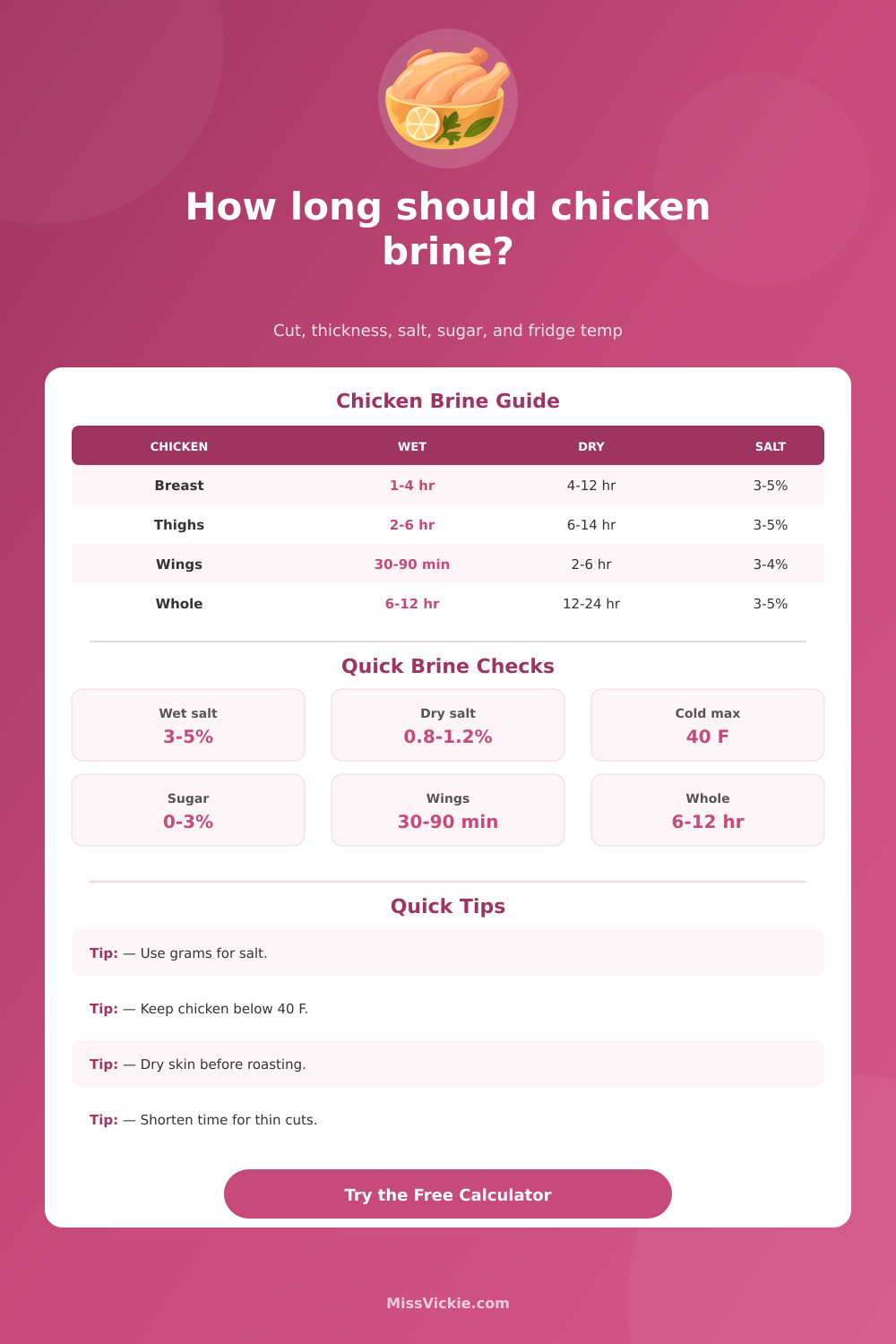
| Chicken Cut | Typical Thickness | Wet Brine Window | Dry Brine Window | Watch Point |
|---|---|---|---|---|
| Thin breast cutlets or tenders | 1/2 inch / 1.3 cm | 20 to 60 minutes | 1 to 3 hours | Overbrines quickly because the center is close. |
| Boneless chicken breasts | 1 to 1 1/2 inch / 2.5 to 3.8 cm | 1 to 4 hours | 4 to 12 hours | Use the thickest center, not the tapered edge. |
| Bone-in breasts | 1 1/2 to 2 inch / 3.8 to 5 cm | 2 to 6 hours | 6 to 14 hours | Bone and skin slow seasoning slightly. |
| Thighs and drumsticks | 1 to 1 3/4 inch / 2.5 to 4.4 cm | 2 to 6 hours | 6 to 14 hours | Dark meat handles a slightly longer window. |
| Wings | Small pieces | 30 to 90 minutes | 2 to 6 hours | Use lower salt for overnight plans. |
| Whole or spatchcock chicken | Breast path matters | 4 to 12 hours | 10 to 24 hours | Cavity shape and breast thickness drive timing. |
| Brine Goal | Wet Brine Salt | Dry Salt Rate | Sugar Level | Best Chicken Use |
|---|---|---|---|---|
| Gentle quick brine | 2.5% to 3.5% | 0.6% to 0.9% | 0% to 1% | Thin breasts, tenders, or meal prep. |
| Balanced everyday brine | 3.5% to 4.5% | 0.9% to 1.15% | 1% to 2% | Breasts, thighs, drumsticks, and whole birds. |
| Bold grill or fryer brine | 4.5% to 5.5% | 1.1% to 1.35% | 2% to 4% | Fried chicken, smoked chicken, or grilled dark meat. |
| Make-ahead lower-salt brine | 2.5% to 3.5% | 0.7% to 0.95% | 0% to 1.5% | Overnight dry brines and packed lunches. |
| Fridge Temperature | Brining Effect | Calculator Adjustment | Chicken Safety Note |
|---|---|---|---|
| 32 to 35°F / 0 to 2°C | Very cold salt movement | Adds a little time | Good cold holding, but near-freezing chicken seasons slower. |
| 36 to 39°F / 2 to 4°C | Normal refrigerator brining | Uses calculated window | Best target range for predictable poultry brining. |
| 40°F / 4°C | Upper safe refrigerator target | Uses shorter side | Check the fridge with a thermometer before long brines. |
| Above 40°F / 4°C | Too warm for raw chicken holding | Caps plan and warns | Chill the chicken and brine before starting. |
| Skin or Shape | Wet Brine Behavior | Dry Brine Behavior | Best Finish | Calculator Factor |
|---|---|---|---|---|
| Skinless boneless pieces | Fastest salt uptake | Moderate surface drying | Pan, grill, or air fryer | Shortens the window. |
| Skin-on pieces | Skin slows contact a little | Good surface seasoning | Roast, grill, or smoke | Adds a small time buffer. |
| Skin-on crisp goal | Needs a dry finish after wet brine | Best path for crisp skin | Rack dry, then high heat | Extends dry brine; warns to dry skin. |
| Bone-in and skin-on | Thicker geometry | Slow but forgiving | Roast or smoke | Adds both bone and skin factors. |
| Whole chicken cavity | Interior shape slows even contact | Works well if salted inside too | Roast or spatchcock | Uses whole-bird cap. |
Best for quick chicken breasts, thighs, drumsticks, or wings when the surface will be dried before cooking.
Best for skin-on roasting, grilling, smoking, and air frying because the surface stays drier.
Uses chicken plus liquid weight in a bag, so the brine is gentler for make-ahead chicken.
Cutlets, tenders, and wings need shorter windows because salt reaches the center quickly.
By relying on some basic chemistry; specifically how changing muscle protein allows food to hold onto water better… We can make chicken taste and feel better by brining. Through time, temperature, and salt, we alter our chicken’s proteins in ways that help the chicken holds onto water better as it cooks.
Because salt doesn’t travel fast, it will season a thin cutlet in no time; its center is near its edges. Salt slowly moves inward from the surface based off how far it has to go and the concentration gradient. But a whole bird or a thick bone-in breast might take hours to get seasoned thoroughally. In short, thickness. Not total weight (is main factor for deciding timing). For example: two-pound chunks of chicken may need different brine times, one being thick while the other is mostly thin tenders.
Simple Guide to Brining Chicken
The calculator above account for such nuances. By inputting both raw weight and approximate thickness, it calculate an exact window for seasoning time, ensuring your dinner won’t be a salty science project.
And here’s where this changes everything: How do you choose? Do you use a “wet” brine? This means you submerge the meat in a mixture of water and salt until all those water molecules force themselves into the muscle fibers, realy fast. Or do you go with a so-called “dry” brine, i.e., rub salt right onto the skin (or into the meat)? In that case, the salt pulls moisture to the surface, dissolving the salt so it can reabsorbs the moisture. It takes longer but the surface will be relatively dry, making it nice and crisp as it browns in the oven.
For roast chicken, for example, with crackling skin, the dry approach is generaly better, even if it requires some time. That’s why the calculator tailors its recommendations accordingly: When you indicate whether you plan to wet- or dry-brine something, it’ll shorten the window if you’re using the faster wet method and lengthen it if you opt for the slower dry. That way, no matter what, there’s enough time for salt to penetrate.
Sugar’s role is one many cooks forget. Yes, it adds sweetness, but sugar also fights for attention on your tongue and balances the sharp taste of salt. That’s why a dash of it mellows salinity’s rough edges, and makes things brown faster by contributing to Maillard reaction. In big-flavor grilling situations, a touch of sugar offsets the salt’s punch. Too much and you’ll burn different than cook the meat.
Tweak the ratio of sugar based on your heat source using the inputs. Use less sugar when cooking with high direct heat to avoid burning it. With gentler roasts like those below, a bit more sugar will yield color.
One important safety point: refrigerator temperature matter. While brining occurs on the cellular level, bacteria love warmth. At temperatures above 40°F, bacteria grow even as salt diffuses. You want your chicken below that number to slow the bacteria without impeding salt’s diffusion. Your fridge may season more quickly if it’s warmer than mine, but with added risk. Food safety always beats food texture, so the calculator notes unsafe temperatures.
And that makes you think about where you will keep the chicken in your kitchen. An over-loaded main fridge or a warm garage fridge throws off not only timing, but also safety margins.
And then there’s the issue of structure: skin and bones present friction. Salt penetrates more slowly through skin; that same skin also help maintain moisture during dry brining. Bones aren’t absorptive; they just add density to protect the surrounding meat. All this means it will take more time for all the parts to season evenly.
If you’re brining a chicken, a whole bird that must be brined inside out will take longer than one that has been spatchcocked and flattened into a single layer. The surface-to-center distance, and therefore the way the salt travels. Is greater and more unpredictable in a whole bird. These are the kind of structural truths built into the tool to keep your legs and breasts neither too salty nor too unseasoned.
Bringing is an art form. It takes precision and patience: Asking a piece of meat to transform itself slowly can’t be hurried or else the transformation will break instead of build. When the method meets your expectations, when you learn the relationship between thickness and time, the guesswork ends. You no longer fret over, “is this long enough?” You trust the process, and the best part about brining chicken is that nobody remembers it was ever in a brine anyway. They just taste something tender and flavorful, and everyone wants the recipe.