🍗 Protein in Chicken Breast Calculator
Calculate exact protein, calories & macros by weight — raw or cooked, boneless or bone-in
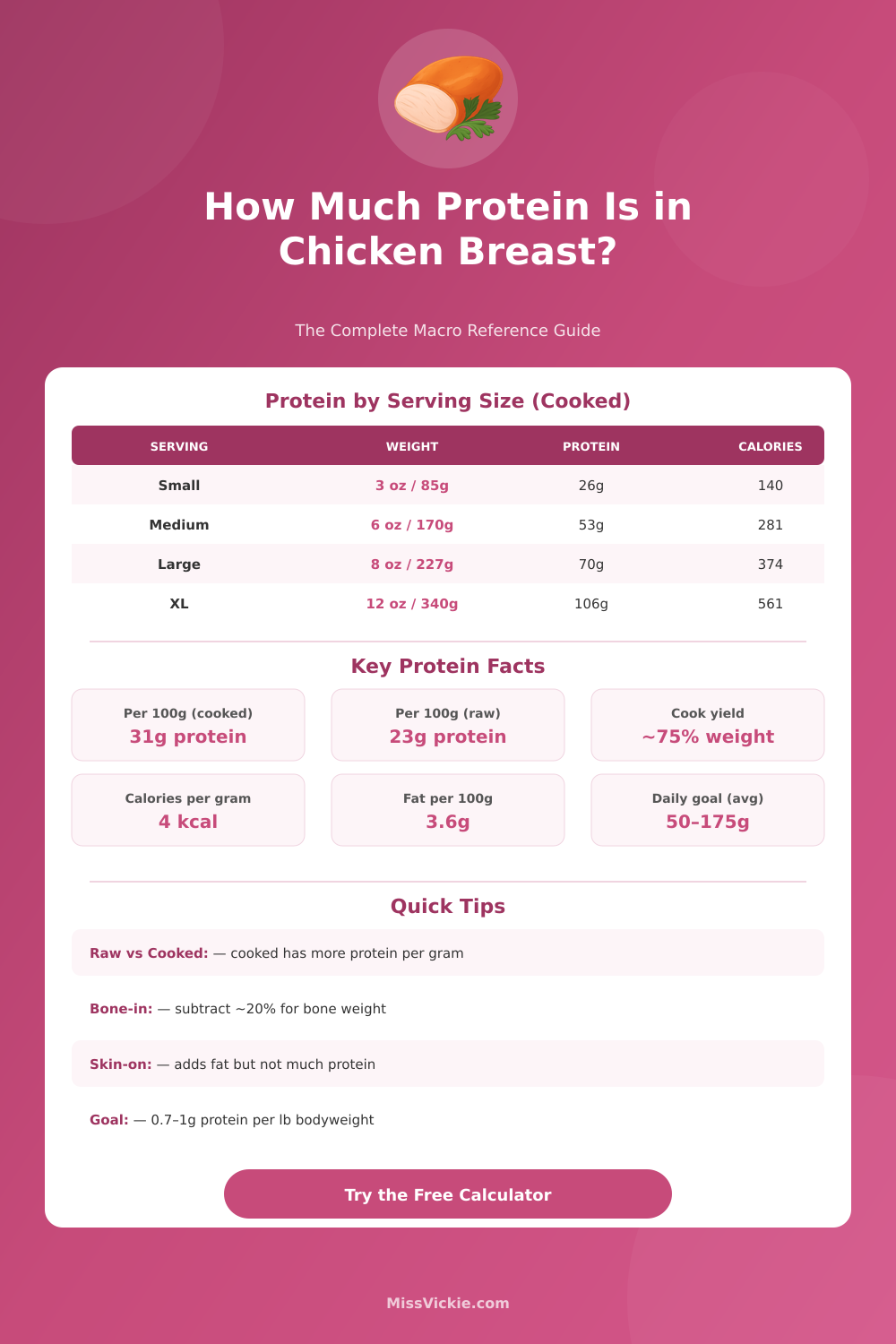
| Serving | Weight (oz) | Weight (g) | Protein (g) | Calories | Fat (g) |
|---|---|---|---|---|---|
| Extra Small | 2 oz | 57g | 17.7g | 94 | 2.1g |
| Small | 3 oz | 85g | 26.4g | 140 | 3.1g |
| Medium | 4 oz | 113g | 35.0g | 186 | 4.1g |
| Standard | 6 oz | 170g | 52.7g | 281 | 6.1g |
| Large | 8 oz | 227g | 70.4g | 375 | 8.2g |
| Extra Large | 10 oz | 284g | 88.0g | 469 | 10.2g |
| Jumbo | 12 oz | 340g | 105.4g | 561 | 12.2g |
| Double | 16 oz | 454g | 140.7g | 749 | 16.3g |
| Raw Weight | oz | Protein (g) | Est. Cooked Weight | Cooked Protein |
|---|---|---|---|---|
| 100g | 3.5 oz | 23.1g | ~75g | 23.3g |
| 150g | 5.3 oz | 34.7g | ~113g | 35.0g |
| 200g | 7 oz | 46.2g | ~150g | 46.5g |
| 250g | 8.8 oz | 57.8g | ~188g | 58.3g |
| 300g | 10.6 oz | 69.3g | ~225g | 69.8g |
| 400g | 14.1 oz | 92.4g | ~300g | 93.0g |
| 500g | 17.6 oz | 115.5g | ~375g | 116.3g |
| Bodyweight | Sedentary (0.4g/lb) | Active (0.7g/lb) | Athletic (1.0g/lb) | Building (1.2g/lb) |
|---|---|---|---|---|
| 120 lb / 54 kg | 48g | 84g | 120g | 144g |
| 140 lb / 64 kg | 56g | 98g | 140g | 168g |
| 160 lb / 73 kg | 64g | 112g | 160g | 192g |
| 180 lb / 82 kg | 72g | 126g | 180g | 216g |
| 200 lb / 91 kg | 80g | 140g | 200g | 240g |
| 220 lb / 100 kg | 88g | 154g | 220g | 264g |
| Type | Edible Yield | Protein / 100g Total | Est. Protein / 100g Meat Only |
|---|---|---|---|
| Boneless, Skinless | ~100% | 31g (cooked) | 31g |
| Bone-in, Skinless | ~78–82% | ~24g (cooked) | ~31g |
| Bone-in, Skin-on | ~72–78% | ~22g (cooked) | ~29g |
| Boneless, Skin-on | ~90–95% | ~28g (cooked) | ~30g |
Chicken Breast comes from the chest muscle of the bird and belongs to the group of white meat. Here are boneless and skinless Chicken Breast options: they truly are great for fast dinners, you cook them quickly and their simple taste soaks up like a sponge all marinades, spices or sauces that you add to them.
Here is the secret of breast meat: it has the best ratio between fat and Protein in the whole chicken. Fat gives the taste and keeps everything juicy, so breast meat always will seem drier and less tasty than dark meat. That honestly explains why so many home cooks fail with it.
Chicken Breast Basics
The lean nature does make it good from a healthy viewpoint, naturally, but the fear about undercooking pushes folks to burn it outright.
Grilled three-ounce serving delivers 26 grams of Protein with only 2.7 grams of fat. Also zero carbs. For that same bit you find around 128 calories.
If one raises it to 100 grams, that reaches 165 calories with 31 grams of Protein. The usual serving suggestion comes to around 3 to 4 ounces… Almost like a pack of playing cards.
The trouble is that the majority of store-bought Chicken Breast pieces two or three tiems surpass that size.
Bodybuilders almost live on Chicken Breast during preparation for contests. The advantage is clear: one boosts the Protein intake while controlling the fat, and breast meat gives exactly that kind of lean Protein without any dietary trouble.
Here is advice for cooking in a nutshell, that truly works. Sear the chest on high heat for three minutes each side, later lay cover on the pan and lower the temperature. Leave to cook slowly for around 15 minutes, then remove the heat fully and allow it too rest covered for another 10 to 12 minutes.
The truth happens in that resting time. If you pre-marinated, you already are halfway to tenderness. Brining makes a surprisingly big difference.
The main challenge comes from this, that lean breast burns in a flash and has almost no fat protection, so overcooking happens before one notices, and quickly it gets tough and rubbery. Beat it to same thickness helps so that everything cooks evenly. An internal thermometer, set for alarm at 165 degrees, is truly agame changer for oven-cooked chicken.
Chicken tenders and Chicken Breast pieces do not differ much in usage. One can swap them in most recipes without anyone noticing. The key is that tenders usually have more fat and sodium.
Bone-in Chicken Breast costs less, because producers skip the deboning and skinning work. Also, the bones help to protect the meat against drying out during cooking.
Woody breast syndrome is a real issue in factory-raised chickens. Factory farm methods make chickens grow more quickly, and that causes that weird, woody texture in the meat. Spatchcocking a whole bird can seem weird, but it cooks much more evenly; your breast does not end overdone while the thighs stay raw.