Cherry Tomatoes Per Pint Calculator
Estimate cherry tomato count per pint, total cups, pounds, grams, prep yield, trim loss, and recipe targets from clamshell pints or loose market baskets.
🍅Cherry Tomato Presets
Pick a common kitchen plan, then adjust pint boxes, tomato size, variety, prep form, trim loss, cup target, and weight target.
⚖Pint Yield Inputs
Cherry tomato pint estimate
Your pint estimate appears here.
Pint And Count
Yield Math
Recipe Target Plan
📌Fast Pint Count Cards
🔍Cherry Tomato Comparison Grid
Balanced count, juicy bite, and reliable salad yield.
Smaller oval tomatoes with firmer skin and lower gel.
Tiny sweet fruit with high count and delicate skins.
Juicy cherry type that gives bright salad color.
Variable size and shape, so trim and count can swing.
Light, pear-shaped fruit with loose cup packing.
Meatier small tomato for roasting and quick sauce.
Firm texture helps pieces stay intact in lunch prep.
📊Cherry Tomatoes Per Pint Table
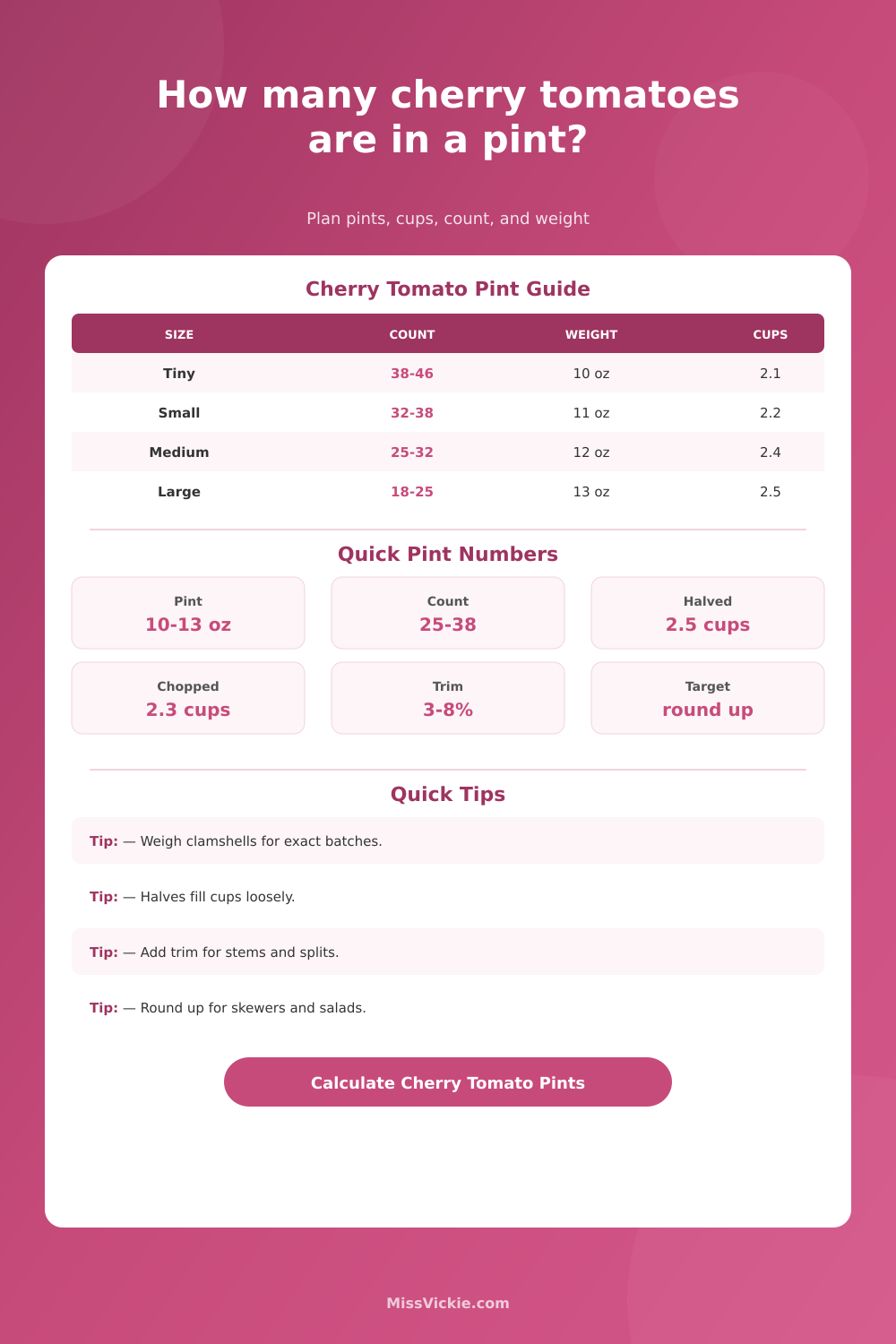
| Tomato size | Typical count per pint | Typical pint weight | Average each | Best kitchen use |
|---|---|---|---|---|
| Tiny cherry tomatoes | 38 to 46 tomatoes | 9.5 to 10.5 oz / 270 to 298 g | 0.22 to 0.28 oz | Garnish, snacking, pasta toss-ins |
| Small cherry tomatoes | 32 to 38 tomatoes | 10 to 11.5 oz / 284 to 326 g | 0.28 to 0.36 oz | Lunch boxes, salads, skewers |
| Medium cherry tomatoes | 25 to 32 tomatoes | 11 to 12.5 oz / 312 to 354 g | 0.36 to 0.50 oz | Salads, bowls, caprese cups |
| Large cherry tomatoes | 18 to 25 tomatoes | 12 to 13.5 oz / 340 to 383 g | 0.50 to 0.75 oz | Halving, roasting, bruschetta prep |
| Mixed market pint | 24 to 36 tomatoes | 10.5 to 12.5 oz / 298 to 354 g | 0.32 to 0.55 oz | Farm boxes and mixed color packs |
🥄Prep Form Yield Table
| Prep form | Cups per pint guide | Packing style | Moisture change | Planning note |
|---|---|---|---|---|
| Whole cherry tomatoes | 1.9 to 2.2 cups | Loose, round gaps | None | Best for snack cups and garnish count |
| Halved cherry tomatoes | 2.3 to 2.7 cups | Looser than chopped | 0 to 4% juice loss | Good for salads, bowls, and caprese |
| Quartered cherry tomatoes | 2.2 to 2.5 cups | Moderate packing | 2 to 6% juice loss | Useful when pieces need to cling to pasta |
| Chopped cherry tomatoes | 2.1 to 2.4 cups | Dense cup fill | 4 to 10% juice loss | Use for salsa, bruschetta, and topping bars |
| Crushed raw pulp | 1.8 to 2.1 cups | Very dense | 6 to 14% juice loss | Good for quick raw sauce and marinades |
| Roasted cherry tomatoes | 1.0 to 1.5 cups | Collapsed pieces | 35 to 60% water loss | Depends strongly on oven time and pan crowding |
🧪Recipe Target Table
| Recipe use | Common target | Pints to start | Prep form | Extra planning note |
|---|---|---|---|---|
| Two dinner salads | 2 cups halved | 1 pint | Halved | Add extra if tomatoes are very tiny |
| Family pasta bowl | 4 cups halved | 2 pints | Halved or quartered | Salted tomatoes may shed some juice |
| Caprese skewers | 48 tomatoes | 1.5 to 2 pints | Whole | Count matters more than cup volume |
| Fresh salsa topping | 5 cups chopped | 2.5 to 3 pints | Chopped | Use a higher trim setting for watery packs |
| Roasted side tray | 3 cups roasted | 3 to 4 pints | Roasted | Roasting shrink can exceed half the raw volume |
| Meal prep bowls | 8 cups halved | 4 pints | Halved | Firm varieties hold best after chilling |
🔧Trim And Target Adjustment Table
| Adjustment | Light setting | Standard setting | Heavy setting | When to use it |
|---|---|---|---|---|
| Trim loss | 1 to 3% | 4 to 7% | 10 to 18% | For stems, split skins, bruises, and sorter loss |
| Service buffer | 3 to 5% | 8 to 12% | 15 to 20% | For party trays, skewers, tasting, and uneven pints |
| Raw juice loss | 0% | 3 to 6% | 8 to 12% | For salted, chopped, or drained tomato prep |
| Roast shrink | 30% | 45% | 60% | For juicy tomatoes, high heat, and long roasting |
💡Cherry Tomato Measuring Tips
Cherry tomato pint estimates vary with variety, season, clamshell fill, tomato size, ripeness, trim, and how tightly the measuring cup is filled.
The label says A pint is convenient. The recipe calls for cups. You need some bite-sized tomatoes for a salad, and others halved for something else entirely. Then there’s the fact that every tomato come to market different: Some are huge; others are tiny. How do you even begin? That’s when dinner plans go wrong, the difference between how things look on the package and what actualy happens in the kitchen. One second you have too much for a pasta toss, then the next not quite enough for a party of caprese skewers.
Enter the calculator up top. By taking into consideration changing factors like trim loss, prep method and varying size, it bridges the gap between raw count and usable yield, turning a shot in the dark into a shopping list you can bank on.
How to Use the Tomato Calculator
Tomato size is a variable that messes up even professional cooks so I guess it’ll throw off home cooks too. Sixteen large heirlooms may fit in a box marked one pint, while there can be as many as 46 small sweeties in the same amount of space. On the scale, they may seem equal. But they are not equal by count. You have to count them to make skewers. Counting is more important for skewers because each fruit has to be threaded on its own.
To adjust your estimate for how many tomatoes is in a given container, you can pick a size category. This avoids that oh-shit moment when you realize you’ve come up short of fruit at assembly time. Then, the tool will tell you how much fits.
The other big variable is how they will be prepared. If you are packing whole tomatoes into a measuring cup, there is a lot of air space between each round tomato. If they are cut in half (which stacks better flat-side-down), there is not quite as much air. If they are chopped the pieces fit even tighter and settle further. And if you want to roast those suckers until soft, then you’ll have to account for lost volume from any evaporated water. Depending on what you’re going to do with them, serve whole, chop into salsa, or roast, this calculator takes that into account when calculating how many cups your tomatoes will produce. For example, I know that roasting my tomatoes reduces the volume by as much as 60 percent, so I make sure to get enough that I won’t end up with an empty pan.
A bitter pill most recipes don’t swallow: no pint comes perfectly whole. Some fruits have bruise-y bottoms that yield to pressure and go mushy; others won’t let go of their stem, other than in ragged chunks that stain everything else. Some skins split open and ooze juice into the pot long before you’ve brought it near enough to touch. Whatever your specific rate of loss, setting a reasonable trim percentage in the tool will help you factor in waste, and five percent is a fair starting point. (If you’re purchasing at a farmers’ market stand where fruit varies in size, you may wish to increase that slightly, so that a half-pint or a pint more isn’t the difference between life and death on a salad.)
With heirlooms, you get that great flavor complexity, but they’re so variable in size that unless you count (and actualy do), there’s no way to know what your bag contains. As the chart on the page explains, juicy classic reds are best for soups and sauces. Grape tomatoes also holds their shape well despite heat or salt, making them ideal when texture is important. When meal prepping, you want tomatoes that stay intact, meaning firmer varieties will give you more consistant results. Tomatoes meant to be eaten whole need to stand up to several days spent in a fridge, not turn into sauce themselves.
The tool helps you think in outcomes instead of pints. Shopping is more effective this way, since it knows exactly how many boxes of any given size you should grab to get four cups (halved) of tomatoes to serve over dinner, for instance. No more conversion math in our heads from ounces-to-counts-to-cups: just type your desired amount into the tool and the computer figures out the rest. You will have less shopping stress at the store, less food waste at home, and fewer leftovers that make you wonder, “what do I do with all of this?”.
(Now go eat something.)
Next time you grab the one from the shelf (and there’s always a choice), skip right over the pretty red color: It’s the size of each individual fruit and what you’re planning to do with it; dicing it into salsa vs. Serving it whole in a bowl determines the yield as much as, if not more than, what the label says. Plan ahead with the tool; don’t just scramble at 5 o’clock when it comes to cooking. A little math now means everyone goes home with their fair share of those sweet, bite-sized bits of brightness.