🥣 MissVickie Cheese math
Cheese Converter
Convert Cheese between cups, grams, ounces, tablespoons, teaspoons, and milliliters, then scale recipes with a method-aware view of how this absorbent cheese behaves.
Each preset fills a real cheese scenario, from pancake batter to breading and sauces, then runs the conversion automatically.
Choose a Cheese format, the way you measured it, and the moisture setting in your kitchen so the conversion reflects how this cheese actually behaves.
| Format | 1 cup | 1 tbsp | 1 oz equals | Best use |
|---|---|---|---|---|
| Standard Cheese | 128 g | 8 g | 0.22 cup | Pancakes, muffins |
| Sifted Cheese | 118 g | 7.4 g | 0.24 cup | Cakes, custards |
| Spoon-filled Cheese | 124 g | 7.8 g | 0.23 cup | Cookies, bars |
| Lightly packed Cheese | 136 g | 8.5 g | 0.21 cup | Breading, dough |
| Ultra-fine Cheese | 132 g | 8.3 g | 0.22 cup | Breads, batters |
| Toasted Cheese | 122 g | 7.6 g | 0.23 cup | Toppings, bakes |
| Kitchen amount | Tablespoons | Teaspoons | Metric | Imperial |
|---|---|---|---|---|
| 1 teaspoon | 0.33 tbsp | 1 tsp | 3 g | 0.1 oz |
| 1 tablespoon | 1 tbsp | 3 tsp | 8 g | 0.3 oz |
| 1/4 cup | 4 tbsp | 12 tsp | 32 g | 1.1 oz |
| 1/3 cup | 5.33 tbsp | 16 tsp | 43 g | 1.5 oz |
| 1/2 cup | 8 tbsp | 24 tsp | 64 g | 2.3 oz |
| 1 cup | 16 tbsp | 48 tsp | 128 g | 4.5 oz |
| Original | Target | Multiplier | Shortcut | Kitchen note |
|---|---|---|---|---|
| 4 servings | 6 servings | 1.5x | Add half again | Good for weekend breakfast bakes |
| 6 servings | 12 servings | 2x | Double everything | Great for pancakes, muffins, and bars |
| 8 servings | 12 servings | 1.5x | Add half again | Useful for brunch and dessert trays |
| 12 servings | 18 servings | 1.5x | Half plus full | Keep leavening close, then tweak liquid |
| 12 servings | 24 servings | 2x | Double batch | Best time to switch Cheese to grams |
| 24 pieces | 36 pieces | 1.5x | Half extra dough | Cheese needs a little extra moisture |
| Use case | 1/4 cup | 1/2 cup | 3/4 cup | 1 cup |
|---|---|---|---|---|
| Sweet batters | 30 g | 60 g | 90 g | 128 g |
| Extra-light cups | 29 g | 59 g | 88 g | 118 g |
| Spoon-filled cups | 31 g | 62 g | 93 g | 124 g |
| Lightly packed | 34 g | 68 g | 102 g | 136 g |
| Ultra-fine grind | 33 g | 66 g | 99 g | 132 g |
| Toasted finish | 31 g | 61 g | 92 g | 122 g |
Fast for home baking, but Cheese shifts a lot when the cup is scooped, packed, or sifted.
Best for Cheese because density changes less once everything is weighed directly.
Useful when a recipe mixes U.S. labels and scale checks, especially for low-carb baking.
Ideal for thickening, coatings, and test batches where a teaspoon or tablespoon matters.
These totals update from the converted amount so you can estimate the impact of scaling a single Cheese amount in the batch.
Converting cheese from weight to volumes require an understanding of the density of the cheese. Density is a factor in cheese because different types of cheese has different amounts of moisture and air within there particles. Hard cheeses like parmesan cheese have a highly density because they contain fine shreds of cheese that pack tight together.
In contrast, soft cheeses like ricotta have a low density due to an air pockets within the cheese. Because of the low density of soft cheeses, a cup of soft cheese will weigh less then a cup of hard cheese. In order to accurately convert the weight of cheeses to volume, it is important to account for the density of the cheese; otherwise, the conversion will lead to incorrect measurement and the recipe may fail altogether.
How to Convert Cheese Weight to Volume
The style in which you measure the cheese can also have an effect on the weight of the cheese being measured. If you pack the cheese tight into the measuring cup, more cheese will be added to the cup than if it was measured in a loose fashion. Most recipe will use level measurements of ingredients.
However, if the recipe calls for it, it is possible that the cheese must be packing into the cup. Using the incorrect style to measure the cheese will lead to the preparation of cheese that is either 10 percent or more of the required weight; 10 percent of the weight of some cheese recipes can alter the texture of the final product altogether. Increasing the size of the recipe to feed more people require additional calculations.
In addition to simply increasing the amount of cheese according to the number of people that will eat the recipe, it is also necessary to account for the loss of volume of the cheese that melts during the cooking process. Some cheese melt and loses volume, and to account for this, you can add 4 percent of the cheese to the recipe. For instance, if you increase the recipe from 4 people to 6 people, the recipe will be multiplied by 1.5 to account for the additional people, but an additional 4 percent of cheese will be added to the recipe to account for the melting of the cheese.
Using a scale to measure the weight of the cheese will provide more accurate measurements than using measuring cups to measure the volume of the cheese. The reason for the increased accuracy of using a scale is that the scale measure the mass of the cheese and doesnt have to account for air pockets within the cheese. The unit of measurement of grams is a consistant unit of measurement and will not change according to the scooping of the cheese.
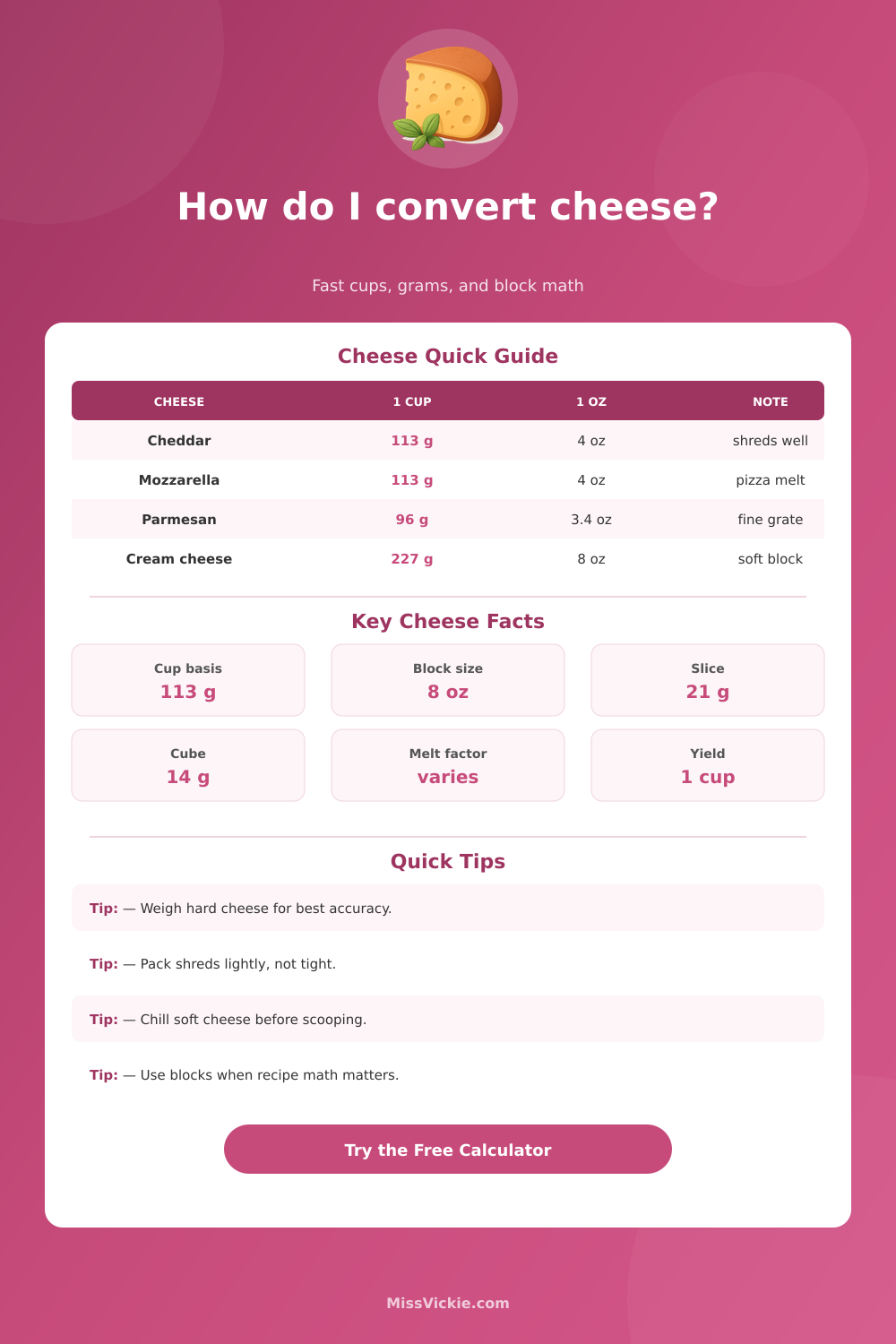
For hard cheeses, grams can be used to measure the weight of shredded cheese. However, for soft cheeses, it is better to chill the cheese before measuring its weight. A slice of soft cheese weigh approximately 21 grams; a cube of soft cheese weighs approximately 14 grams.
Using these weights will allow cooks to maintain the consistency of there recipes. Common mistakes include packing the cheese too tight into the measuring cup or using the cup to scoop the cheese; both of which will add extra weight to the cheese. Using too much cheese will make the batch of food, such as muffins, too dense.
Underestimating the amount of cheese needed will mean that the guest will not have enough cheese to eat. Soft cheeses tend to crumble in ways that are not easy measured, so they must be measured in a loose fashion. Additionally, the scaling of a recipe will also scale the nutritional content of that recipe.
Therefore, if you double the recipe, the amount of protein and fat needed will also be doubled.