🔥 Charcoal Calculator
Dial in charcoal for long smokes, hard sears, and mixed grill sessions with a margin for weather and refills.
| Grill Type | Base Load / Hr | Heat Hold | Typical Refill Cadence |
|---|---|---|---|
| Kettle Grill | 1.05 lb/hr | Medium | 45 to 60 min |
| Offset Smoker | 1.90 lb/hr | Low | 30 to 45 min |
| Ceramic Grill | 0.78 lb/hr | High | 90 to 120 min |
| Kamado | 0.70 lb/hr | Very High | 120 min or more |
| Hibachi / Small Grill | 1.30 lb/hr | Low | 20 to 30 min |
| Portable Grill | 1.15 lb/hr | Medium-Low | 30 to 45 min |
| Pizza Cooker | 1.45 lb/hr | High | 15 to 25 min |
| Fuel Type | Ignition | Heat Character | Ash Level | Best Use |
|---|---|---|---|---|
| Briquette | Slower | Steady and predictable | Medium | Long cooks, repeatable temps |
| Lump | Faster | Hotter and more reactive | Low | Searing, fast recovery, pizza |
| Temp Band | Style Match | Burn Factor | What It Means |
|---|---|---|---|
| 200 to 275 F | Low and slow | 0.84 to 0.92 | Small fire, long hold, gentle airflow |
| 276 to 325 F | Ribs and roasts | 1.00 | Balanced load for steady cooking |
| 326 to 400 F | Chicken and burgers | 1.10 | Moderate draw with a warmer coal bed |
| 401 to 500 F | Reverse sear and pizza | 1.22 | Strong initial bed and quicker reloads |
| 501 to 750 F | Sear and blister | 1.32 | Hot, hungry fire with a fast burn cycle |
| Preset | Grill | Hours | Temp | Fuel | Reserve |
|---|---|---|---|---|---|
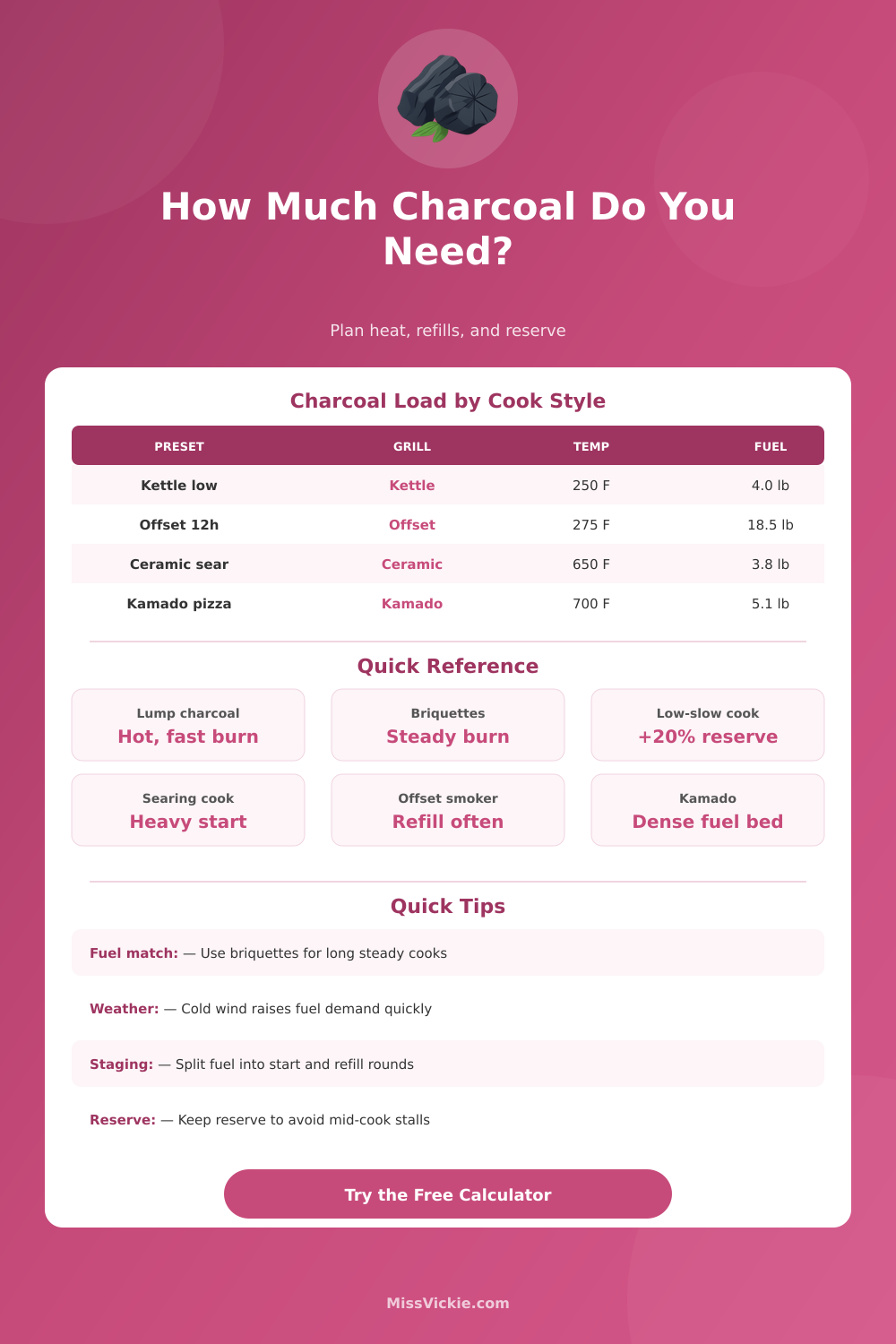
| Kettle Low-Slow | Kettle | 4.0 | 250 F | Briquette | 15% |
| Offset Smoker Brisket | Offset | 12.0 | 275 F | Lump | 25% |
| Ceramic Grill Sear | Ceramic | 1.5 | 650 F | Lump | 10% |
| Kamado Pizza Night | Kamado | 2.0 | 700 F | Lump | 12% |
| Tailgate Burgers | Portable | 1.0 | 375 F | Briquette | 12% |
| Backyard Ribs | Kettle | 6.0 | 275 F | Briquette | 15% |
| Reverse-Seared Steak | Ceramic | 1.75 | 500 F | Lump | 10% |
| Wings & Snacks | Kettle | 2.0 | 350 F | Briquette | 12% |
| Pork Shoulder Overnight | Offset | 9.0 | 250 F | Briquette | 20% |
| Charred Vegetables | Hibachi | 1.0 | 500 F | Lump | 10% |
Charcoal management are a necessary skill because charcoal provide the heat required for cooking. Using too little charcoal will cause the fire to die before the cooking are finished, while using too much will waste charcoal and create excess ash to clean up after cooking. The amount of charcoal needed to reach a target temperature will vary depending on the type of grill that is being used.
For instance, kettle grills will consume charcoal much more faster than kamado grills because kettle grill basket are opened to allow heat to escape from the grill while kamado grill shells is thick materials that trap heat within the grill. The type of charcoal used will also affect the burn rate of charcoal. Briquette burn at a steady rate and are good for cooking that requires a consistant heat level.
How to Manage Charcoal for Your Grill
Lump charcoal burn hotter than briquettes and is good for cooking that requires high heat. However, lump charcoal is more sensitive to airflow than briquettes. The type of charcoal that you should use will depend on the cooking style.
Low and slow cooking will require a different amount of charcoal than high heat cooking. The weather will also play a role in the amount of charcoal needed for cooking. In colder temperature or in areas with much wind, more charcoal will be consumed due to the effect that cold air and wind have on grills.
Accounting for the weather by adjusting the efficiency of the grill will ensure that there is enough charcoal to maintain the target cooking temperature. Additionally, you should plan charcoal refills in segment during the cooking process to ensure that there is a steady temperature within the grill. A charcoal calculator will provide the measurements for cooking.
The calculator will provide the total amount of charcoal needed for the cooking session and how much charcoal should be used for the initial start of the grill and how much charcoal should be added during the cooking process for refills. The charcoal calculator will also provide a safe burn window for the charcoal which is the amount of time the charcoal will last before it run out. The amount of charcoal that will be consumed is calculate based off the recipe, target temperature, grill type and weather conditions.
For instance, cooking to a target temperature of 250 degrees will consume the charcoal slowly as compared to a target temperature of 650 degrees which will consume the charcoal very quickly. There are specific lighting method for charcoal that can be used to enhance the cooking process. The snake method which is best for long cooking sessions involve laying the unlit charcoal around the lit charcoal.
The Minion method which is often used in offset smokers involve burying the lit charcoal under the cold charcoal. Charcoal should always be reserved for cooking in case the weather change or if an increase in the amount of food to be cooked is needed. A reserve of charcoal should be maintained when using a charcoal grill.
Maintaining a 15 percent reserve of charcoal ensures that there is enough charcoal in case of emergency. When adding charcoal to the grill, you must add the charcoal correctly so as to not stall the temperature of the grill. Adding charcoal to a grill that is already lit will cause the temperature to drop if the cold charcoal is simply dumped onto the grill.
The cook should prepare the new charcoal outside of the grill and place it into a trench within the bed of charcoal that is already in the grill. By following these charcoal addition steps, the temperature of the grill will remain stable. By understanding how different type of grills, types of charcoal and the weather affect the burn rate of charcoal, charcoal grill cooks will always have enough charcoal to finish the cooking session.