Cauliflower Cooking Time Calculator
Estimate cauliflower cooking time for whole heads, florets, steaks, and riced cauliflower by method, size, fresh or frozen start, batch load, water level, doneness, and roast browning.
🥦 Cauliflower Presets
Choose a kitchen scenario, then adjust floret size, batch depth, water level, and doneness to match your pan or steamer.
⚖ Cooking Inputs
Estimated Cook Window
Set the cauliflower size and method to estimate timing.
Timing Breakdown
Batch Breakdown
Cooking Notes
🍴 Cauliflower Size Guide
Very quick; easy to overcook.
Good for steaming and bowls.
Best all-purpose timing size.
Better for roasting or whole-head cuts.
The calculator uses stem thickness and head diameter because cauliflower florets cook through the stems before the tops look fully relaxed.
🔥 Method Comparison Grid
Best for bright florets, whole heads, and clean fork-tender texture.
Fast for mash, but drains flavor if the pot runs too hard.
Best browning when florets are dry and spread out.
Quick crisp edges, but crowding changes the timing quickly.
Fast covered steam; rest briefly before judging doneness.
📋 Method Timing Table
| Method | Best cauliflower form | Typical time | Doneness cue |
|---|---|---|---|
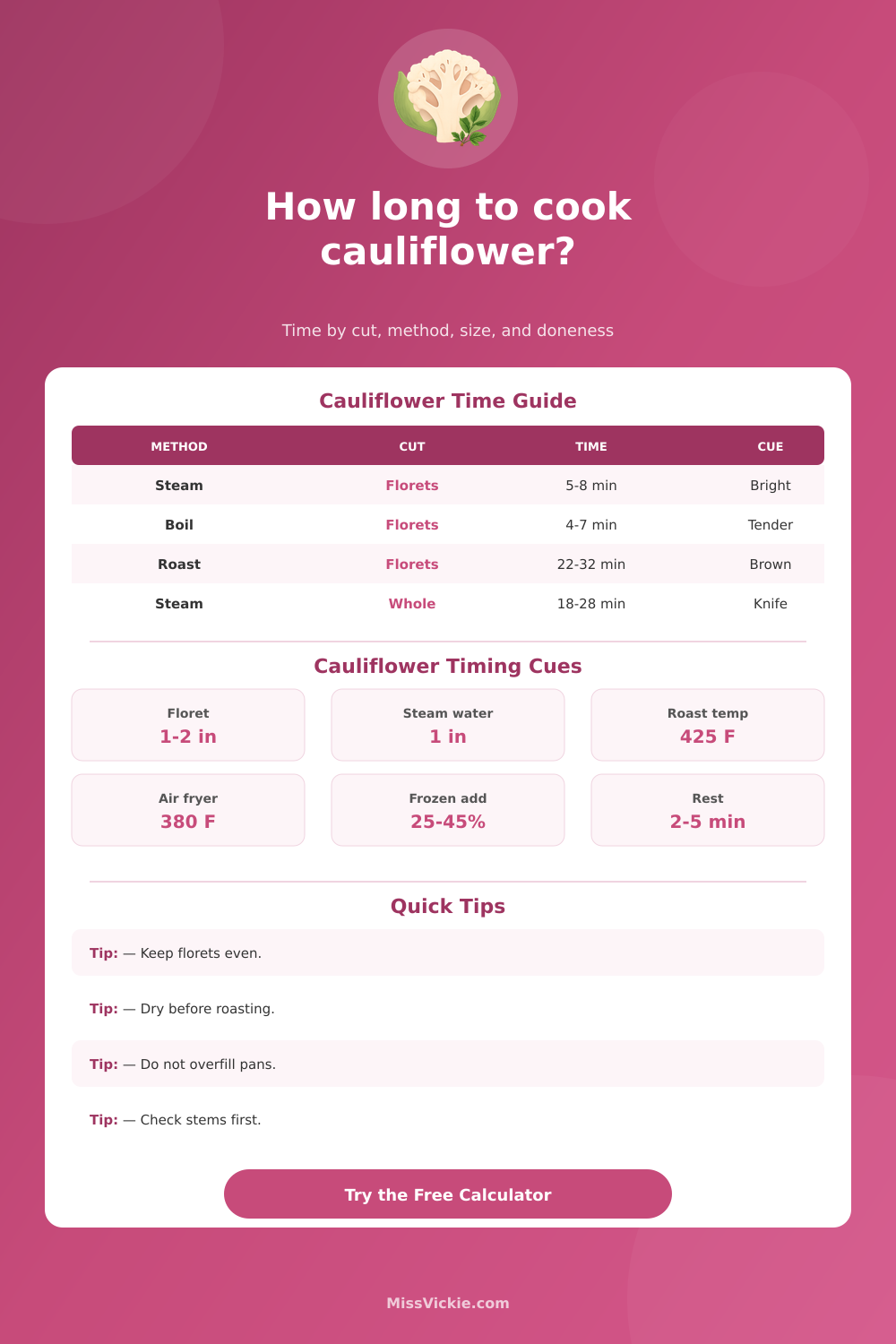
| Steam basket | Florets, halves, whole head | 5-10 minutes for florets; 18-28 for whole | Knife slides through the thickest stem with light resistance. |
| Boil or simmer | Florets for mash or puree | 4-8 minutes for florets; longer for large chunks | Stem breaks with a fork but tops are not waterlogged. |
| Oven roast | Dry florets, steaks, or halves | 22-38 minutes depending on browning | Flat sides brown and stems are tender. |
| Air fryer | Medium florets or small steaks | 12-24 minutes | Edges are crisp and centers still look moist. |
| Microwave | Small batch florets or whole mini head | 4-14 minutes | Covered bowl steams; rest before opening fully. |
| Saute | Riced cauliflower or small florets | 5-12 minutes | Moisture cooks off and edges turn lightly golden. |
🔪 Cut Size and Form Table
| Form | Size to enter | Timing behavior | Best check point |
|---|---|---|---|
| Riced cauliflower | 0.25-0.5 inch pieces | Very fast; batch depth matters more than size. | Taste for raw crunch and excess moisture. |
| Small florets | 0.75-1.25 inch diameter | Quick steaming and boiling; easy to over-soften. | Stem tip pierces but head stays intact. |
| Medium florets | 1.25-1.75 inch diameter | Most predictable for roasting and air frying. | Thickest stem in the middle of the pan. |
| Cauliflower steaks | 0.75-1.25 inch thick | Need time for the core plus browning on flat sides. | Center core and browned face. |
| Whole head | 4-7 inch head diameter | Diameter and core depth dominate the timer. | Knife into the core from the top. |
❄ Fresh, Frozen, and Batch Table
| Setting | Timing effect | Texture effect | Calculator note |
|---|---|---|---|
| Fresh, room temperature | Baseline | Cleanest roast and steam texture | Best default for even florets. |
| Refrigerated fresh | Slightly slower | Firm stems hold shape well | Adds more time to whole heads than small florets. |
| Washed and damp | Slower browning | Softer surface | Dry thoroughly before roasting. |
| Frozen loose florets | Adds about 25-35 percent | More moisture in the pan | Roast longer after steam evaporates. |
| Frozen clumped bag | Adds about 35-55 percent | Uneven early cooking | Break apart halfway when possible. |
| Deep or packed batch | Adds about 15-35 percent | Steams before browning | Use two pans for roasting if browning matters. |
🧈 Water, Oil, and Browning Table
| Choice | Best for | Timing change | What to watch |
|---|---|---|---|
| Low steam water | Small covered pans | Slightly slower if water runs dry | Keep enough steam without submerging florets. |
| Standard 1 inch water | Steam baskets | Reliable baseline | Water should simmer below the basket. |
| Deep boiling water | Soft mash florets | Fast heat transfer | A hard boil can break small florets. |
| Light oil coating | Roast and air fryer | Improves browning | Dry florets first so oil can cling. |
| Heavy sauce | Glazed or cheesy finishes | Can slow crisping | Add thick sauces late to avoid steaming. |
💡 Two Cauliflower Timing Tips
When judging a head of cauliflower as done, use stems instead of florets: The stems will stay stubbornly hard while the curds, once cooked, will be nicely soft. It’s this miscommunication that makes so many roasted cauliflower tray turn out with raw middles and mushy tops. Cook the stem, not the flower. Knowing that will change everything about your approach to the vegetable.
After plugging in size and method, the calculator (above) does the rest of math for you. You don’t have to guess or do any conversions or coefficients. It accounts for things that most recipes don’t consider, such as surface moisture and density of whatever batch is going into the pot. When you choose a cooking method, the tool knows that’s its new starting point.
How to Cook Cauliflower Perfectly
Steam uses gentle heat to penetrate without shocking cell walls. Roast, on the other hand, concentrates on browning and drying out. These opposite goals mean they uses different time frames.
Then there’s the matter of crowding. You’re not roasting anything if you put all those wet florets on one baking sheet. You’re steaming them in their own juice till they turns into limp, overcooked broccoli. To factor that in, the calculator assumes that when you pick a loaded batch size, some of that time will be used up. That little detail is why no matter how hard you try to replicate restaurant-style roast at home, it just never happen.
Room makes all the difference. When moisture escapes, there’s browning. Without space, there’s no way for moisture to escape and thus start the Maillard reaction.
There is another issue: frozen cauliflower. Steam forms the instant those icy florets comes into contact with warmth. To account for this, you need to add an additional 25 to 45 percent when starting from frozen. And no, this isn’t some arbitrary padding; it’s the amount of time needed for all that moisture to burn off so anything begins to brown. Rush it and you’ll wind up with graying sogginess, rather then crisped-up gold. Patience isn’t a virtue here; it’s a physical necessity.
A head of cauliflower is another story, as there’s a lot of material to penetrate before you get to the heart of the matter. To solve that, cut your whole head into evenly sized florets so heat has less distance to cover. Cooking them whole is a long game. The calculator accounts for the head diameter; a two inches wider or narrower across makes a 10-minute difference in cooking time. Thermal mass. More mass equal more time until tender, and holds the heat longer afterward.
Once you have an actual indication of doneness, it’s up to your discretion. Tender-crisp means when you press on it, it gives slightly without collapsing. Soft won’t put up any fight; it will just surrender. That changes the window of what comes out on the other end. For example, a side dish could be tender, while a mash would need to be soft. Not knowing that can cause mistake of overcooking something for a salad or undercooking it for a puree.
Skipping the resting period. Letting cauliflower hang out off the heat for several minutes will cook the thickest portions fully on residual heat. This also provides a bit of drying time to help the texture if you plan to dress it or drizzle some oil on it afterwards. Carryover cooking realy exists and can be measured; there’s even a rest variable in the calculator.
The key is largely knowing what’s really happening when you heat it up. It’s not simply heating an ingredient. You’re moving heat and moisture around. When you start thinking of the vegetable as more of a series of variables instead of one thing, then timing makes sense. Use the calculator (above) and let it crunch numbers for you. Then you’ll have a window to operate in.
But finally, look with your own eyes and poke with your own fork. Begin with the biggest stem in the bunch. If they are done, the rest is too. It should of been easier if you used the tool from start. You would of saved time.