🥕 Carrot Per Person Calculator
| Role | Light | Standard | Hearty |
|---|---|---|---|
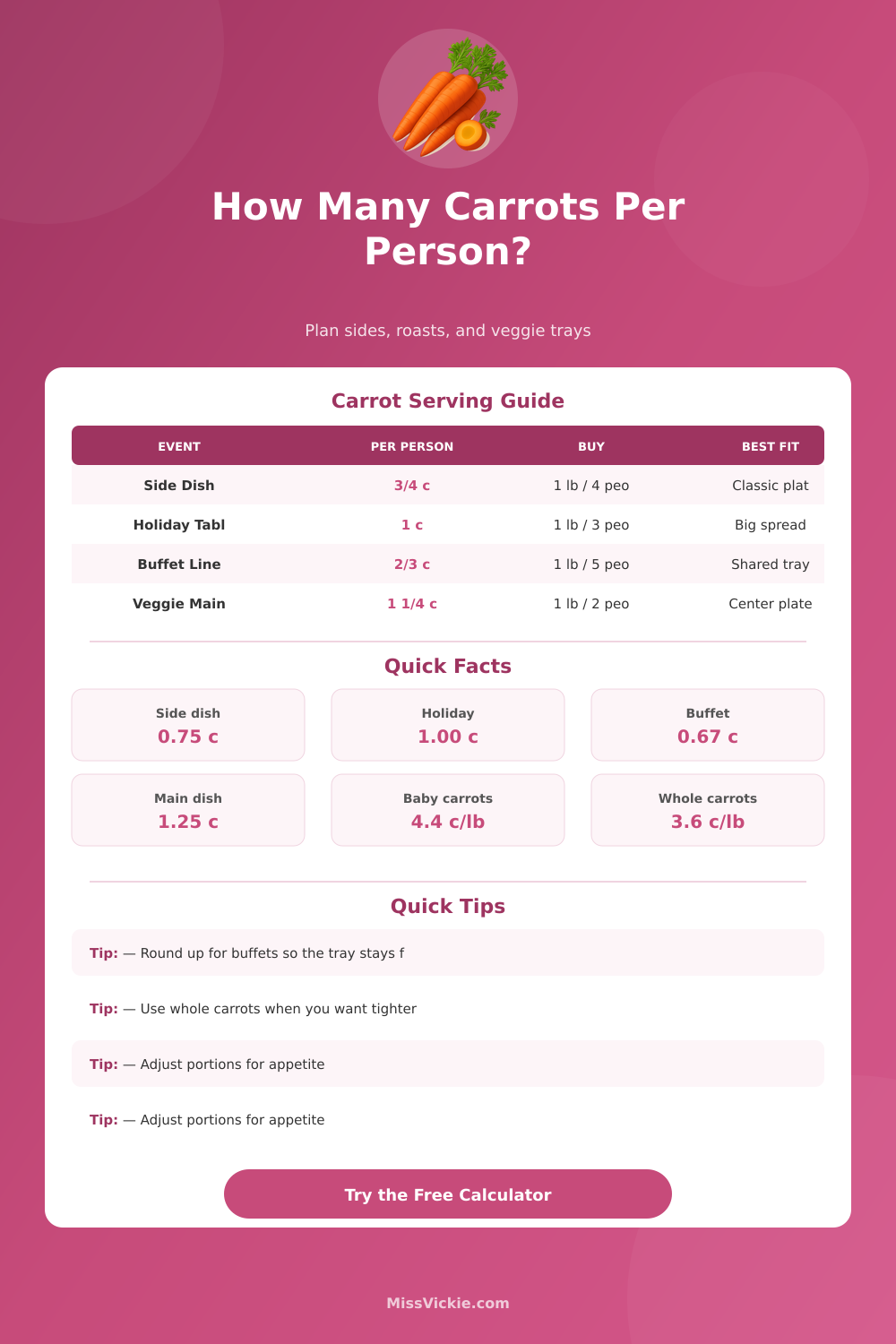
| Side Dish | 1/2 c | 3/4 c | 1 c |
| Holiday Table | 2/3 c | 1 c | 1 1/4 c |
| Buffet Line | 1/2 c | 2/3 c | 3/4 c |
| Veggie Main | 1 c | 1 1/4 c | 1 1/2 c |
| Form | Cups/Lb | Unit | Note |
|---|---|---|---|
| Baby Carrots | 4.4 | 1-lb bag | Fastest buy |
| Whole Carrots | 3.6 | 2-lb bunch | Tighter trim |
| Peeled Sticks | 4.1 | Snack pack | Ready to serve |
| Rainbow Carrots | 3.8 | 1-lb bag | Color mix |
| Guests | Side Buy | Main Buy | Notes |
|---|---|---|---|
| 10 Guests | 2.5-3.5 lb | 4-6 lb | Small dinner |
| 25 Guests | 6-8 lb | 11-15 lb | Medium buffet |
| 50 Guests | 11-14 lb | 21-28 lb | Large crowd |
| 100 Guests | 22-28 lb | 42-56 lb | Big event |
| Prep | Trim | Buffer | Best Fit |
|---|---|---|---|
| Sliced Coins | 8-10% | 6-8% | Classic side |
| Snack Sticks | 10-12% | 6-8% | Tray snack |
| Roasted Chunks | 12-15% | 8-12% | Hot buffet |
| Glazed Coins | 10-14% | 10-12% | Holiday menu |
In order to calculate the proper amount of carrot to feed a group of individuals, there are many different variable that must be considered. These variables include the number of individuals that will be attending the event, the way in which the cook will serve the carrots, and in what way the cook will prepare the carrots. Without accounting for these different variables, it is possible that there will be either too many carrots left over after all of the guest have eaten, or there will not be enough carrots for all of the guests to eat.
The amount of carrots that will be needed is dependent upon the way in which the cook will serve the carrots. For plated meals that include carrots as one of the side dish that is served to each guest, an individual will eat three-quarters of a cup of carrots. For holiday meals that include various other dishes in place of the carrots, each individual will eat one cup of carrots as the holiday meal will increase the appetite of the guests.
How Many Carrots to Buy for a Group
For buffet style meals, the amount of carrots that each individual will eat is thought to be two-thirds of a cup of carrots. This is due to the fact that guests have the ability to eat at their own pace at a buffet event. For meals in which carrots are to be the main vegetable dish, one and a quarter cup of carrots will be needed per person.
Beyond the way that the carrots are to be served, the appetite and the demographic of the individuals that will attend the event will also play a role in the amount of carrots that are required. For instance, individuals will have more eating desires at a tailgate event then they may have at a brunch event. Thus, more carrots will be required for a tailgate event.
Children will eat less than adults; therefore, the amount of carrots that must be bought for children would of been calculated as two-thirds the amount of the serving for an adult. Additionally, if there are many other side dishes that are to be served, individuals will eat fewer carrots. These other side dishes will take up the plate of the individuals.
The preparation of the carrots will also have an impact upon the amount of carrots that are required for the group. For instance, carrots that are to be served as carrot coin will cook even throughout the meal and will lose very little of their volume during the cooking of the meal. However, if the cook roasts the carrots prior to the meal, the carrots will lose some of their volume during the roasting process.
Additionally, if carrots are to be served as whole carrots, some of the carrots will be lost in the trimming of the carrots; whole carrots will lose ten percent of their total weight when they are trimmed to remove their tops and bottoms. Baby carrots lose very little in the trimming process as the carrots are already pre-trimmed and available in these forms. One pound of baby carrots yield four and a half cups of carrots.
One pound of whole carrots yields three and a half cup of carrots. When buying carrots for an event, it is also important to purchase some of the carrots with the group an expected amount of carrots will be eaten by the guests. This additional amount of food that is purchased is referred to as a buffer.
The buffer can be calculated at eight percent to ensure that the carrot pan are full and there are no leftovers. However, a larger buffer, such as twelve percent, may be purchased for an event that is to feature a large number of holiday guests. For instance, if an event is to feature twenty individuals that have standard appetite, the amount of baby carrots that should be purchased will be approximately five pound.
Twenty individuals that have hearty appetites and that will attend a holiday meal in which carrots are the main vegetable will require that the amount of carrots be doubled and that the buffer for the loss of carrots due to trimming is increase. Some of the most common mistake in purchasing the correct amount of carrots includes those that purchase the amount of carrots based off the size of the carrots that are observed. In many instances, the number of carrots that are bought does not account for the fact that children will eat less than adults.
Additionally, the number of carrots that are bought does not account for the fact that if there are other side dishes that are to be served, the number of carrots will be less. If there isnt enough of other side dishes, the carrots will be the primary food of the guests, and more carrots will need to be bought. Additionally, the way that the carrots are prepared should match the type of event at which the carrots are to be served.
For instance, carrot stick are best for casual events at which individuals are using their hands to eat the food, while carrot chunks are better for hot buffet lines at which the carrots will remain crisp.