🧴 Canning Calculator
Estimate jars, lids, processing time, salt, and sugar for your home canning project
Jams & Sauces
Veggies & Pickles
Fruits & Tomatoes
Juice Only
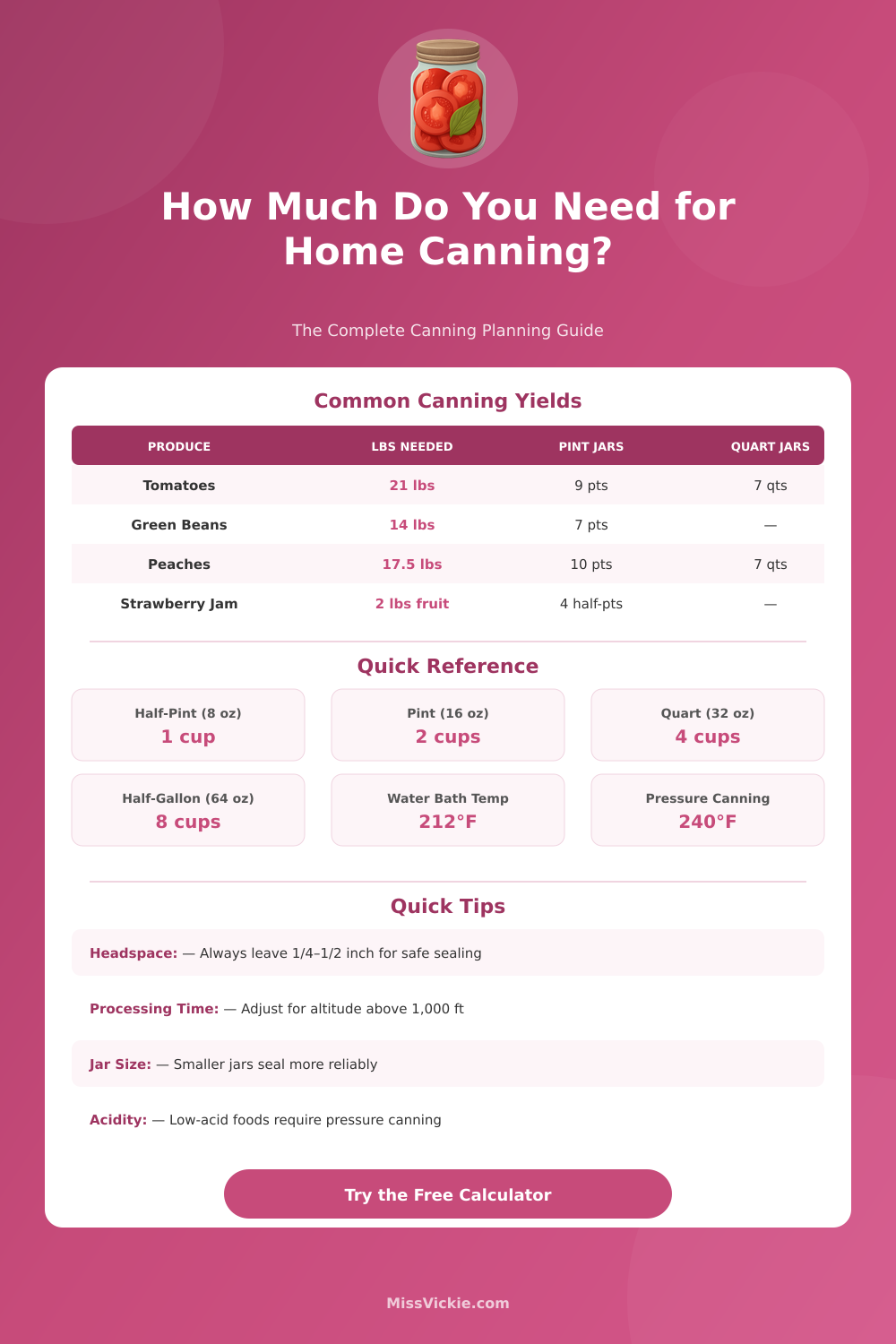
| Produce | Lbs for 7 Qts | Lbs for 9 Pts | Method |
|---|---|---|---|
| Tomatoes (whole) | 21 lbs | 13 lbs | Water Bath |
| Green Beans | 14 lbs | 9 lbs | Pressure |
| Peaches | 17.5 lbs | 11 lbs | Water Bath |
| Applesauce | 21 lbs | 13.5 lbs | Water Bath |
| Beets | 21 lbs | 13.5 lbs | Pressure |
| Sweet Corn | — | 20 lbs | Pressure |
| Dill Pickles | 14 lbs | 9 lbs | Water Bath |
| Pears | 17.5 lbs | 11 lbs | Water Bath |
| Food | Jar Size | Water Bath | Pressure (10 PSI) |
|---|---|---|---|
| Tomatoes | Pint | 35 min | 15 min |
| Tomatoes | Quart | 45 min | 15 min |
| Green Beans | Pint | N/A | 20 min |
| Green Beans | Quart | N/A | 25 min |
| Peaches | Pint | 20 min | N/A |
| Peaches | Quart | 25 min | N/A |
| Jam / Jelly | Half-Pint | 10 min | N/A |
| Pickles | Pint | 10 min | N/A |
| Altitude (ft) | Water Bath Add | Pressure Gauge (PSI) |
|---|---|---|
| 0 – 1,000 | +0 min | 10 PSI |
| 1,001 – 3,000 | +5 min | 11 PSI |
| 3,001 – 6,000 | +10 min | 12 PSI |
| 6,001 – 8,000 | +15 min | 13 PSI |
| 8,001 – 10,000 | +20 min | 14 PSI |
| Syrup Type | Sugar | Brix % | Best For |
|---|---|---|---|
| Very Light | 3/4 cup | 10% | Mildly sweet fruit |
| Light | 1.5 cups | 20% | Peaches, pears |
| Medium | 2.75 cups | 30% | Most fruits |
| Heavy | 4.25 cups | 40% | Tart fruit, cherries |
When talking about saving foods, canning already exists for many centuries. And that for good reason. It does help to protect the supply of foods closing them tightly in glass or metal containers and using heat to destroy the germs, that could cause decay or dangers for health.
After the food is ready and closed tightly in sealed tins, like Mason jars or metal cans, it can last quite a long time, usually from one to five years. A bit more than that, if the storage happens in good conditions.
How to Can Food Safely
Glass jars and metal cans work according to the same basic idea, so canning stays popular for both, even if one does not always use real tins. One closes the food tightly in that kind of container, one applies heat to remove rotting creatures and stop fermenting, and vacuum forms the closure. Same idea, but different forms.
There are two main ways to do that: canning in water bath and pressure canning. The water bath method is easy, just submerge the filled jars in hot water for a certain time. That kills bacteria and creates a vacuum closure inside.
It works well for foods with high acidity, for instance tomatoes. Even so, one must check, that the jars and seals are well cleaned, and that the jars themselves are fully covered. Saving tomatoes like this is fairly simple and calm, while one follows the recipe and adds lemon juice too strengthen the acidity.
A whole other case is the pressure canning. It alone reaches temperatures around 240°F, what is needed for safely saving foods with low acidity. The secret sits in the mix of heat and time, that destroys bacteria born by the food and seals everything well.
Foods with low acidity are dangerous, because they can cause botulism. Vegetables belong to that group, so unless one pickles them in vinegar, one needs a pressure canner and recipes, that already were tested and accepted.
The process itself is not complex. One puts the ready food in a clean jar, lays the flat seal and the ring for sealing, then puts the whole thing in hot water for the time, that the recipe points. The cooking times adjust a lot according to the kind of canning.
Before starting, one checks twice the type of their jars and prepares everything needed. One would want seals for one use with that slim rubber edge. To clean the jars, one boils them in water for about ten minutes.
Something to remember, when one buys the ingredients, take them fresh, as close as possible to the day of canning. Frozen or thawed products do not work, because the cold mixes with pectin and forms blocks or gel, that one does not want. Using tested recipes is not only for taste.
Those amounts of ingredients have their target. Bad prepared or stored bits can grow mold, fermentation or bad bacteria like botulism. If the jars do not close well, lay the content in the refrigerator, use it soon or redo with a new seal.
For the water bath canning, a big pot with heavy bottom, cover and stand for jars eases the work. Folded kitchen fabric on the botom of the pot also protects the jars. Other than that, a useful tool is a canning funnel, thatslips right into jars with little openings.