🐟 Protein in Canned Tuna Calculator
Calculate total protein from canned tuna by servings, cans, or daily goals — imperial & metric
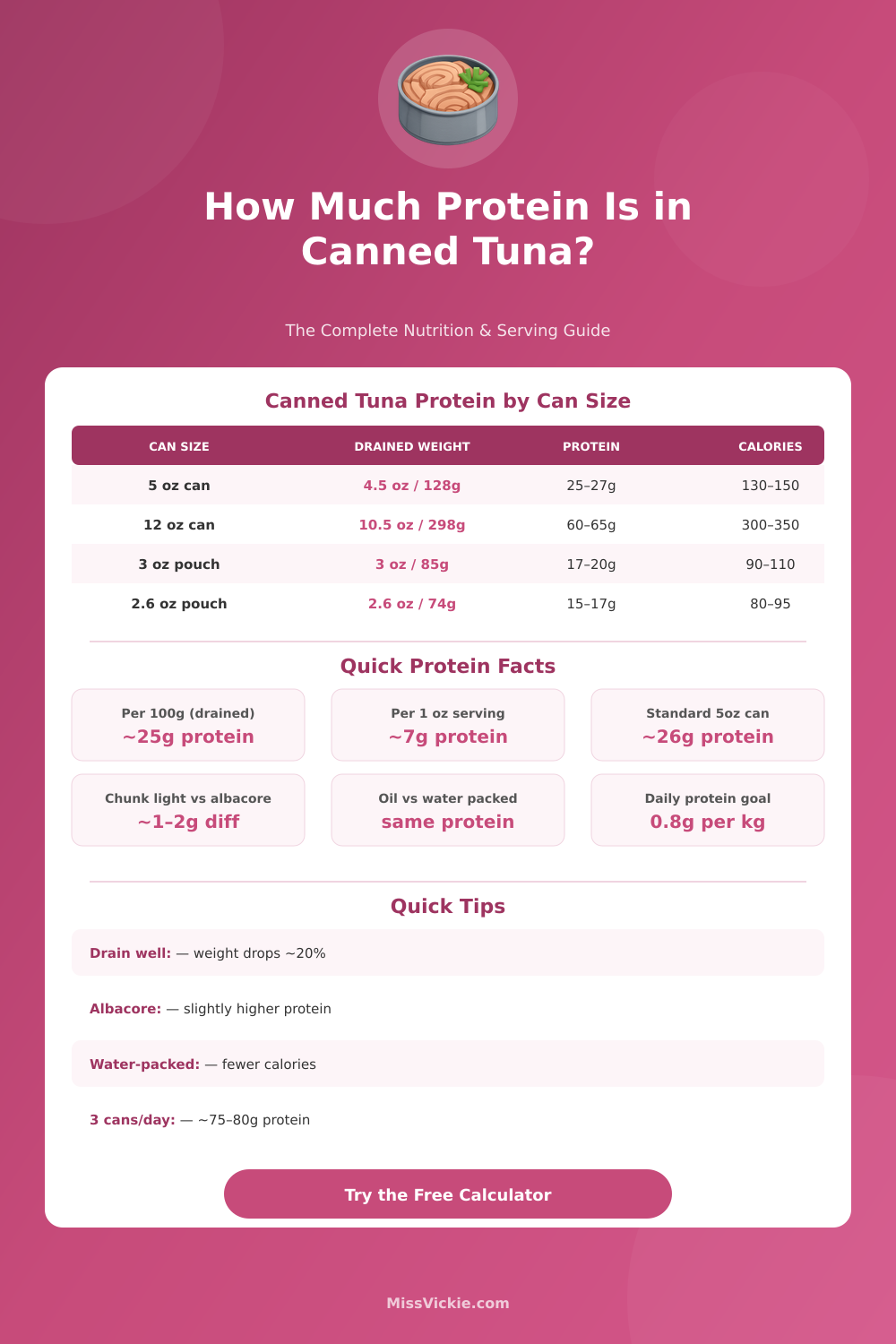
| Product / Can Size | Drained Wt (oz) | Drained Wt (g) | Protein (g) | Calories |
|---|---|---|---|---|
| Chunk Light in Water – 5 oz can | 4.5 oz | 128g | 26g | 130 |
| Albacore in Water – 5 oz can | 4.5 oz | 128g | 28g | 150 |
| Chunk Light in Oil – 5 oz can | 4.0 oz | 113g | 25g | 210 |
| Albacore in Oil – 5 oz can | 4.0 oz | 113g | 27g | 220 |
| Chunk Light in Water – 12 oz can | 10.5 oz | 298g | 62g | 310 |
| Albacore in Water – 12 oz can | 10.5 oz | 298g | 68g | 360 |
| Chunk Light – 3 oz pouch | 3.0 oz | 85g | 18g | 90 |
| Albacore – 3 oz pouch | 3.0 oz | 85g | 20g | 100 |
| Chunk Light – 2.6 oz snack pouch | 2.6 oz | 74g | 16g | 80 |
| Skipjack in Water – 5 oz can | 4.5 oz | 128g | 27g | 135 |
| Yellowfin in Water – 5 oz can | 4.5 oz | 128g | 29g | 140 |
| Weight (oz) | Weight (g) | Chunk Light (g protein) | Albacore (g protein) |
|---|---|---|---|
| 1 oz | 28g | ~6.5g | ~7.2g |
| 2 oz | 57g | ~13g | ~14.5g |
| 3 oz | 85g | ~18g | ~20g |
| 4 oz | 113g | ~22g | ~25g |
| 4.5 oz | 128g | ~26g | ~28g |
| 5 oz | 142g | ~28g | ~31g |
| 6 oz | 170g | ~33g | ~37g |
| 8 oz | 227g | ~44g | ~50g |
| 10 oz | 284g | ~55g | ~62g |
| 12 oz | 340g | ~62g | ~70g |
| Goal / Person Type | Daily Protein Target | Cans of Tuna Needed | Notes |
|---|---|---|---|
| Sedentary Adult | 50–60g | ~2 cans | 0.8g per kg body weight |
| Active Adult | 80–100g | ~3 cans | 1.0–1.2g per kg |
| Athlete / Weight Training | 130–180g | 4–6 cans | 1.6–2.2g per kg |
| Weight Loss (high protein) | 100–140g | 3–5 cans | Preserves muscle mass |
| Bodybuilder (heavy training) | 180–220g | 6–8 cans | 2.2g+ per kg |
| Senior (65+) | 70–90g | 2–3 cans | 1.0–1.2g per kg |
Canned tuna ranks among those foods that genuinely simplify everyday life. It offers fast and simple dinner when you lack time, energy or money. Fully ready for use, it can be eaten directly from the tin.
In the process of canning the tuna cooks twice: once before closing it and later again after sealing. That heat under high pressure reaches temperatures that surpass what average home kitchens reach.
Canned Tuna: What It Is and How to Use It
One can choose between various kinds. Chunk light tuna mostly carries bigger bits, thanks to the strong packing in the tin. Usually the canned tuna comes from albacore, on the other hand fresh tuna commonly is bigeye, yellowfin or bluefin.
Some brands offer also yellowfin in tins, occasionally called mainstream round style. Solid white albacore usually costs more than the chunk light.
The canned tuna is filled with water or with oil. Preference for the water-filled version depends on the wanted texture. For oil-filled one uses vegetable oil, that stays almost plain, or olive oil, that gives delicious flavor that can match or even compete with the other ingredients.
Blocks of tuna in oil most commonly cost more, because the ratio between fish and liquid is more favorable.
Good brand canned tuna well reaches the balance between quality and price, sometimes only too dollars for a tin. It commonly is cheaper than canned salmon, for instance a tin of light tuna costs around one to two dollars, while salmon goes from three to five. One brand openly tests every tuna for mercury and declares it the lowest among all brands.
Talking about mercury, the chunk light tuna has relatively little. Consumption of albacore one should limit to around one four-ounce serving each week. Too much tuna eaten over long time can create health troubles.
Early signs of mercury problems are also numbness in the fingers.
Canned tuna works well in many meals. Classic is the tuna salad, mixed with mayo, mustard, celery, onion, salt, pepper and lemon. For a lighter version one can use Greek yoghurt instead of mayo.
Classic is tuna on toasted English muffin half, covered with cheese. Patties from tuna, sandwich with tuna and spaghetti with tuna all are reliable ideas. Tuna and potatoes agree well, and chickpeas can replace breadcrumbs as a binder in tuna cakes.
Tomatoes add to canned tuna their sweet and bitter juice to liven it. Even one can toss it in a dish of ramen or ricenoodles.
Canned tuna in the long term lasts. If the tin stays undamaged and kept in a cool place, the contents stay safe during years, even decades after the date on the label. Omega-3 fatty acids form an important benefit, because the body does not produce them.
Two of the three mainstream omega-3 types usually locate in fish like canned tuna.