Pork loin cure math
Canadian Bacon Cure Calculator
Calculate Cure #1 ppm, added salt, sugar, maple syrup, wet brine water, injection pump, cure days by loin diameter, smoke loss, cooked weight, and slice yield for pork loin Canadian bacon.
Important: Cure #1 is assumed to contain 6.25% sodium nitrite. Use an accurate gram scale and follow your local food safety rules for curing, cooking, chilling, and storage.
Measured in grams.
Cure salt carrier subtracted.
Sweetener by cure basis.
Wet brine and injection plan.
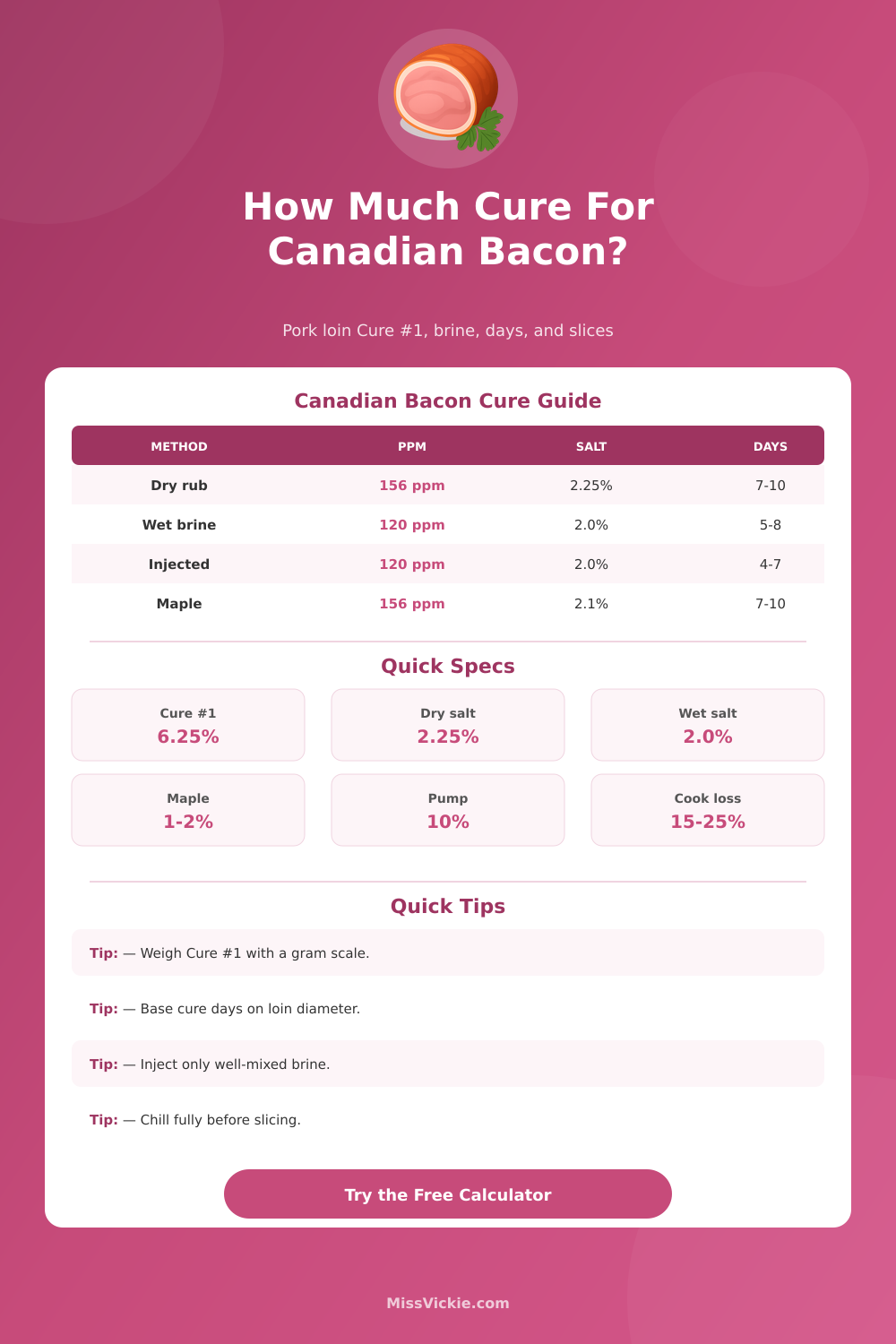
| Method | Cure Basis | Typical PPM | Best For Pork Loin |
|---|---|---|---|
| Dry cure / bag cure | Trimmed loin weight only | 120-156 ppm, never above 200 ppm in this calculator | Firm slices, lower water, clear maple or pepper crust |
| Wet equilibrium brine | Loin plus brine water | 100-156 ppm depending on your formula target | Even seasoning with a covered pork loin roast |
| Injected wet brine | Loin plus brine water, then pumped by weight | Usually set lower, often around 120 ppm | Thicker loin sections where center color matters |
| Sweet maple cure | Same as dry or wet method selected | Match method target, not sweetness level | Breakfast slices, sandwiches, and pan browning |
| Loin Diameter | Dry Cure Days | Wet Brine Days | Injected Wet Days |
|---|---|---|---|
| 2.5 in / 6.4 cm | 7 days | 6 days | 5 days |
| 3 in / 7.6 cm | 8 days | 7 days | 5-6 days |
| 3.5 in / 8.9 cm | 9 days | 8 days | 6 days |
| 4 in / 10.2 cm | 10 days | 8-9 days | 7 days |
| 4.5 in / 11.4 cm | 11 days | 9 days | 7-8 days |
| Finished Style | Cook Loss Range | Slice Thickness | Yield Note |
|---|---|---|---|
| Light smoke, gentle finish | 12-16% | 1/16 in / 1.5 mm | More slices, delicate texture |
| Classic breakfast Canadian bacon | 18-22% | 0.08 in / 2 mm | Balanced pan slices |
| Firm deli-style loin | 22-28% | 1/8 in / 3 mm | Fewer slices, stronger bite |
| Thick sandwich medallions | 18-25% | 3/16 in / 5 mm | Heavier portions per slice |
| Trimmed Loin | Dry Cure #1 at 156 ppm | 2.25% Total Salt | Approx Cooked Yield |
|---|---|---|---|
| 2 lb / 0.91 kg | 2.27 g Cure #1 | 20.4 g total salt basis | 1.6 lb after 20% loss |
| 3 lb / 1.36 kg | 3.40 g Cure #1 | 30.6 g total salt basis | 2.4 lb after 20% loss |
| 4 lb / 1.81 kg | 4.53 g Cure #1 | 40.8 g total salt basis | 3.2 lb after 20% loss |
| 5 lb / 2.27 kg | 5.66 g Cure #1 | 51.0 g total salt basis | 4.0 lb after 20% loss |
| 8 lb / 3.63 kg | 9.06 g Cure #1 | 81.6 g total salt basis | 6.4 lb after 20% loss |
Home-made Canadian bacon is a careful process; it require specific measures. Pork loins are not bellies, and the math applies. It is no good if there is too much salt on the outside and to little inside. It is no good.
To get it right, you need a calculator: Enter size of the loin (diameter), its weight, and desired cooking method. It will tell you which amounts of ingredients (sugar, salt, maple syrup, and Cure #1) to use, and how long it needs to rest in a brine to be properly cooked or smoked. And none of these are random numbers.
Why You Need a Calculator for Bacon
Cure time depend on how wide the loins are (keep in mind that the thickest part is deepest inside). Even two loins of equal weight, say, a 4.5-incher and a 3-incher. Will require distinct schedules. For dry-cured meats, the weight of meat is all that factors in. With wet brines, there’s also water involved; that brings down the actual concentration of nitrites somewhat. If your thick cut were injected with brine, this speeds up process overall…but then you have to make certain that solution gets distributed evenly through entire piece.
The second choice point is amount of salt in recipe. You want most to be about 2 percent salt after taking out the amount of Cure #1. This is the right amount of seasoning, and it ensures that final slices don’t taste like deli ham. Maple syrup/sugar are more about flavor then they are about safety. Dial up or down depending on what sounds best to you. Do you want a sweeter breakfast or something slightly less sweet that is more like sandwich meat? The calculator keeps the nitrite level the same as you change sweetness.
After curing, it’s all about weight loss and how many slices you get. If your loins goes into the smoker or oven, you’ll lose anywhere from 15 (25 percent of that loin). That alters the number of actual slice that come off of a loaf. If you know what cooked weight will be, you can determine whether you have enough for weekend of bacon and egg breakfasts. Or whether you should of cure two loins. And you won’t make the typical error of slicing too thick and running out of portions sooner than expected.
No matter how you do it, follow safe practices. Use a scale with at least one-tenth-gram precision. Cook to appropriate temperatures and chill quickly after cooking. Cool during curing. Those are the things the calculator can’t do for you. It simply takes out all guesswork in terms of time and amounts. That lets you pay more attention to what really needs your attention.
But here’s where running the numbers comes in: It makes things consistent. Now that you have your 3.5-inch-diameter, 4-pound loin and concentration is 156 parts per million, you can make another batch. And make adjustments accordingly without having to start from square one. That predictability transforms a once-in-a-while thing into something you can rely on every week when you’re prepping meals.