Calories, grams, macros, servings, food mixes, alcohol, and label context
Calorie to Gram Converter
Convert calories into grams for protein, carbs, fat, alcohol, or a mixed food pattern while scaling servings and checking how label context changes the result.
Load a common nutrition-label or meal scenario, then adjust calories, servings, macro type, food mix, and label context.
Calorie to Gram Breakdown
| Component | Calories | Grams | Formula |
|---|
Use for meat, dairy, tofu, beans, protein powders, and macro targets.
Use for starch, sugar, fruit, grain foods, and most carb-counting labels.
Use for oil, butter, nuts, seeds, avocado, cheese, and rich sauces.
Use for ethanol calories in wine, beer, spirits, liqueurs, and cocktails.
| Macro Type | Calories Per Gram | Gram Formula | Best Use |
|---|---|---|---|
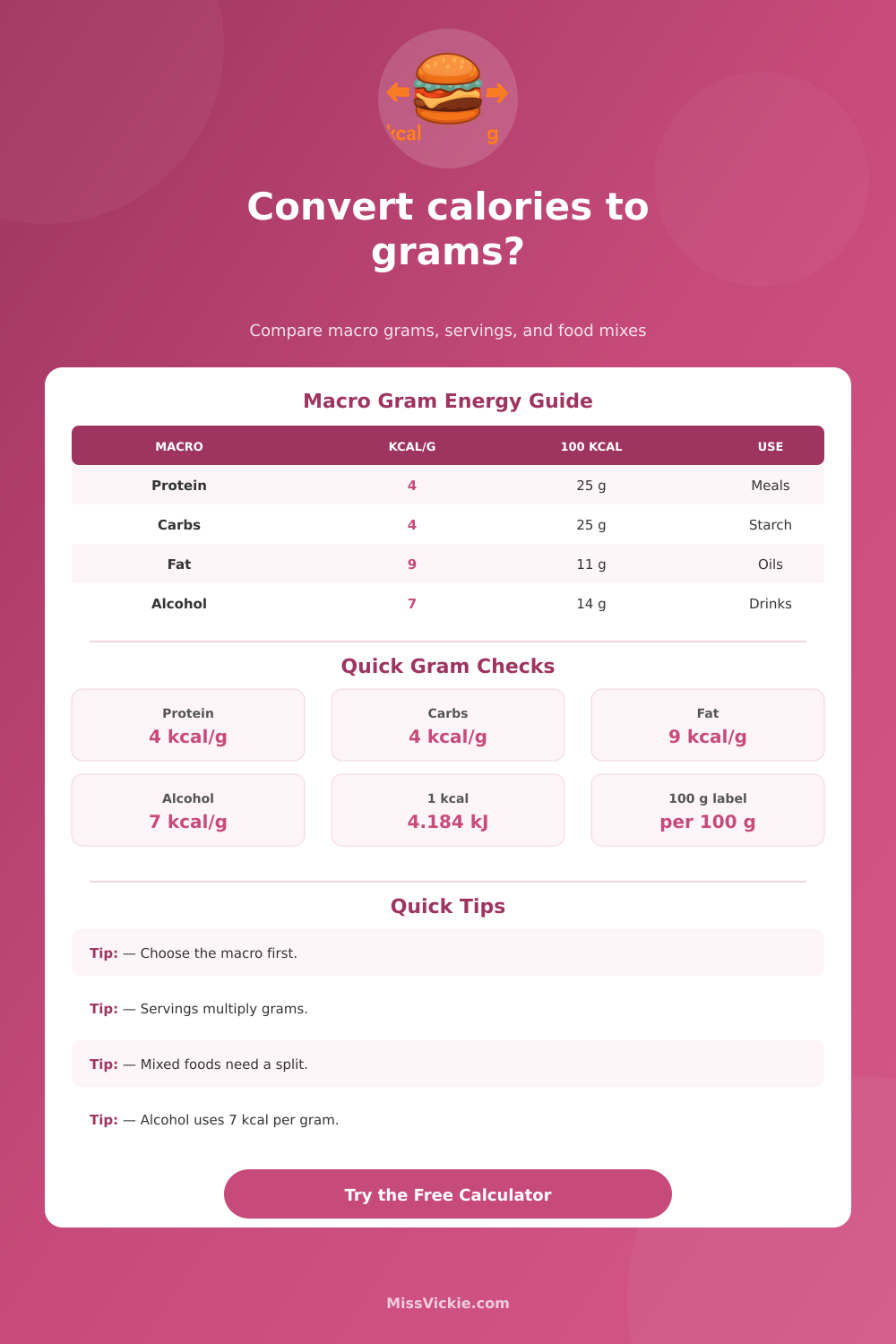
| Protein | 4 kcal per g | calories divided by 4 | Lean meat, eggs, dairy, tofu, beans, protein powders. |
| Carbohydrate | 4 kcal per g | calories divided by 4 | Rice, pasta, bread, fruit, sugar, starch, snack labels. |
| Fat | 9 kcal per g | calories divided by 9 | Oil, butter, nuts, seeds, avocado, sauces, cheese. |
| Alcohol | 7 kcal per g | calories divided by 7 | Ethanol in wine, beer, spirits, seltzers, and cocktails. |
| Fiber option | 0 to 2 kcal per g | depends on label rule | Use only when comparing fiber-heavy or net-carb labels. |
| Calorie Target | Protein Grams | Carb Grams | Fat Grams |
|---|---|---|---|
| 50 kcal | 12.5 g | 12.5 g | 5.6 g |
| 100 kcal | 25 g | 25 g | 11.1 g |
| 150 kcal | 37.5 g | 37.5 g | 16.7 g |
| 250 kcal | 62.5 g | 62.5 g | 27.8 g |
| 500 kcal | 125 g | 125 g | 55.6 g |
| Food Mix | Typical Calorie Split | Approx Food Density | Planning Note |
|---|---|---|---|
| Lean protein meal | 55% protein, 20% carbs, 25% fat | 160 kcal per 100 g | Water in cooked foods means food weight exceeds macro grams. |
| Starchy side | 10% protein, 80% carbs, 10% fat | 130 kcal per 100 g | Cooked rice and pasta carry substantial water weight. |
| Cereal or snack bar | 8% protein, 70% carbs, 22% fat | 380 kcal per 100 g | Dry packaged snacks sit much closer to macro gram weight. |
| Nuts or rich spread | 8% protein, 12% carbs, 80% fat | 600 kcal per 100 g | Fat-heavy foods need fewer grams for the same calories. |
| Alcoholic drink | 0% protein, 20% carbs, 80% alcohol | 110 kcal per 100 g | Finished drink weight includes water, ice melt, and mixers. |
| Label Context | Energy Display | Calculator Handling | Rounding Note |
|---|---|---|---|
| US Nutrition Facts | Calories | Uses kcal and shows label-friendly gram rounding. | Calories may be rounded to 5 or 10. |
| EU / UK label | kJ and kcal | Converts kJ to kcal before grams. | Energy may be shown per 100 g and per portion. |
| Australia / NZ label | kJ first | Uses kilojoules first, then kcal and grams. | kJ is the everyday front label unit. |
| Recipe analysis | Calculated kcal | Keeps precise decimals before serving scaling. | Useful before nutrition-label rounding. |
| Drink context | Alcohol plus mixers | Uses 7 kcal/g for alcohol and 4 kcal/g for sugar carbs. | Finished drink grams are not ethanol grams. |
Reference values use common Atwater factors: protein 4 kcal/g, carbohydrate 4 kcal/g, fat 9 kcal/g, and alcohol 7 kcal/g. Packaged labels may round before printing.
A nutrition label will provides the calories for a food product. However, the calorie count will not provide a specific weights for that food product because the weight of the food product will depend on the macronutrient contained within that food. For instance, 200 calories will not necessarily equal 50 grams of foods because the food may contain more fat grams than protein or carbohydrate gram.
The energy density for macronutrients is the amount of energy that an individual get from a specific weight of that macronutrient. Protein and carbohydrates contains 4 calories per gram. Fat contains 9 calorie per gram.
How to Convert Calories to Grams
Alcohol contains 7 calories per gram. Because fat contains more calories per gram then protein and carbohydrates, fat is more energy-dense than protein and carbohydrates. Therefore, 200 calories of fat will not equal the same numbers of grams as 200 calories of protein and carbohydrates.
The macronutrient converter allow an individual to first select the macronutrient that they is interested in. The reason that the macronutrient should be selected first is to make it easier to understand the calculation for that specific macronutrient. If the calories is selected without first selecting the macronutrient, the calculation will not take into account the energy density of the macronutrient.
For instance, 200 calories of protein will equal 50 grams of protein but only 22 grams of fat. These different value for the same calorie amount allows individuals to understand the energy density of the macronutrients and how this affect the weight of the food product. The nutrition labels for food products and the macronutrient converter may differ because of the labeling convention for the different regions of the world.
For instance, the nutrition label for a food product in the United States will round the calories to the nearest five or ten. In addition, the nutrition label for products in Europe and Australia will use kilojoules instead of calorie. To ensure that the gram calculations are accurate, the macronutrient converter allows individuals to adjust the settings to the labeling convention for the region in which the individual live.
Accuracy in the measurement is important when comparing the calories of a packaged food product to the calories of food products that are cooked at home. Many food products contains a mix of macronutrients. These foods, referred to as mixed food, will not contain only protein or carbohydrates.
Therefore, the macronutrient converter must account for the different type of macronutrients contained in the food product. The converter includes preset mix of food that can help you determine the macronutrient split that should be used for a meal that contains that type of food. For instance, meals that are high in protein will have a different macronutrient split then meals that are high in carbohydrates.
The share field for each macronutrient can be used to adjust for the actual macronutrient split of the specific meal of food being prepared. The density of the food can impact the total weight that the food contain. Foods that contain water will weigh more then foods that do not contain water.
For instance, cooked rice and cooked pasta will weigh more than protein, carbohydrates, and fats alone would suggest due to the water content in those foods. Foods that are high in fat, like nut or oils, will weigh less for a given number of calories. The density setting in the converter ensure that the total number of grams calculated for the food is accurate to the type of food being prepared.
The carbohydrate count for the food can impact the total number of grams of carbohydrates that is calculated for the food. Some nutrition label state that fiber contains 2 calories per gram of fiber, while other nutrition label state that fiber contains 0 calories per gram of fiber. It is important to ensure that the converter calculates the correct number of grams of carbohydrates.
While the difference in calories from fiber may seem small for a single serving of food, the difference can be more significant for large batch of food. Alcohol contains 7 calories per gram of alcohol, but does not contain the vitamin and fiber that other macronutrients contain. When calculating alcohol, the total weight of the drink account for water and other mixer, but the calorie count is only for the ethanol in the drink.
The alcohol mode in the converter ensure that the calories from alcohol are not mistaken for the calories from carbohydrates or protein. The total number of calories for the food is only a starting point for calculating the weight of the food. You must identify the dominant macronutrient in the food, the number of serving to be prepared must be accounted for, and the density of the food must be considered to find the total correct weight of the food.
The converter can calculate the math for you, but you must provide the correct macronutrient and density information for the converter to calculate the total grams of the food correctly.