
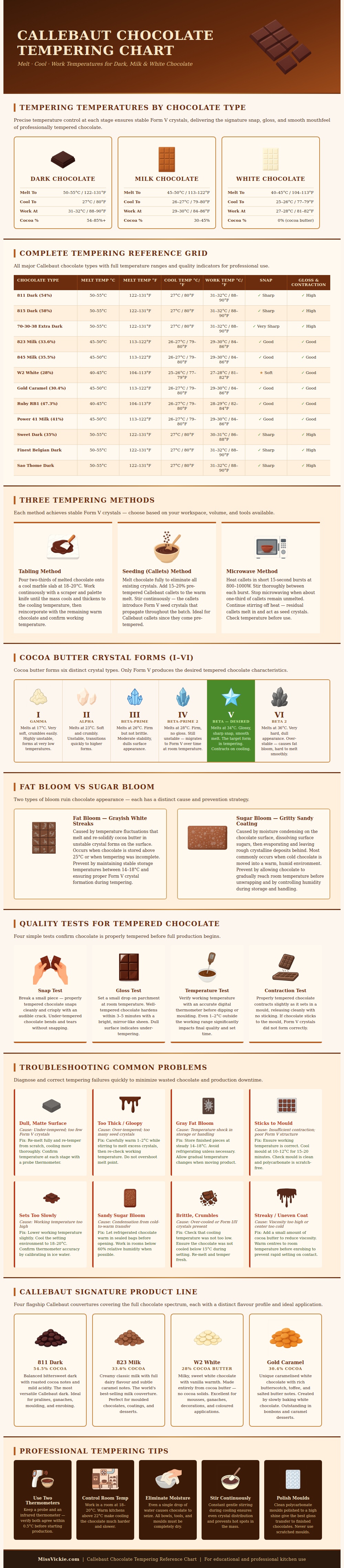
Tempering are the process of heating and cooling chocolate to obtain specific forms of cocoa butter crystals. Chocolate contain cocoa butter, an fat that can form six different types of crystals according to teh temperature of the chocolate. All but one of these types of cocoa butter crystals is useless in the formation of chocolate that set well.
Specifically, cocoa butter crystals must be allowed to form in the fifth form, which result in chocolate that has a glossy shine, readily snap when broken, melts at body temperature, and readily releases from mold. To temper chocolate, it is necessary to heat and cool the chocolate to specific temperature range. Not all types of chocolate require the same temperature for setting.
How to Temper Chocolate
For instance, chocolate that contains more cocoa require higher temperatures. Dark chocolate should be melted to between 50 and 55 degrees Celsius, then cooled to 27 degrees Celsius, and used between 31 and 32 degrees Celsius. Milk chocolate, which contains less cocoa than dark chocolate, should be melted to between 45 and 50 degrees Celsius, cooled to 26 or 27 degrees Celsius, and used between 29 and 30 degrees Celsius.
White chocolate, which also contains milk solids and sugar, is the most delicat of chocolate type and requires the lowest temperatures. White chocolate should be melted between 40 and 45 degrees Celsius and used between 27 and 28 degrees Celsius. There are a few method that can be used to temper chocolate.
One method is the tabling method, wherein you evenly spread two-thirds of the melted chocolate onto a cool marble slab. A scraper is used to ensure the chocolate is well worked until it thicken. Once thickened, the chocolate is folded into the remaining melted chocolate.
Another method is the seeding method, wherein you melt all of the chocolate and add 15 to 20 percent of the chocolate that has not been melted. These unmelted chocolate pieces will provide the necessary Form V cocoa butter crystals to the melted chocolate. Lastly, chocolate can be melted in the microwave in short burst.
During each brief heating period, you should stir the chocolate until one-third of the chocolate is solid. These solid chocolate pieces will act as a seed for the melted chocolate. After tempering the chocolate, it is necessary to test the chocolate to ensure that the process was successful.
A small portion of the tempered chocolate can be dropped onto parchment paper. Properly tempered chocolate will harden in three to five minutes and have a mirror shine when complete. Additionally, you should snap a piece of chocolate; properly tempered chocolate will fracture along a clean crack.
The candy thermometer should be placed into the chocolate to ensure that the chocolate is within its correct working temperature. Properly tempered chocolate will slightly shrink as it set, which allow the chocolate to pop out of molds. In the case that the chocolate does not appear correct after the described process, you must find the cause of the chocolate’s poor tempering.
If the chocolate does not appear to have a shine to its surface, the chocolate is under-tempered and need to be remelted and cooled again. If the chocolate appears to be thick and gloopy, the chocolate may have been over-seeded, and the temperature of the chocolate need to be increased by a few degree. Fat bloom occur when gray streaks appear on the chocolate.
Fat bloom is caused by temperature swings in the chocolate that allow the cocoa butter to form unstable cocoa butter crystals. Fat bloom can be prevented by storing the chocolate between 14 and 18 degrees Celsius. Sugar bloom occur when the chocolate appears to have a gritty coating.
This is caused by condensation between warm chocolate and cold air. The environment in which the chocolate is tempered is important. The room should be dry and between 18 and 20 degrees Celsius; warmer temperatures will make it difficult to cool the chocolate properly.
All tool must be dry, as any contact between chocolate and water will cause the chocolate to seize. Additionally, you should stir the chocolate during the process to even out the temperature. All thermometer should be calibrated using ice water.
Finally, you should polish the molds to allow the chocolate to set and gain a shine to the molds during the setting process.