Cake Weight Calculator
Estimate the finished weight of a layer cake, sheet cake, or tall tier from pan size, batter density, frosting load, filling, servings, and trimming loss.
Pick a real baking scenario, then adjust the pan, layers, frosting, filling, or trim loss to match your cake plan.
Weight Breakdown
Raw batter density used for the selected cake style.
Estimated moisture loss from batter to cooled cake.
Baked volume compared with raw batter volume.
Frosting weight changes with top and side area.
These cards compare the same cake with lighter or heavier finishes so you can see how frosting choice changes the finished weight.
| Batter style | Raw density | Typical bake loss | Best weight use |
|---|---|---|---|
| Vanilla or butter cake | 240 g per cup | 10% | Everyday layer cakes with buttercream |
| Chocolate cake | 250 g per cup | 12% | Moist layers, cocoa batters, birthday cakes |
| Sponge or chiffon | 205 g per cup | 14% | Light cakes where volume is high but weight is lower |
| Pound cake | 265 g per cup | 8% | Dense tiers, loaf cakes, carving bases |
| Carrot or fruit cake | 275 g per cup | 9% | Heavy mix-in batters and rustic celebration cakes |
| Cheesecake layer | 285 g per cup | 6% | Dense chilled layers with low rise and high weight |
| Finish | Top load | Side load | Typical result |
|---|---|---|---|
| Naked or semi-naked | 0.04 oz per sq in | 0.025 oz per sq in | Lightest finished weight, visible cake edges |
| Thin buttercream coat | 0.07 oz per sq in | 0.045 oz per sq in | Simple home layer cake with a tidy finish |
| Classic buttercream | 0.10 oz per sq in | 0.065 oz per sq in | Standard birthday cake coverage and borders |
| Thick decorated buttercream | 0.14 oz per sq in | 0.090 oz per sq in | Tall sides, rosettes, extra piping, heavy finish |
| Ganache finish | 0.09 oz per sq in | 0.065 oz per sq in | Smooth dense coating with moderate side weight |
| Fondant over buttercream | 0.12 oz per sq in | 0.085 oz per sq in | Heavier wedding-style exterior over a crumb coat |
| Cake size | Layers | Serving range | Finished weight range |
|---|---|---|---|
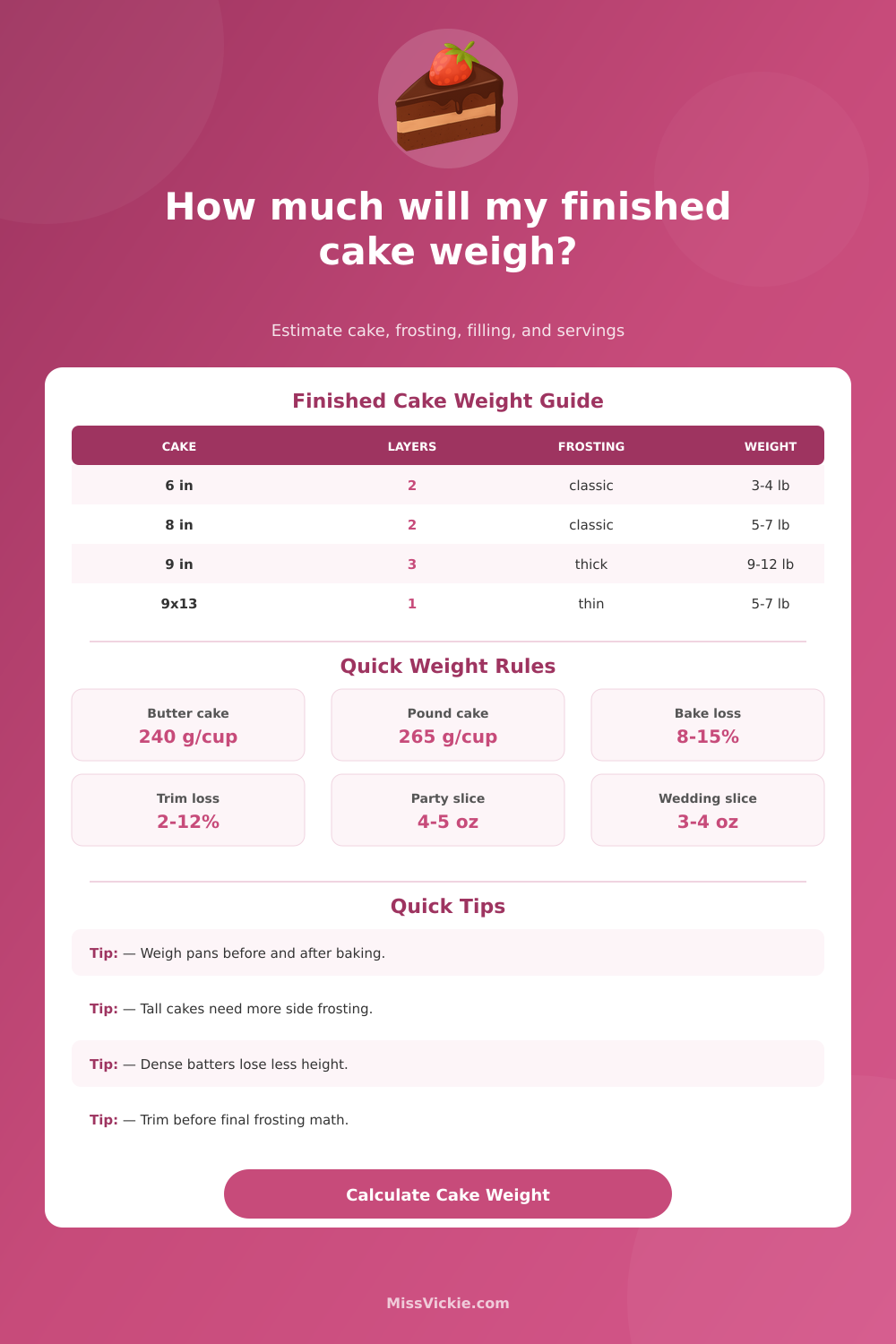
| 6 inch round | 2 to 3 | 8 to 14 servings | 3 to 5 lb with classic frosting |
| 8 inch round | 2 to 3 | 14 to 28 servings | 5 to 9 lb with filling |
| 9 inch round | 2 to 4 | 22 to 38 servings | 7 to 13 lb depending on height |
| 10 inch round | 2 to 4 | 30 to 50 servings | 10 to 18 lb for decorated tiers |
| 9x13 sheet | 1 to 2 | 20 to 35 servings | 5 to 10 lb with thin or classic frosting |
| Quarter sheet | 1 to 2 | 30 to 48 servings | 8 to 15 lb depending on thickness |
| Slice style | Usual slice weight | Trim allowance | Planning note |
|---|---|---|---|
| Wedding coffee slice | 3 to 4 oz | 2% to 5% | Good for tall tiers and formal portions |
| Party dessert slice | 4 to 5 oz | 4% to 8% | Useful for birthdays and casual gatherings |
| Large home slice | 5 to 6 oz | 5% to 10% | Better when guests expect generous pieces |
| Carved shape cake | 4 to 6 oz | 10% to 20% | Carving removes more cake before frosting |
| Sheet cake square | 3.5 to 5 oz | 2% to 6% | Efficient cuts usually reduce waste |
| Stacked transport cake | 4 to 5 oz | 5% to 12% | Add carrier capacity for boards and supports |
Cake weight are an important measurement in the baking of cakes. The weight of the cake will determine how you have to move the cake and how many person the cake will feed. Additionally, the weight of the cake will determine if a cake board will be strong enough to hold the weight of the cake.
The weight of a cake is influenced by the weight of the cake layer, the weight of the frosting, the weight of the filling, and the weight of the decorations. To calculate the weight of the cake, several different input are asked of the baker. For instance, the size of the cake pan, the number of layers, the type of batter, the style of frosting, the type of cake filling, the number of servings that is to be prepared, and the trim loss will all influence the weight of the cake.
How to Calculate a Cake’s Weight
For instance, if the recipe use a dense pound cake batter, it will weigh more than a cake that uses a light sponge cake batter. Another factor in the calculation of the weight of the cake is the bake loss of the cake. Bake loss occur during the baking of the cake.
Because of the baking process, some of the moisture in the cake will be lost. Recipes contain different amounts of bake loss than other recipes due to the difference in ingredients in each cake recipe. For instance, cakes that contain more sugar will lose less moisture during the baking process then cakes that contain more eggs and less sugar.
The cake weight calculator accounts for bake loss by applying different percentage to the weight of the cake based on the style of cake that is to be prepared. The weight of the frosting and the cake filling will add to the total weight of the cake. For instance, if the cake is to be finished in a naked or semi naked fashion, the cake will weigh less than if it was to be frosted in a classic buttercream fashion.
Classic buttercream will add to the total weight of the cake. Additionally, decorations made of thick fondant will add to the total weight of the cake. Additionally, the type of filling will add to the total weight of the cake, but the weight of the filling will be within the layers of the cake rather than the outside of the cake layers.
The cake weight calculator separate the weight of the cake from the weight of the frosting and the weight of the filling. The trim loss of the cake is another factor in the determination of the total weight of the cake. Trim loss is the weight of the cake that will be lost when cutting the cake.
For instance, if the cake contains a domed top to the cake, the weight of that domed top will be lost. Additionally, if the cake is carved in some way, that weight is also lost. Carved cakes and cakes that are tall and stacked will have a higher trim loss percentage than simple round cake that only require a level top to the cake.
The target weight for the servings of the cake will influence the weight calculations that are performed. For instance, if the target weight of the servings is to be large in weight, then that cake will contain fewer servings than if the target weight is to be small in weight. The calculator will provide the average weight of each serving of the cake, as well as the total number of servings that the cake will contain.
Due to the different variables in the baking process, it is likely that the weight of the baked cake will be different from that calculated by the cake calculator. For instance, the evenness of the heat within the oven will influence the bake loss of the cake. The humidity within the kitchen will also influence the bake loss of the cake.
Additionally, the brands of the baking ingredients can alter the weight of the batter that is used in the cake recipe. Thus, the actual weight of the cake may weigh more differently from the estimated weight. However, the cake calculator will still provide a reliable estimate for the weight of the cake if the baker maintains the same process in the kitchen.
To increase the accuracy of the weight calculations, it is possible for the baker to weigh the layers of the cake before the frosting is applied. By weighing these layers before they are frosted and keeping a record of the weight, the baker can determine if trim loss for those cakes is higher or lower than that which is estimated by the cake calculator. The weight of the cake is also important in relation to the movement and display of the cake.
For instance, if the cake is particularly heavy, it will require a strong cake board to hold the weight of the cake, as well as two person to carry the cake. The cake calculator will indicate the weight capacity of the carrier so that the baker can account for the weight of the cake board and any additional decoration of the cake. Thus, calculating the weight of the cake will allow the baker to plan for the weight of the cake effectively.
By calculating the weight of the cake, the baker will be able to determine the weight of the cake before the cake is finished baking. By knowing the weight of the cake that will be produced by the recipe, the baker can select a lighter frosting or filling for the cake that will allow the cake to reach the desired weight. Thus, calculating the weight of the cake will allow the baker to plan for the weight of the cake effectively.