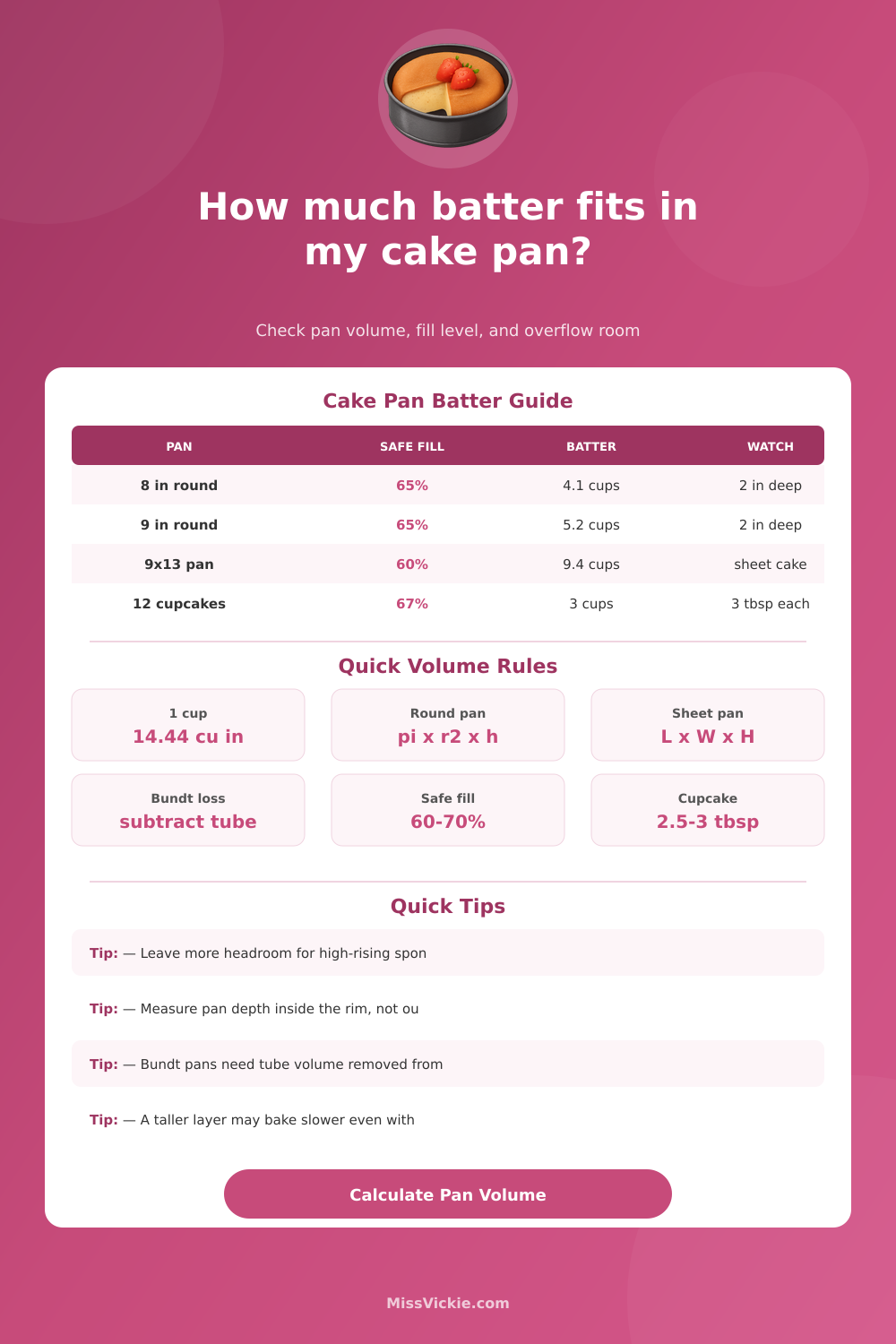
Cake Pan Volume Calculator
Estimate true pan capacity, safe batter fill, baked layer height, and overflow margin from pan geometry instead of only swapping one pan size for another.
Choose a named baking scenario, then adjust any dimension. These presets are volume-first: they load shape, depth, fill percent, rise behavior, and material response.
Full Volume Breakdown
| Round pan | 2 in capacity | 65% fill | 70% fill | Best use |
|---|---|---|---|---|
| 6 inch round | 3.9 cups | 2.6 cups | 2.7 cups | Small layer or smash cake |
| 8 inch round | 7.0 cups | 4.5 cups | 4.9 cups | Classic two-layer cake |
| 9 inch round | 8.8 cups | 5.7 cups | 6.2 cups | Roomier family layer |
| 10 inch round | 10.9 cups | 7.1 cups | 7.6 cups | Party tier or single layer |
| 12 inch round | 15.7 cups | 10.2 cups | 11.0 cups | Wide tier with lower center risk |
| Pan | Inside depth | Capacity | 60% fill | Volume note |
|---|---|---|---|---|
| 8 inch square | 2 in | 8.9 cups | 5.3 cups | More capacity than an 8 inch round |
| 9 inch square | 2 in | 11.2 cups | 6.7 cups | Good for thick coffee cakes |
| 7x11 inch pan | 2 in | 10.7 cups | 6.4 cups | Compact sheet cake size |
| 9x13 inch pan | 2 in | 16.2 cups | 9.7 cups | Standard rectangle party pan |
| 11x15 inch pan | 2 in | 22.9 cups | 13.7 cups | Large sheet cake batter load |
| Pan style | Typical measure | Estimated capacity | Safe batter | Why it differs |
|---|---|---|---|---|
| Standard loaf | 9x5x2.75 in | 8.6 cups | 5.2 to 6.0 cups | Tall sides need slower center baking |
| Small loaf | 8.5x4.5x2.5 in | 6.6 cups | 4.0 to 4.6 cups | Good for quick breads and pound cake |
| 10 inch bundt | tube varies | 10 to 12 cups | 7 to 8 cups | Center tube subtracts volume but adds heat |
| 10 inch tube | 4 in deep | 15 to 16 cups | 9 to 11 cups | High-rising cakes need generous headroom |
| 12 cupcakes | 2.5 in cavities | 4.8 cups | 3.0 to 3.3 cups | Each cup is usually filled two-thirds full |
| Batter | Suggested fill | Expected rise | Overflow cushion | Volume habit |
|---|---|---|---|---|
| Butter cake | 60 to 67% | 30 to 45% | 8 to 12% | Balanced rise with predictable dome |
| Chocolate cake | 58 to 65% | 35 to 55% | 10 to 15% | Loose batter can climb quickly |
| Sponge or chiffon | 50 to 60% | 55 to 85% | 15 to 20% | Airy batter needs the most headroom |
| Pound cake | 62 to 72% | 18 to 30% | 6 to 10% | Dense batter rises more slowly |
| Cheesecake | 70 to 82% | 5 to 12% | 4 to 8% | Low rise, but water bath space matters |
| Brownie batter | 55 to 70% | 10 to 22% | 5 to 10% | Layer height affects fudgy texture |
Use diameter for area. Fill percent controls dome height more than width swaps.
More volume than a same-size round. Corners may bake before the center sets.
Length times width makes volume simple, but shallow layers bake quickly.
Use a lower fill for high-sugar batters because the center needs extra time.
Subtract the center tube. Cast aluminum usually browns faster around ridges.
Glass dishes can brown edges fast, so many bakers reduce oven temperature slightly.
Dark finishes absorb heat, making overflow and doming show up sooner.
Flexible molds need a tray underneath and a conservative fill level.
A cake pan volume calculator is a tool online that will help you calculate the amount of batter that you should use in your cake pan. Baking a cake can be a dificult task if you arent using the correct cake pans for the recipe that you are using. Using the wrong type of cake pan for the recipe can result in your cake batter spill out of the sides of the cake pan.
Most people will look at the diameter of the cake pan to determine the volume of the pan. The diameter of the cake pan does, however, not take into account the depth of the cake pan and the shape of the cake pan. A cake pan that is shallow will hold less batter than a deep cake pan.
How to Use a Cake Pan Volume Calculator
The cake pan volume calculator will remove the guesswork that you must deal with when using a cake pan of any given shape. To use the cake pan volume calculator, you will need to measure the depth of the cake pan. You should measure the depth of the cake pan from the base of the cake pan to the rim of the cake pan.
Measuring the outside of the cake pan will provide you with an inaccurate measurement of the depth of the cake pan. Take note of the depth of a bundt pan differently than other cake pans. The bundt pan has a center tube for cakes to rise through the middle of the cake.
When using the cake pan volume calculator, you can account for this center tube so that the remainder of the pan provides you with the true volume of the cake pan. Knowing the true volume of the bundt pan will allow you to prevent your cake from rising into the heating element for your oven and ensure that the center of the cake is fully cooked. The type of cake batter that you will use will change the amount of rise that the batter will make in the cake pan.
Butters cake batter will rise to form a dome on top of the cake. This type of batter will allow for a moderate amount of fill in the cake pan. Sponge and chiffon cake batters will rise more than butters cake batter.
Hence, you will need more headroom to accomodate this type of cake batter. Pound cake batter is more dense and will rise less when baked. Therefore, you can fill the cake pan higher with pound cake batter.
The cake pan volume calculator allows you to select the type of batter that you are using so that it can calculate the amount of batter that will be safe to pour into the cake pan. The cake pan volume calculator will also tell you how much the batter will rise after the heat is applied to the batter. The material from which the cake pan is made will also impact how the cake sets in the pan.
If the cake pan is made from aluminum, it will reflect the heat. A dark nonstick material will absorb the heat faster than the aluminum pan. This can cause the edges of the cake to cook faster than the center of the cake.
If the cake pan is made from glass, it will retain the heat that is applied to the cake for a longer period of time. The cake pan volume calculator also allows you to account for the material of the cake pan so that you can correctly calculate the amount of batter to use. The cake pan volume calculator will display several different pieces of information for you.
It will tell you the total capacity of the cake pan. The calculator will display the amount of batter that you should pour into the cake pan. The risen rim use percentage will tell you how much room there is in the cake pan after the cake rises.
If this percentage is too high, the cake will rise above the sides of the cake pan and hit the oven rack. The layer height estimate will display the height of the cake once it is sliced. This is especially useful if you are producing a tiered cake.
Many people make several mistakes when they use cake pans. Using an eight-inch pan for a recipe that calls for a nine-inch pan is one mistake. This would produce cake layers that are too thin.
Using a bundt pan and a sheet pan to the same amount of batter is another mistake. The center tube in a bundt pan would create a tunnel through the center of the cake. Using the outside of the pan to measure depth is yet another mistake.
The depth of the cake pan includes the rim. The same is true for cupcake trays. Each cavity will have a specific diameter and depth.
You will have to calculate the volume of each cavity and multiply it by the total number of the cavities in the cupcake tray. Other variables cannot be accounted for by the cake pan volume calculator. The humidity in the air will impact how much rise the sponge cake batter will make.
Using an oven that is too hot will make the edges of the cake rise and set before the center of the cake is fully cooked. The altitude at which you live will also affect the way that the cake sets. These variables will have to be watched while the cake is baking.
The cake pan volume calculator allows you to account for these variables to a degree. The reference tables on this page will tell you the amount of volume for the following cake pans: round cake pans, square cake pans, and loaf pans. You can also use these reference tables to find the measurement of the batter if the recipe does not state the weight of the batter to be used.
The cake pan volume calculator will allow you to make a plan for baking that will lead to the best results for your baked goods.