Cake Pan Size Converter
Convert one cake pan to another by surface area, batter depth, layer count, and oven behavior so your batter lands at the right height instead of overflowing or baking flat.
1. Pick a quick pan preset
Use a preset to fill the starting pan, then choose the pan you want to bake in. You can still adjust every field manually.
2. Enter pan dimensions and batter
Original recipe pan
Pan you want to use
Pan conversion results
Full calculation breakdown
Cake pan area reference
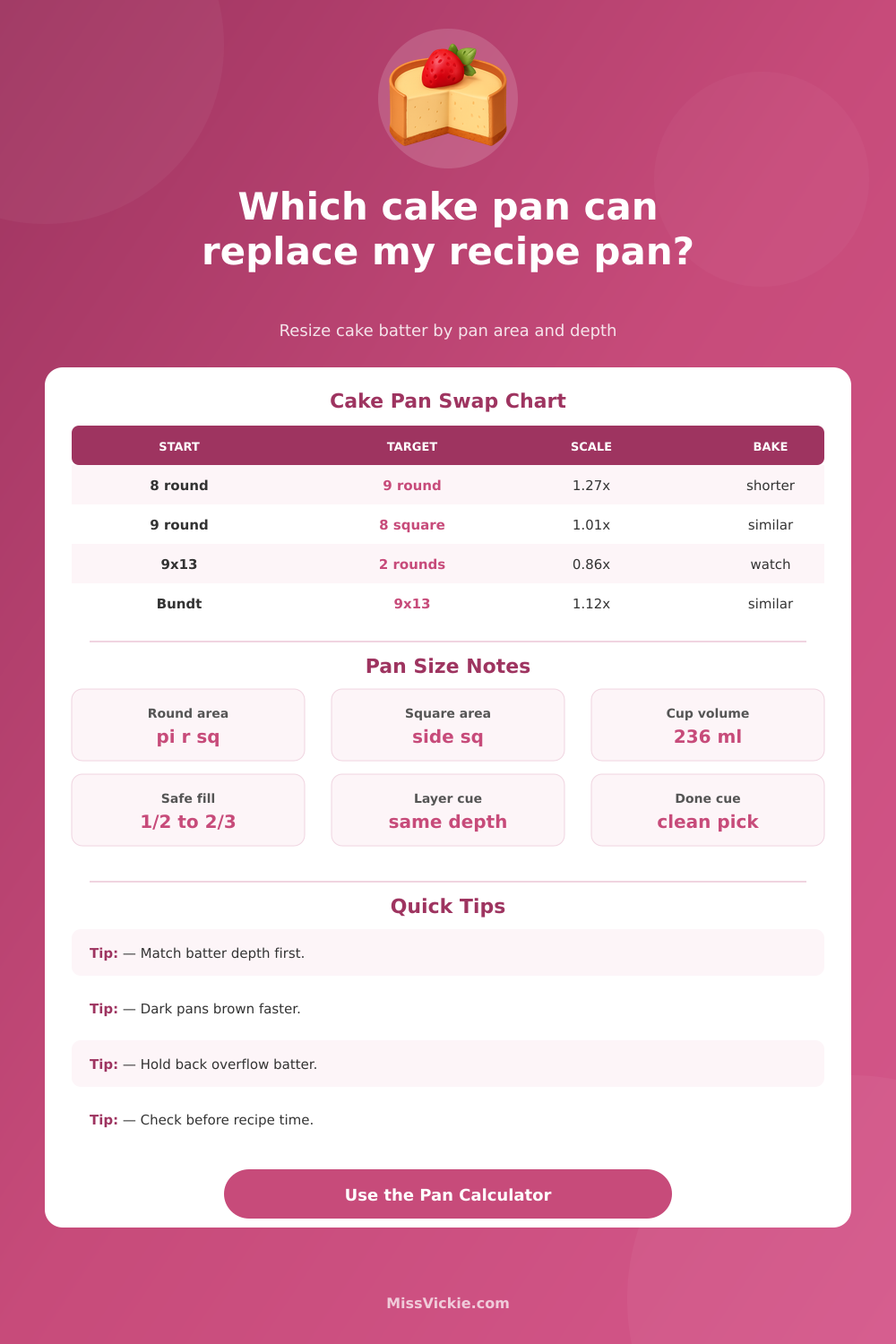
These common pan areas are the backbone of pan conversions. When the new pan area is larger, you need more batter to keep the same cake height. When it is smaller, reduce batter or bake extra cupcakes.
| Pan size | Approx area | Usual batter | Typical use |
|---|---|---|---|
| 6 inch round | 28.3 sq in | 3 to 4 cups | Small tier or smash cake |
| 8 inch round | 50.3 sq in | 5 to 6 cups | Classic two layer cake |
| 9 inch round | 63.6 sq in | 6 to 8 cups | Wide birthday layer |
| 8 inch square | 64 sq in | 6 to 8 cups | Coffee cake or snack cake |
| 9 inch square | 81 sq in | 8 to 10 cups | Thicker party squares |
| 9 by 13 inch | 117 sq in | 12 to 15 cups | Family sheet cake |
Batter capacity guide
| Pan style | Safe fill range | Best for | Watch for |
|---|---|---|---|
| Layer cake pans | 1/2 to 2/3 full | Even layers | Doming if overfilled |
| Loaf pans | 1/2 to 2/3 full | Pound cake and quick bread | Cracked tops are normal |
| Bundt pans | 1/2 to 3/4 full | Dense batters | Grease every ridge |
| Tube pans | 1/2 to 2/3 full | Angel food and chiffon | Do not grease foam cakes |
| Sheet pans | 1/3 to 1/2 full | Thin slab cakes | Fast edges |
Bake time adjustment cues
| Change | What happens | Check early by | Helpful cue |
|---|---|---|---|
| Wider, shallower pan | Bakes faster | 20 to 25 percent | Edges pull slightly |
| Narrower, deeper pan | Bakes slower | Begin at original time | Center springs back |
| Dark metal pan | Browns faster | 5 to 8 minutes | Lower oven 25 F if needed |
| Glass pan | Holds heat longer | 5 minutes | Use lower rack cautiously |
| Silicone mold | Insulates batter | Start on time | May need extra minutes |
Frosting and serving estimates
| Cake format | Serving style | Frosting estimate | Notes |
|---|---|---|---|
| One 8 inch round | 8 to 10 slices | 2 to 3 cups | Add more for piping |
| Two 8 inch rounds | 12 to 16 slices | 4 to 5 cups | Includes filling layer |
| One 9 by 13 cake | 20 to 24 squares | 3 to 4 cups | Top only is lighter |
| Bundt cake | 12 to 16 slices | 1 to 2 cups | Glaze needs less |
Pan, material, and method comparison
The calculator handles the math, but pan behavior still matters. Use this grid to decide whether you should change temperature, lining, or checking time.
Light aluminum pan
Most recipe times assume this style. It gives steady browning, clean layer edges, and predictable rise.
Dark nonstick pan
Dark finish absorbs heat quickly. Start checking sooner and consider reducing oven temperature by about 25 F for delicate cakes.
Glass baking dish
Glass heats slowly but retains heat. It can brown edges after the cake leaves the oven, so avoid overbaking.
Silicone mold
Flexible silicone insulates batter and may need support from a baking sheet. It releases well but browns less deeply.
Bundt method
Grease and flour detailed pans thoroughly. Dense batters perform better than very loose sponge batters in deep patterned pans.
Sheet cake method
Spread batter evenly into the corners and rotate once if your oven has hot spots. Thin cakes can overbake quickly.
Pan swaps work best when the batter depth stays close to the original. If the new pan is wider, the cake bakes faster because the batter layer is thinner.
If the result says your pan is too full, do not force it. Bake the extra batter as cupcakes or a small tester cake and check doneness early.
When you are going to change the cake pans that you are using for your cake recipe, you must consider how the batter will behave within the new cake pan. While the recipe might call for you to use two 8-inch round cake pans in baking the cake, you may desire to use a one 9-by-13-inch cake pan instead. The way that the cake batter will behave within the new cake pan will depend upon the surface area of the cake pan, the depth of the cake pan, and the material of the cake pan.
If you dont consider these three factor, you will be guessing as to the proper baking time for the cake. To move a recipe from one type of cake pan to another type of cake pan, you should compare the baking areas of the two pans. Round cake pans has areas that you can calculate using the circle formula.
How to Use a Different Cake Pan
For rectangular cake pans, you can calculate the area by multiplying the length of the pan times the width of the pan. The area of the new cake pan will determine whether the batter will spread thin within the pan (if the area of the new pan is larger than the original pan) or deeper into the pan (if the area of the new pan is smaller than the original pan). Since deeper cakes take longer to bake than thinner cakes, you must take baking time into consideration when you are changing the recipe.
Another factor to consider when changing cake pans is the depth of the pan. Shallow pans will cook their cakes faster than deep pans. Deep pans may require more baking time than pans with a more even depth.
Additionally, when changing pans, you should fill the batter to no more than halfway to two-thirds of the height of the cake pan. If the cake pan is filled to the very top with batter, baking the cake will result in the cake overflow from the pan when it is finished baking. Once you have calculated the area of the pan and its depth, you can calculate the amount of batter that should be used within the pan.
If there are more batter calculation that are required, the recipe will need to be scaled up or down. In scaling a recipe, it is important to consider the number of egg that are required in the recipe. Since eggs will not divide equally when scaled, baking for a larger batch will require measuring the eggs by weight or by tablespoon.
Additionally, leavening agent will need to be maintained in the recipe in order to ensure the texture of the baked cake. Another factor to consider is the material that the cake pans are made from. Aluminum cake pans will allow for even baking of the cake because aluminum metal evenly and quickly release heat from the cake pan.
However, dark metal cake pans will absorb the heat from the oven faster than light aluminum pans. This can cause the edges of the cake to brown before the center of the cake is bake. For glass cake pans, the cakes will continue to bake after the oven is turned off because glass retains heat; the edges of the cake can continue to bake on the counter after baking.
Silicone cake pans will insulate the cake; the cake will need to bake for a few extra minutes when baked in a silicone pan. A common error in baking cakes in different cake pans is to consider only the total amount of batter that is required to bake the cake. While a 9-by-13 inch cake pan may hold the same amount of batter as two 8 inch round cake pans, the baking times and baking results can differ.
A cake pan that has a thinner layer of batter will likely cause the edges of the cake to dry out before the center of the cake is bake. To avoid overbaking the edges of the cake, use a cake tester to test the center of the cake while baking; bake the cake until the tester shows the center is no longer raw or gummy. If you calculate the batter that will be baking in the new cake pan and determine that the batter will go beyond the top of the cake pan, do not pour all of the batter into the cake pan.
Instead, bake the batter as cupcakes. Baking a small batch of cupcakes will allow you to test the new cake pan or oven. This will provide information about the baking time for the cake without risking the baking of the entire cake.
When scaling the ingredients for the cake, it is important to maintain the same ratio as the batter volume. For instance, flour, sugar, and fat will scale in the same manner as the recipe. However, the leavening agents requires extra consideration.
Additionally, if baking a very large batch of cake, mixing the batter into smaller portions will ensure that the cake recipes are not overworked. When scaling back the amount of cake recipe to bake, measure the salt and flavoring agents. The final way to determine whether the cake is finished baking is to look at the cake itself.
Once baked, you can test the cake with a cake tester. The cake is done baking when the tester comes out clean. Additionally, when you press the center of the cake, it will spring back.
The edges of the cake will begin to pull away from the cake pan. These signs indicate the cake is baked. You can begin to check the cake a few minutes before the original recipe indicated that the cake should be baked.
If the edges of the cake are browning too quick while baking, place a sheet of foil on the edges of the cake pan to prevent the edges from baking too quickly. By calculating the area of the pan, calculating the depth, and by observing the cake while baking, you can achieve a reliabel result when baking with a new type of cake pan.