How Much Icing For A Cake Calculator
Estimate icing for round, square, sheet, and tiered cakes by surface area, layer filling, crumb coat, frosting style, decoration level, and spare allowance.
Pick a real cake style to load shape, layers, finish thickness, filling, piping, and spare icing. Every field can still be adjusted.
Full Icing Breakdown
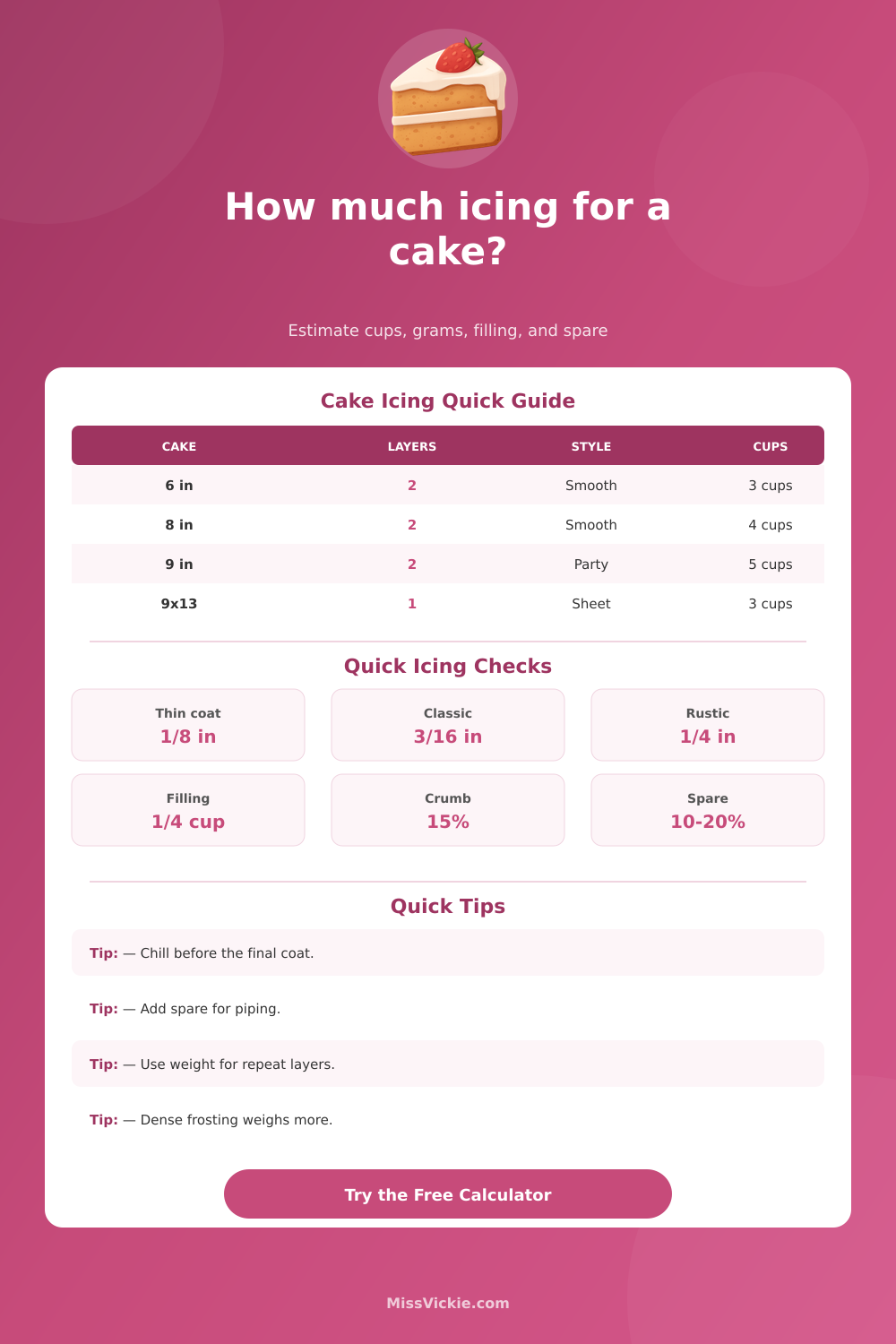
| Cake Size | Layers | Smooth Finish | With Piping |
|---|---|---|---|
| 6 inch round | 2 layers | 2.5 to 3 cups | 3 to 3.5 cups |
| 8 inch round | 2 layers | 3.5 to 4 cups | 4.5 to 5 cups |
| 9 inch round | 2 layers | 4.5 to 5 cups | 5.5 to 6 cups |
| 10 inch round | 2 layers | 6 to 7 cups | 7 to 8 cups |
| 6 plus 9 tiers | 2 layers each | 8 to 9 cups | 10 to 12 cups |
| Tall 8 inch cake | 3 to 4 layers | 5 to 6 cups | 6.5 to 8 cups |
| Finish Style | Thickness | Best Use | Coverage Note |
|---|---|---|---|
| Thin glaze or skim coat | About 1/12 inch | Loaf cakes, snack cakes | Low volume, little smoothing |
| Semi-naked light coat | About 1/8 inch | Rustic layer cakes | Some cake shows through |
| Smooth classic coat | About 3/16 inch | Most birthday cakes | Good scraper coverage |
| Rustic textured coat | About 1/4 inch | Swirls and spatula marks | Uses more icing on sides |
| Thick piping-ready coat | Over 1/4 inch | Heavy designs | Needs generous spare |
| Fondant base coat | About 1/8 inch | Under rolled fondant | Smooth but not bulky |
| Icing Type | Approx Weight | Texture | Planning Note |
|---|---|---|---|
| American buttercream | 230 g per cup | Sweet and firm | Good for borders and rosettes |
| Swiss meringue buttercream | 220 g per cup | Silky and light | Smooths thinly and evenly |
| Cream cheese frosting | 245 g per cup | Soft and dense | Chill before stacking tall cakes |
| Whipped ganache | 255 g per cup | Rich and sturdy | Heavier by weight than buttercream |
| Whipped cream frosting | 170 g per cup | Very light | Use a little more for coverage |
| Ermine frosting | 215 g per cup | Soft and fluffy | Good for gentle swirls |
| Add-On | Typical Amount | When To Use | Calculator Input |
|---|---|---|---|
| Thin filling | 1/6 cup per 8 inch layer gap | Jam plus buttercream dams | Thin filling layer |
| Standard filling | 1/4 cup per 8 inch layer gap | Classic layer cakes | Standard filling layer |
| Thick filling | 3/8 cup per 8 inch layer gap | Bakery-style tall slices | Thick filling layer |
| Crumb coat | 10% to 20% of outside coat | Loose crumbs or dark cake | Crumb coat menu |
| Simple border | About 8% extra | Shell border and writing | Simple border |
| Heavy piping | 20% to 40% extra | Rosettes, swirls, tall cupcakes | Decoration menu |
Uses less icing because the side coat stays thin and partly exposed.
Balanced finish for most layer cakes and clean scraper sides.
Spatula texture and visible ridges add meaningful volume.
Rosettes, borders, and tall swirls need the largest buffer.
Calculating the correct amount of icing for a cake project is an important task. If you find yourself out of icing during the decorating process, there may be problems in being able to complete your cake with the desired appearance. The calculator will help you to determine the amount of icing that is required for your project.
The calculator takes into account various factors that will allow it to remove the need for you to guess at the amount of icing that you will need to complete your cake project. Thus, by using the calculator, you will assuredly have enough icing to complete your cakes decoration. The amount of icing that is required for your cake project will depend in part upon the shape of the cake that you will create.
How Much Icing You Need for Your Cake
Round cakes will have different icing requirement than sheet cakes, due to the different amounts of icing that the sides of each of these cake will require. The height of the cake will also have an impact upon the amount of icing that is required for that cake project. Because icing will cover the cake’s surface area, the calculator utilizes this measurement to determine the amount of icing that will be required for your cake project.
Frostings can have different densities. For instance, American buttercream frosting is considered to be a dense frosting, and weighs more per cup then Swiss meringue frosting. Cream cheese frosting is a frosting that can easily be spread onto the cake, but can soften in the warm rooms in which the cakes are often displayed.
Because one cup of frosting will cover a different area of a cake than another type of frosting, the calculator accounts for these variable so that you can have enough icing to complete your project. Otherwise, you may need to scale the recipe for the icing to account for the type of frosting that will be used on the cake. An additional factor is the amount of icing that will be used for the cakes filling.
As cakes often have multiple layer of cake, the amount of icing used for the filling will be multiplied according to the number of layers that will be included in the cake. For example, if the cake contains 3 layer of cake, a thin layer of filling will be multiplied by 3. Thus, the calculator allows for the selection of thin, standard or thick fillings to account for this additional icing.
If you dont account for this amount, you may find that you are out of icing before you can add the final layer of cake. Another factor to consider is icing for the crumb coat. A crumb coat is a thin layer of icing that is poured onto the cake to set the crumbs that may otherwise interfere with the even application of icing.
A crumb coat is used to allow for a smooth application of the final coat of icing. The amount of icing that will go into the crumb coat will be represented as a percentage of the final icing coat. If your cake layers are to be crumbly, such a percentage will be higher than if the cake is to be non-crumbly.
An additional factor that will impact the icing requirements for your cake is the decoration level. Cakes may include various decorations with the icing. For instance, simple decorations may require less icing to coat the cake than decorations that include feature like rosettes or drip decorations.
The icing for these decorations will be accounted for separately from the icing required for the cake to be coated in icing. Thus, you can determine from the calculator whether you will need to make a double batch of icing for your project, or whether you will need to split your icing into different bowl to prepare icing of different colors. Another reason that it is useful to include an amount of icing beyond what is required for your cake is that the icing may be used for other feature of the cake decoration.
For instance, you can use extra icing to fill in any scrape marks on the cake. Additionally, if you find that the icing is too pale, you can use the extra icing to prepare another batch of icing of the same color. Finally, you can use icing to pipe additional row of shells onto the cake if the first row is not even.
The various icing amounts that are offered on the icing calculator may be required for different projects, as some projects may require more icing than others. For instance, color matching may require an amount of icing in excess of that which will be used to coat the cakes layer. The reference tables that are included in the icing calculator can show you the amount of icing that will be required based off the thickness of the icing that you choose to use.
For example, a rustic swirl icing is thicker than a thin semi-naked icing, so more icing will be required to achieve the rustic swirl than the thin semi-naked icing. Thus, these tables allow you to understand the differences in icing thickness without having to create the icing itself. In addition to the icing calculator, other factor that you should consider include those related to the environment in which the icing will be prepared and used.
For instance, humidity may impact the rate at which buttercream icing will crust, and the softening of cream cheese icing if the cakes are placed in warm rooms. Additionally, the texture of the cake may have an impact upon the amount of icing that is used. Cakes that contain crumbly layers will absorb more icing when covered in a crumb coat than cakes that contain non-crumbly cake layers.
Thus, while the icing calculator will allow you to determine the amount of icing that will be required for your cake project, you will also have to account for these other factor. In addition to considering the factors that are represented in the icing calculator, there are some icing-specific habits that you can utilize to ensure that you have enough icing for your cake. For instance, you may choose to measure out the amount of filling for the cake, and to place the filling aside from the icing for the cake.
In this way, you will not use the icing to prepare the filling for the cake layers. Additionally, you may choose to tint an amount of icing in excess of that which will be used for the cake. This way, should you need to use the icing for color matching, you wont have to create a batch of icing of the same color as the one that is being used for the cake.
The main goal in preparing icing for a cake project is not to prepare the largest batch of icing of icing that you can create. Rather, you will want to prepare a batch of icing that will cover the cakes surface, be finished with icing of the desired thickness, and include icing of the desired decoration. Thus, the icing calculator will allow you to remove the need for any arithmetic to determine the amount of icing that is required for your cake.
In this way, you can focus upon other aspect of the cake decoration.