Cake Flour to All-Purpose Flour Conversion Calculator
Convert a cake flour amount into an all-purpose flour and cornstarch substitute with cup-to-gram math, protein targeting, sift loss, and batch scaling built in.
Pick a common cake flour amount, then adjust the fields for your flour brand, target protein, and batch size.
Conversion Breakdown
Enter your flour details and calculate.
| Flour or starch | Common protein range | Texture effect | Calculator use |
|---|---|---|---|
| Cake flour | 6.5-8.5% | Fine, tender, soft crumb | The target the substitute is trying to mimic. |
| Pastry flour | 8-9.5% | Tender but a little stronger | A useful middle target for muffins and scones. |
| All-purpose flour | 10-12% | Moderate gluten structure | The flour being diluted with cornstarch. |
| Bread flour | 12-14% | Chewy and elastic | Usually too strong for this cake flour swap. |
| Cornstarch | 0% | Dilutes protein and lightens bite | The replacement portion in the blend. |
| Measure | Cake flour at 115 g/cup | AP flour at 125 g/cup | Cornstarch at 128 g/cup |
|---|---|---|---|
| 1 teaspoon | 2.4 g | 2.6 g | 2.7 g |
| 1 tablespoon | 7.2 g | 7.8 g | 8.0 g |
| 1/4 cup | 28.8 g | 31.3 g | 32.0 g |
| 1/2 cup | 57.5 g | 62.5 g | 64.0 g |
| 1 cup | 115 g | 125 g | 128 g |
| AP protein | Target protein | AP flour share | Cornstarch share |
|---|---|---|---|
| 10.0% | 8.0% | 80.0% | 20.0% |
| 10.8% | 8.0% | 74.1% | 25.9% |
| 11.7% | 8.0% | 68.4% | 31.6% |
| 12.5% | 8.0% | 64.0% | 36.0% |
| 10.8% | 7.5% | 69.4% | 30.6% |
| Final cake flour needed | Sift loss | Blend to prepare | Why it matters |
|---|---|---|---|
| 115 g | 0% | 115 g | Best when mixing directly in a bowl. |
| 115 g | 1.5% | 116.8 g | Covers light dusting left in the sieve. |
| 230 g | 2% | 234.7 g | Useful for double-layer cakes. |
| 575 g | 3% | 592.8 g | Useful when scaling for large batches. |
Cake Flour
Lowest protein, finest texture, and the softest crumb. Best for chiffon, sponge, angel food, white cake, and delicate layer cakes.
AP Plus Cornstarch
The practical home substitute. Cornstarch lowers the protein percentage and interrupts gluten formation, especially after whisking and sifting.
Pastry Flour
A middle option for tender bakes that need a little more structure, such as biscuits, muffins, shortcakes, and some coffee cakes.
All-Purpose Flour
Reliable for everyday baking, but it can make cake crumb slightly firmer when used without dilution in recipes written for cake flour.
Bread Flour
High protein creates chew and stretch. It is not a clean shortcut for cake flour because it needs too much dilution to behave softly.
Self-Rising Flour
Already contains leavening and salt, so it should not be used as a direct cake flour substitute unless the whole recipe is adjusted.
The calculator focuses on protein dilution, cup weight, and sifting behavior. Bleaching, milling fineness, and starch damage can still make commercial cake flour perform differently from a homemade substitute.
Cake flour and all-purpose flour is two different type of flour with different protein levels. The protein levels in flour are important in baking because they determines the amount of gluten that will form in the cake that use that flour. The protein levels in cake flour are low, which allow the cake that use this flour to have a soft and finely texture.
All-purpose flour contain more protein than cake flour. Therefore, cakes that uses all-purpose flour may have a stronger and tighter texture. Using all-purpose flour for cake recipes that require cake flour will results in cakes that are too bready or too tough.
How to Make Cake Flour with All-Purpose Flour and Cornstarch
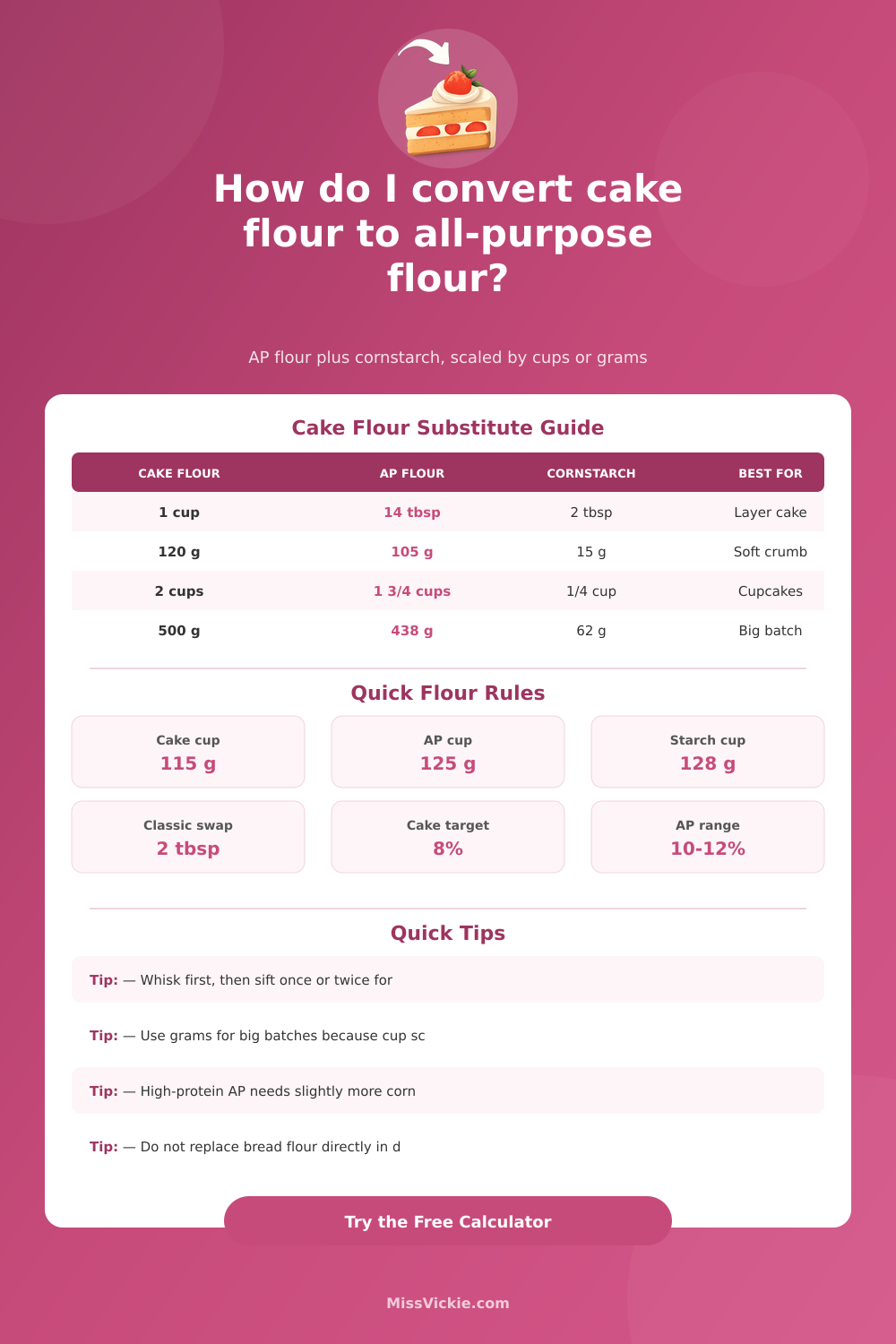
To make a substitute for cake flour with all-purpose flour, blend all-purpose flour with cornstarch. Cornstarch contain no protein. Thus, adding cornstarch to all-purpose flour will reduce the protein level of the flour blend.
This is known as protein dilution. Protein dilution are necessary when you want to use all-purpose flour instead of cake flour because you have to reduce the protein level of the all-purpose flour to the same level as cake flour. A common substitution ratio for cake flour and all-purpose flour is to use two tablespoon of cornstarch for every cup of all-purpose flour.
However, the protein percentages of all-purpose flour brands can differ, so this simple ratio may not provides the proper protein level for you’re flour blend. A conversion calculator can help you determine the proper amount of all-purpose flour and cornstarch to add to your cake flour replacement recipe. The conversion calculator allow you to enter the amount of cake flour that the recipe calls for, the protein percentage of your all-purpose flour, and the protein level that the recipe requires.
The conversion calculator is useful because it account for the protein levels in the flour ingredients. If the protein level of your all-purpose flour is ten percent as the recipe require, the calculator will show a small amount of cornstarch to add to the flour. If the protein level of your all-purpose flour is twelve percent as the recipe requires, the conversion calculator will show a larger amount of cornstarch because the twelve percent all-purpose flour contains more protein than the cake flour and must be diluted more.
The conversion calculator also take into account the weight of the flour in terms of grams and the sift loss that occur when the flour is sifted. All-purpose flour and cornstarch have different weight per cup measure. The conversion calculator will provide the amount of flour and cornstarch in grams to ensure the weight of the flour blend is accuracy.
When flour is sifted, some of the flour remain on the sieve. To compensate for this sift loss, the conversion calculator will show an increased amount of all-purpose flour to add so that after sifting, the recipe will have the amount of flour that it requires. The conversion calculator also allow you to scale your recipe to double or halve the recipe amounts.
The recipe amounts in terms of all-purpose flour will be adjusted to reflect your chose batch size. This batch size adjustment will ensure that the protein level of the cake flour replacement will remains the same, no matter how many cake you are baking. Understanding the diffrent concepts behind flour protein levels, cup weights, and sift loss is important in creating successful cake.
You must understand how protein percentage affect the gluten strength of the flour. You must understand how cup weight affect the accuracy of the recipe measurements. You must understand how sift loss help with flour loss when mixing ingredients.
Using the measurements described above will allow you to create a substitute flour blend for cake flour that will have the same texture as the original recipe. Using the measurements will allow you to ensure that your baked cake will be soft and have a fine crumb texture.