🍰 MissVickie cake math
Cake Flour Converter
Convert cake flour between cups, grams, ounces, tablespoons, teaspoons, and milliliters, then scale soft cake recipes with method-aware density and simple kitchen math.
Each preset loads a real cake-flour scenario with a recipe style, measuring method, and target yield, then runs the converter automatically.
Cake flour is light enough to change quickly when it is sifted, packed, or leveled, so method choice matters when you want a tender, even crumb.
Best for airy sponge layers and very soft crumb structure.
Most common baking standard for reliable cake flour cups.
Use when a recipe expects a slightly fuller, denser cup.
Only use if the recipe says to compact the flour on purpose.
Use these tables for quick checks while you scale recipes, compare measurement styles, and keep your cake flour conversions consistent.
| Measuring Method | Weight per Cup | Texture Clue | Best Use |
|---|---|---|---|
| Sifted and fluffed | 110 g | Very airy | Fine sponge and chiffon |
| Spooned and leveled | 114 g | Flat top | Layer cakes and cupcakes |
| Scooped and leveled | 118 g | Firmer cup | Muffins and soft cookies |
| Lightly packed | 124 g | Compact cup | Only for dense recipe specs |
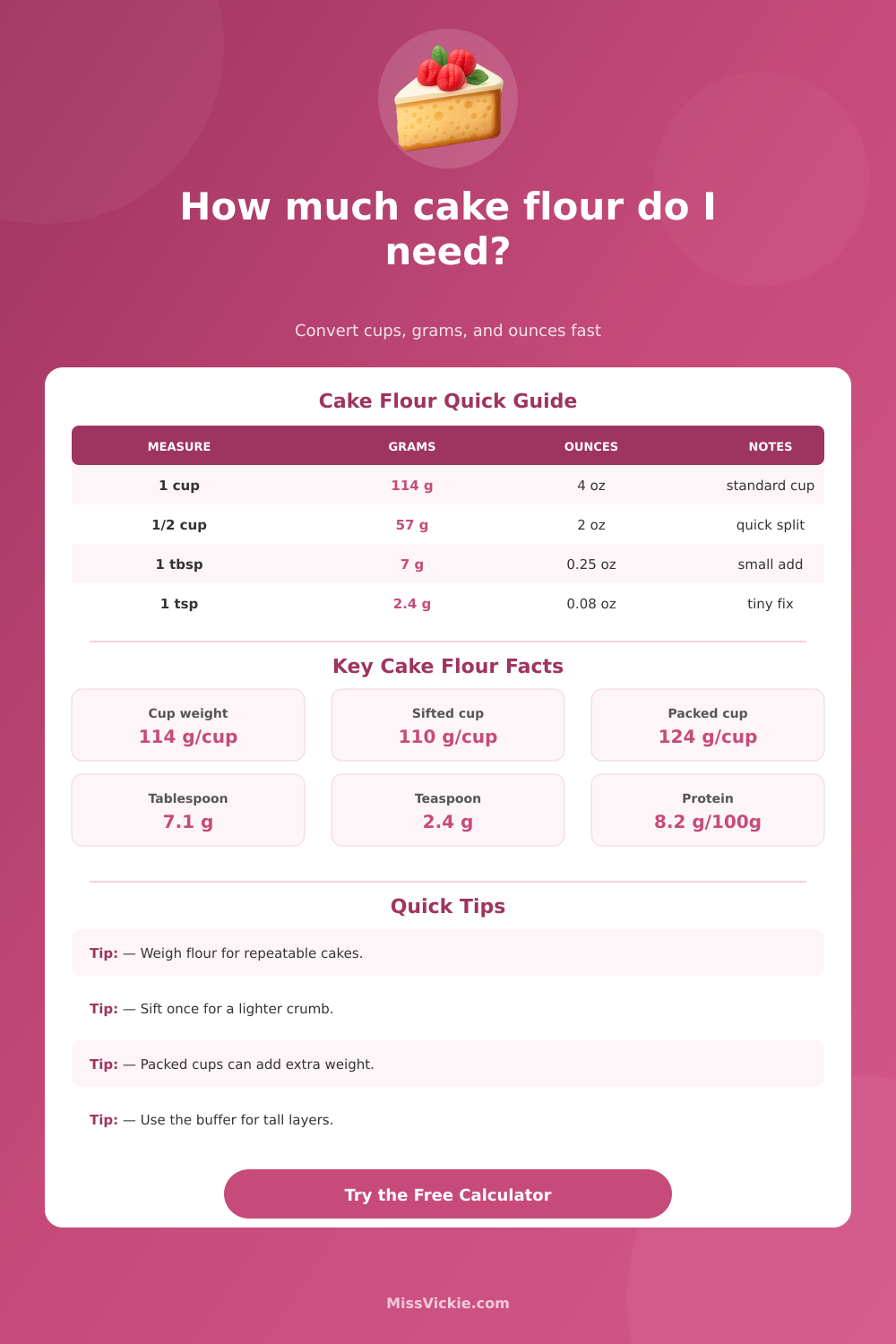
| Measure | Grams | Ounces | Quick Note |
|---|---|---|---|
| 1 cup | 114 g | 4 oz | Standard cake flour cup |
| 1/2 cup | 57 g | 2 oz | Easy half-batch check |
| 1 tbsp | 7.1 g | 0.25 oz | Small adjustment tool |
| 1 tsp | 2.4 g | 0.08 oz | Micro fix for batters |
| Scale Change | Multiplier | Cup Example | Gram Example |
|---|---|---|---|
| Keep the same | 1.00x | 2 cups | 228 g |
| Half batch | 0.50x | 1 cup | 114 g |
| Double batch | 2.00x | 4 cups | 456 g |
| Party batch | 3.00x | 6 cups | 684 g |
| Use Case | Buffer | Crumb Goal | Reminder |
|---|---|---|---|
| Delicate sponge | 2% | Ultra light | Keep the flour airy |
| Cupcakes | 1% | Soft dome | Do not pack the cup |
| Layer cake | 1% | Even slices | Sift before mixing |
| Shortcake | 2% | Tender bite | Measure with a light hand |
Cake flour is a specific types of flour that contains a fine grind and low protein content. Cake flour contains 8% protein, which create less gluten when mixed. Because cake flour contains less gluten, it produces light and more fluffy textures in the baked goods.
However, the density of the cake flour can change depending on the way you measure the flour. These changes in density affect the texture of the cake that is baked. If you use a measuring cup to measure the cake flour, the weights of the cake flour will range between 110 gram and 124 grams.
How to measure and use cake flour
If you spoon in the cake flour into your measuring cup, the flour will be light in weight. This will allow your cake to have a domed shape when it is baked. However, if you pack the cake flour into the measuring cup, the density of the cake flour will make the cake chewily when baked.
The weight of the cake flour will change depending on how you measure the flour. Therefore, to ensure that cakes has the same texture when baked, you must use a scale to measure the cake flour in gram. To scale a recipe mean to multiply the amounts of each ingredient by a specific number.
To scale a cake flour recipe, you must consider the density of cake flour. For example, if a cake recipe calls for 2.25 cups of cake flour to make one cake, to make two cakes, you will have to multiply the amount of cake flour by two. When you double a cake recipe, the amount of cake flour will double.
However, if you change the way you measure the cake flour when you double the recipe, you will have to much or too little cake flour in your batter. Cake flour recipes require the ingredients to be sift. Sifting removes the clumps of flour and introduces air into the flour.
Sifting the cake flour will make the cake flour more aerated. Aerated cake flour will provide better lift for the cake when it is baked in the oven. To achieve a very light texture for the cake, you should sift cake flour multiple time.
Each sift of the cake flour will aerate the flour further and allow for more air to becomes trapped within the cake flour. If the particle of the cake flour are all the same size, the flour will evenly incorporate with the fat and sugar in the cake batter. This even incorporation will allow the cake flour to trap air while baking without becoming tough.
Cake flour should also be store appropriately to maintain the cake flours consistency. If cake flour is left in an open container, it will absorb moisture from the air. This moisture will cause the cake flour to clump together.
If the cake flour clumps together, the cake flour will become denser. The density of the cake flour will affect how easily you can measure the flour. It is important to store cake flour in a sealed container so that it does not become denser and so that its weight remains consistencies.
When measuring the ingredients for a large bake, it is important to use buffers. A buffer is an extra amount of an ingredient that is added to the recipe for cases such as spills or to allow for extra dusting of the cake pan with cake flour. For instance, you can add an extra one or two percent of cake flour to the recipe.
Using a buffer will ensure that you do not run out of cake flour while mixing the ingredients together. Using grams to measure the amount of cake flour is more accurate than using teaspoons or cups of cake flour. Using grams will measure the weight of the cake flour rather than the volume of cake flour.
If the measurement for cake flour are measured in teaspoons or cups, errors will occur in the measured amount of cake flour. These error will compound throughout the baking process. Using grams will minimize the measurement errors.
Using a digital scale to weigh the cake flour will allow you to have repeatable results in baking cakes using cake flour. To bake cakes with the proper texture and rise, the precise math and accurate measuring of cake flour are necessary to account for the density of the ingredient.