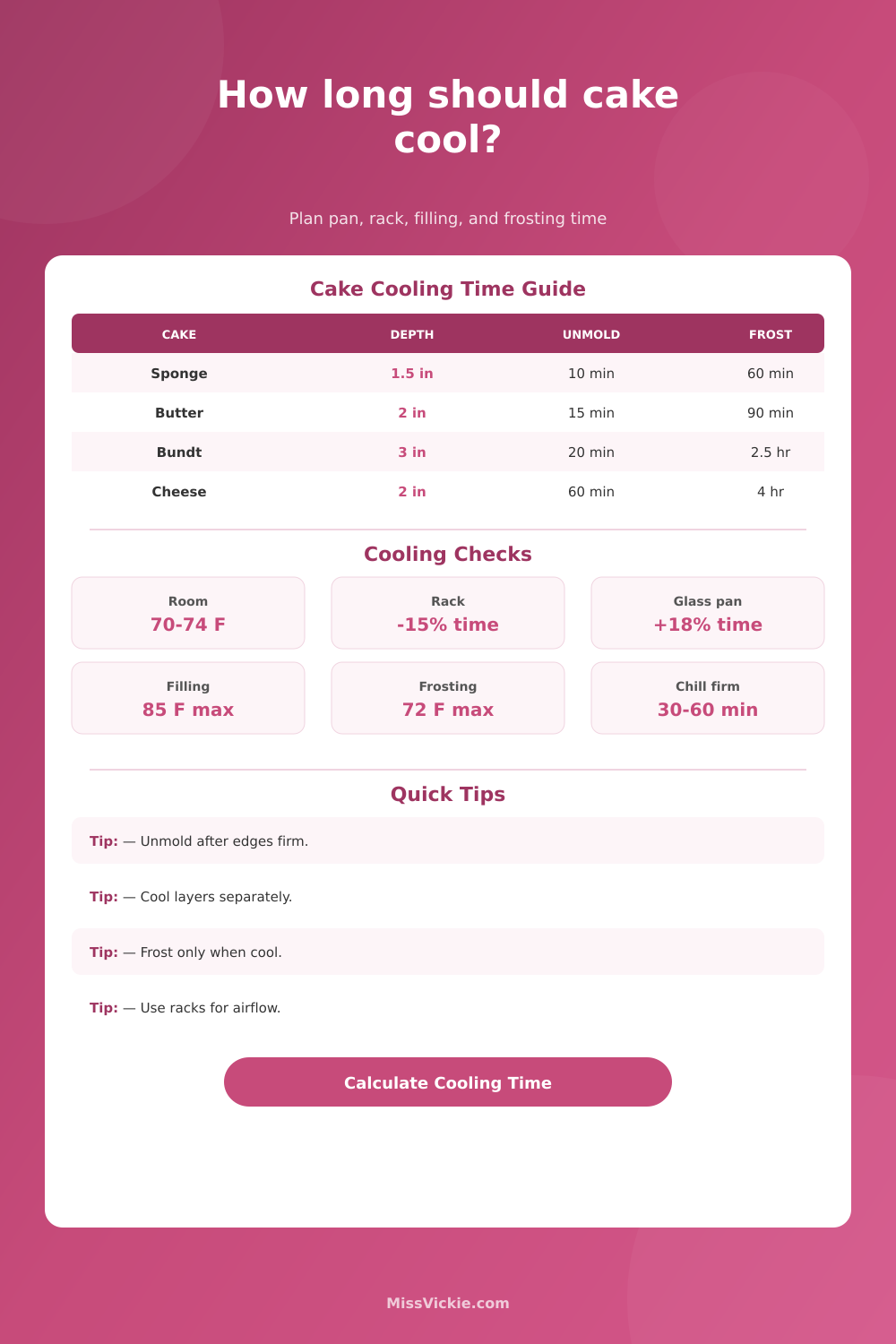
Cake Cooling Time Calculator
Estimate when a cake can leave the pan, move to a rack, take filling, and safely accept frosting based on pan size, cake depth, batter style, room temperature, material, rack airflow, and layer count.
Load a real cooling scenario, then adjust the pan, depth, room, rack, target, and layers to match the cake on your counter.
Your Cake Cooling Plan
Estimated times update as you change the cake and cooling setup.
Cooling Breakdown
Adjustment Factors
Step Timing
| Cake Type | Typical Depth | Pan Rest | Rack Cooling | Best Target |
|---|---|---|---|---|
| Sponge or genoise | 1.25-1.75 in | 5-10 min | 45-70 min | Fill when center is barely warm. |
| Butter layer cake | 1.75-2.25 in | 10-20 min | 75-110 min | Crumb coat only after steam is gone. |
| Chocolate layer cake | 1.75-2.5 in | 12-20 min | 85-125 min | Cool a little longer before buttercream. |
| Carrot or spice cake | 2-2.75 in | 15-25 min | 105-160 min | Use patience before cream cheese icing. |
| Pound or loaf cake | 2.5-3.5 in | 15-30 min | 120-210 min | Cool fully before slicing or wrapping. |
| Cheesecake | 1.75-2.75 in | 45-75 min | 3-4 hr plus chill | Finish cooling slowly to limit cracks. |
| Pan Size | Heat Load | Airflow Need | Common Unmold | Cooling Note |
|---|---|---|---|---|
| 6-inch round | Low | Moderate | 8-12 min | Small layers cool quickly but dry if left uncovered later. |
| 8 or 9-inch round | Medium | Good rack | 10-20 min | Most layer cakes fit the calculator baseline. |
| 9x13-inch pan | Medium-wide | Moderate | Often in pan | Center stays warm under frosting longer than edges. |
| 9x5-inch loaf | High center | Good rack | 15-30 min | Deep middle drives the longest cooling time. |
| 10-inch bundt | High | Open rack | 15-25 min | Do not wait too long or sugar can glue to details. |
| Cupcakes | Low | Fast rack | 3-5 min | Remove from pan quickly to avoid wet liners. |
| Pan Material | Cooling Change | Release Risk | Best Use | Watch For |
|---|---|---|---|---|
| Light aluminum | Baseline | Low | Layer cakes | Edges release cleanly after a short rest. |
| Dark metal | About +5% | Medium | Browned edges | Edges set fast, but the center still holds heat. |
| Glass | About +18% | Low | Snack cakes | Retains heat long after leaving the oven. |
| Ceramic | About +25% | Low | Serve-in-pan cakes | Needs extra time before frosting in the dish. |
| Silicone | About +12% | Medium | Molded cakes | Flexible sides can tear warm cake. |
| Nonstick steel | About +8% | Low | Bundt and loaf | Release while warm but not fragile. |
| Target Use | Center Temp | Touch Test | Extra Step | Risk If Early |
|---|---|---|---|---|
| Filling | 85 F or cooler | Barely warm | Level after cooling | Filling softens and slides. |
| Crumb coat | 80 F or cooler | No steam | Chill after coat | Crumbs smear into icing. |
| Buttercream | 72 F or cooler | Room temperature | Chill if kitchen is hot | Butter melts against the cake. |
| Cream cheese icing | 70 F or cooler | Cool surface | Keep icing cold | Icing loosens quickly. |
| Ganache glaze | 78 F or cooler | Slightly cool | Use warm, fluid ganache | Glaze thins and runs off. |
| Wrap or freeze | 68 F or cooler | Fully cool | Wrap airtight | Condensation forms inside wrap. |
Best default for layers because air reaches the pan base and the exposed cake surface.
Serve-in pans keep heat in the center, so frosting needs a longer wait.
Light cakes cool quickly but need a short pan rest so the crumb can set before handling.
Slow cooling protects texture, and the finishing target often includes refrigerator time.
This planner estimates cooling behavior for home baking. Use a probe thermometer for fragile fillings, cream cheese icing, or cakes that will be transported in warm weather.
The moment you take your cake out of the oven is most treacherous one of all. You’ve beaten this beast: you pulled that lovely golden dome out of the oven and are ready for decorating glory. But don’t rush ahead to the next step: rushed frosting can be disastrous because fresh-from-the-oven cake is a delicate thing. Unmolding too soon? Frosting too soon? If the cake’s crumb is too soft, you won’t just be covering it in gooey frosting; you’ll end up completely destroying structure of the layers themselves.
Waiting for a cake to cool feels like an exercise in patience rather than science. Most people guess by touching the cake but they are really only measuring the outside not realizing the center will be much warmer then the edge. You could hold it in your hands and think it’s cooled off, only to find out interior is still quite warm and will melt any buttercream you put onto it.
Why You Must Let Your Cake Cool Down
What if I told you there was a way to take away the guessing game? There is. The calculator up top figures out all those variables that most home bakers don’t consider, like your baking room temperature or what kind of pan you’re using. It calculates how long it will take for YOUR cake to actualy be good enough to wrap, frost or fill. It takes the guessing out of the one thing about cooking that seems completely intuitive but turns into a disaster when something doesn’t go right.
This is where cake thickness comes into play. You’re looking for heat to move from inside the cake out to its surface and then escape into the environment. A thin, spongy layer of cake will cool down fast; a deep, heavy cheesecake or pound cake will retain heat like a brick. Because of this, the tool will ask how thick your cake is. A three-inch bundt isn’t going to act the same as a two-inch butter cake.
While you wait for the exterior of the cake to cool to the touch, you are also waiting for enough interior coolness so it stays firm and won’t slide around when iced. This coolness also ensures the icing won’t melt right off.
The other thing that really changes things is type of pan. Metal conducts heat and glass does not. Because glass holds heat much longer, a glass casserole will take a lot longer to cool down than a metal one. This is because the container itself act as an insulator. This is why aluminum is the go-to pan for layer cakes, where getting them to cool quickly is important. Ceramic and darker-colored pans change the process too. These are laid out neatly in the table on the page. Knowing this lets you set realistic expectations whether you’re baking something in a regular baking pan versus some fancy serving dish.
Another consideration is airflow: If you leave a cake on a cutting board or counter, the steam gets trapped below and keeps the bottom of the cake warm and soggy. A wire rack will let air flow around the pan, so not only does it cool down the top (speeding up the process) but also the base. Because the calculator factors in your use of racks (whether baking one thing or many, whether in a hot kitchen or not), it can adjust estimates according to how crowded your rack is. That’s some sensible life-saving advice that prevents the bottom of your layers from turning dense.
Different finishes require different temperature targets. Buttercream needs a cooler surface than ganache, which itself requires a cooler finish than cream cheese frosting (which is, in turn, fickle about being warm). And it has individual windows for filling, crumb coating, and finishing. You won’t have to slap a thin layer of delicious glaze onto a barely cooled cake, only to find that the middle was still hot enough to melt away your icing.
Ready to fill? Ready to frost? It’s the difference between knowing how long to let the cake cool before moving on, saving you hours of troubleshooting later. But cheesecakes are an animal of their own. By nature they cool slowly; try to make them cool fast and the outer edges will set before the middle contracts, which leads to cracks. For these custardy baked goods, the calculator takes into account the long chill times needed (since it’s trying to ensure the best texture, not get it on your table ASAP). This again shows how no timer is going to be right for everyone: each batter has its own heat pattern, and baking requires a certain understanding of that.
Ultimately, it comes down to patience. Don’t think you can hurry along baking by going hotter or cooler. And don’t think you can get away with cooling too fast either, not without sacrificing quality. With these approximations, you’ll know when the cake will actualy be ready to decorate. This allows you to schedule your decorating time to match your plan instead of based off how impatient you are to begin!
Once you move from guesswork to knowledge, the proof will be in the pudding, so-to-speak. Your icing will remain smooth. Your layers will retain their shape. Your cake will stand up to itself nicely. What happens in the oven really does deserve a proper ending on the counter.