Cake Batter Per Pan Calculator
Estimate batter for round, square, rectangle, loaf, bundt, tube, sheet, and cupcake pans using dimensions, fill height, batter density, layers, expansion headspace, and serving goals.
🍰 Cake Pan Presets
Choose a common cake format, then adjust the pan dimensions, batter style, target fill, headspace, and serving size.
📏 Pan, Fill, and Batter Details
Cake batter estimate
Enter pan dimensions and batter style to calculate batter per pan.
Pan Geometry
Batter Plan
🧾 Quick Batter Conversion Cards
📊 Pan Substitution Tables
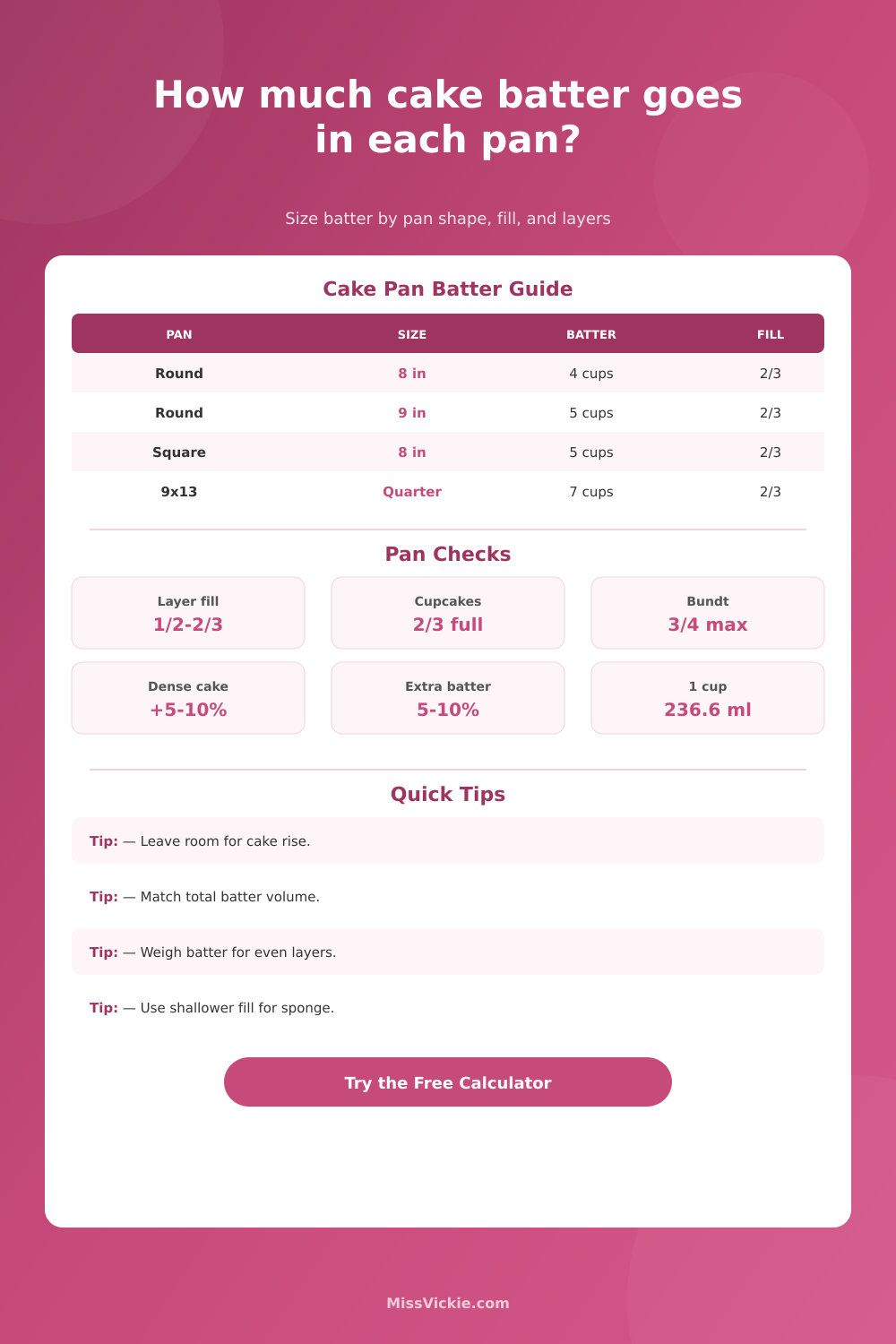
| Pan Shape | Common Size | Approx Capacity | 2/3 Fill Batter | Best Substitution Note |
|---|---|---|---|---|
| Round layer | 6 x 2 in | 4 cups | 2.7 cups | Use three 6-inch pans for many two-layer 8-inch recipes. |
| Round layer | 8 x 2 in | 8 cups | 5.3 cups | Two 8-inch rounds match many 9 x 13 recipes closely. |
| Round layer | 9 x 2 in | 10 cups | 6.7 cups | Reduce fill if using a high-rising sponge or chiffon. |
| Square pan | 8 x 8 x 2 in | 8.9 cups | 5.9 cups | Close to a 9-inch round but slightly more capacity. |
| Rectangle pan | 9 x 13 x 2 in | 15.6 cups | 10.4 cups | Often replaces two 8-inch or two 9-inch layers with adjusted height. |
| Half sheet | 13 x 18 x 1 in | 15.2 cups | 10.1 cups | Same volume neighborhood as 9 x 13, but bakes thinner and faster. |
| Loaf pan | 9 x 5 x 3 in | 17.5 cups | 11.7 cups | Loaf batters are often filled lower to prevent center overflow. |
| Bundt pan | 10 inch | 10-12 cups | 7.5-9 cups | Do not fill above three-quarters full unless the recipe is tested. |
| Batter Style | Typical Density | Suggested Fill | Rise Headspace | Pan-Specific Note |
|---|---|---|---|---|
| Butter layer cake | 0.85 to 0.95 g/ml | 2/3 full | 30% to 35% | Good baseline for birthday cakes and stacked layers. |
| Sponge or chiffon | 0.55 to 0.75 g/ml | 1/2 to 5/8 full | 35% to 45% | Foam cakes rise high and need generous headspace. |
| Chocolate cake | 0.88 to 1.00 g/ml | 2/3 full | 28% to 35% | Thin batters level themselves but can dome strongly. |
| Pound or loaf cake | 1.00 to 1.15 g/ml | 1/2 to 2/3 full | 30% to 40% | Dense loaf batters need room for a center crack. |
| Carrot or fruit cake | 0.95 to 1.12 g/ml | 2/3 full | 25% to 35% | Heavy inclusions reduce rise but add weight per cup. |
| Cheesecake batter | 1.05 to 1.20 g/ml | 3/4 full | 15% to 25% | Low rise, high weight, and usually baked in a springform pan. |
| Serving Goal | Party Slice Area | Wedding Slice Area | Layer Height Cue | Batter Planning Note |
|---|---|---|---|---|
| 8 to 12 servings | 6 to 9 sq in | 4 to 6 sq in | One 8-inch round or square | Use one pan if the cake is a casual single layer. |
| 16 to 20 servings | 6 to 8 sq in | 4 to 5 sq in | Two 8-inch layers | Weigh batter so layers bake level and stack evenly. |
| 24 to 30 servings | 6 to 8 sq in | 4 sq in | 9 x 13 sheet or tall round | Sheet pans cut more predictably than round cakes. |
| 40 to 54 servings | 6 sq in | 3 to 4 sq in | Half sheet or tiered layers | Match total batter volume before swapping pan shapes. |
🧁 Baking Reference Checks
Diameter controls volume quickly; a 9-inch round holds more than an 8-inch round.
Sheet pan swaps should compare filled volume, not just rim size.
Subtract the center tube volume before applying fill level.
Use cup volume per cavity and multiply by the number of wells.
💡 Pan Filling Tips
Pan capacities vary by brand and rim angle. For critical cakes, fill the empty pan with measured water to the same batter height, then use that volume as the best local reference.
Sometimes, you think: “Perfect! You think you have the recipe for a three-tiered celebration cake, but then it happens. One slightly-too-large pan sits on counter, and a small puddle of something that looks more like a disaster than anything else rest in its center. Yes, you read the directions carefully. Yes, you blended it until it looked smooth. Yes, you felt confident as you slid it into the oven. But when it come out, it doesn’t work. Either it is a failed science experiment that overflows edges of the pan, or it has become a thick, heavy puck. No, this isn’t typically a problem with how well-mixed your ingredients are. This is typically a problem of not thinking about shape of your pan, the rise, and the volume before putting the batter near the heat.
And then there’s the geometry. Baking is part science: chemistry. And it’s part science: geometry. When a recipe is written, it is written for a specific pan, typicaly an eight-inch round one. It is also written for a specific height within that pan. What happens when you transfer exact same quantity of batter to a nine-inch pan? Now the layer’s going to be thinner. The crust will dry out more quickley. The texture will suffer. Put it in a six-inch pan and it’ll overflow.
How to Choose the Right Pan Size for Your Cake
Once you input your own dimensions, the calculator does the math. No need to guess at conversion rates and coefficients; just save yourself some trouble and let the thing calculate for you. Turn those vague instructions about filling the pan into an exact volume measurement. Why does this matter? Because batter expands. A sponge cake requires almost half its pan to be empty so that the cake can set up and air can escape. A dense butter cake can go two-thirds full without issue. Get ratio off and you’re doomed before you begin.
People often forget the other half of the equation when they bake at home: the density of your batter. Different types of batter aren’t equal. Moist chocolate batter is heavier than a light and airy sponge cake. A light and airy sponge holds a lot of air bubble. You can fit a lot more of it in a cup. That means a cup of light and airy sponge weigh much less than a cup of heavy, emulsified moist chocolate batter. That’s why the tool lets you choose the type of batter being used. Then it calculates weight-to-volume ratio, so that you’ll have a clear idea of how much (in grams) to pour into each pan.
Batter scales are a pro-baker’s secret weapon. Weighing out the exact amount in each layer allow you to stack and frost them with ease. Guess what happens if you don’t use a scale? You’re just guessing. Use the correct density setting and you’re engineering the cake.
This happens in the heads. Get it? The void in the middle of your pan where your cake expands upward and rise. Fill a pan up all the way and you’ll end up with a crummy mess either atop your cake (flat top) or within your oven (messy clean-up). How much do cakes expand into that empty space? This chart does the math. Some batters will require a lot more headroom than others; maybe 40% if it’s a lighter chiffon cake batter. Some heavier, denser batters like cheesecake might require 20%. Don’t take this into account and you’re looking at cracks, domes, or even a puffed-up middle. The tool does the calculations for you so that you leave room but not too much.
Practical matters also include servings. You aren’t baking for fifty people when only a dozen are coming over. Type in how many servings you’re aiming for, as well as area per slice. Then it’ll work backwards: will the pans you chose really produce that much cake? No more embarrassing moments where there’s no dessert left or else three days’ worth of leftovers. It connects the concrete world of feeding people with the abstract world of measuring out the batter.
Baking, at its core, is all about comfort wrapped up in precision: The right amount in the wrong-sized pan will ruin your best recipe. If you understand density and think about geometry before you turn on the oven, you’re taking charge of this process. No more hoping for the best; now you’ll be making sure of it. That’s what separates knowing from guessing. And that’s why, each time, it’s an even layer instead of a sloppy overflow.