Cake Batter Calculator
Match servings, pan geometry, and fill depth before you mix. Style-aware ingredient factors keep vanilla, chocolate, red velvet, chiffon, and more in range.
Each preset loads a real cake scenario with a shape, pan depth, serving target, and fill-depth target so the calculator can run immediately.
Pan and batter breakdown
Vanilla butter cake
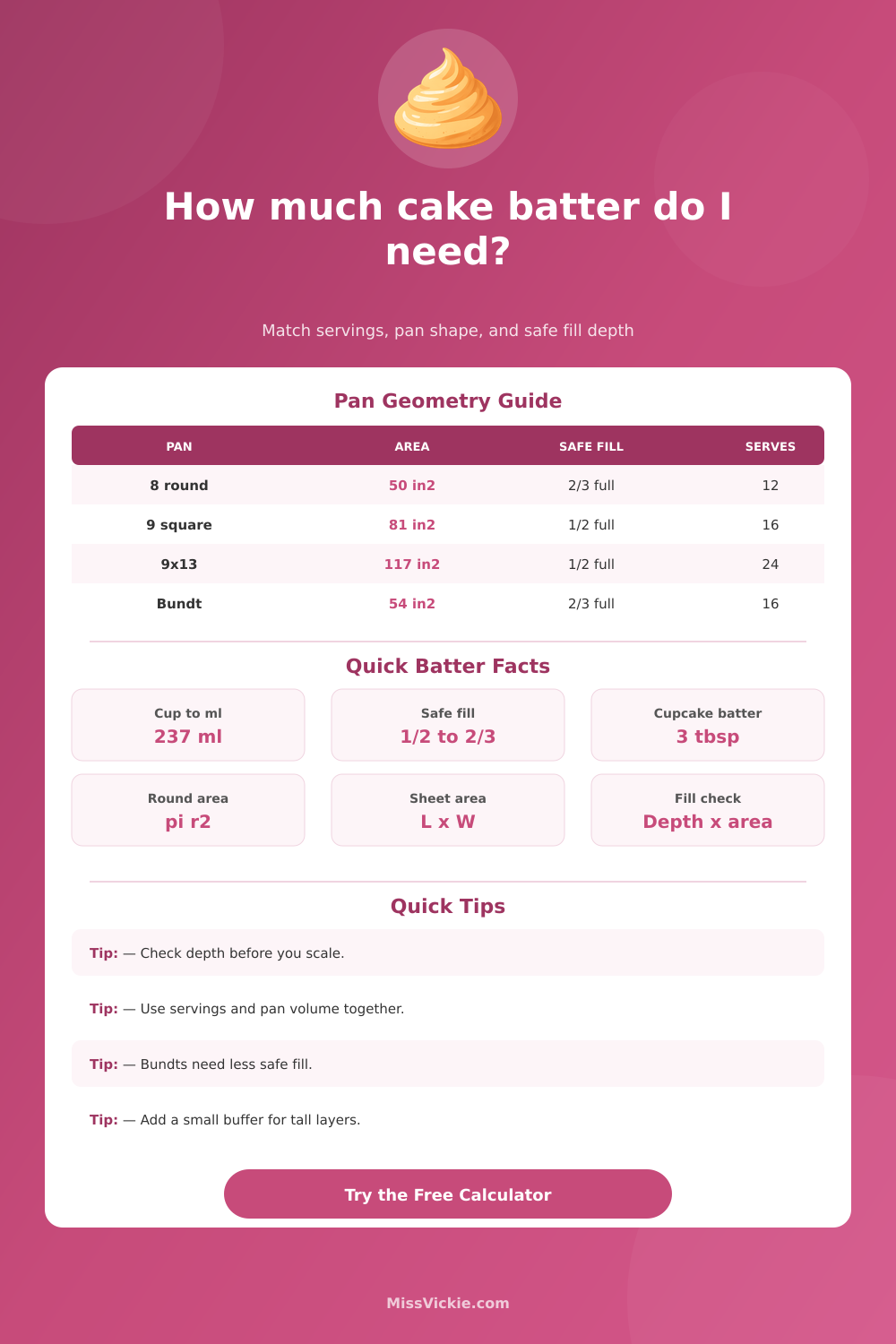
Use these formulas and guide values when a pan is described by diameter, side length, tube opening, or cupcake count instead of a direct volume chart.
| Shape | Area formula | Safe fill | Notes |
|---|---|---|---|
| Round | pi r2 | 62% | Classic layer pan |
| Square | side2 | 60% | Even corners |
| Rectangle | L x W | 55% | Sheet style |
| Ring | pi(R2-r2)/4 | 67% | Tube center |
Cake style changes batter density, rise, and ingredient balance. The calculator uses those differences when it scales the final batch.
| Style | Cups/serving | Grams/cup | Trait |
|---|---|---|---|
| Vanilla butter | 0.48 | 245 | Balanced crumb |
| Chocolate | 0.50 | 248 | More liquid |
| Red velvet | 0.49 | 242 | Plush crumb |
| Chiffon | 0.45 | 230 | High rise |
The larger of the serving volume or the desired fill-depth volume governs the final batter amount, then a small overage is added.
| Scenario | Servings | Depth | Batter cue |
|---|---|---|---|
| Layer pair | 12 to 16 | 1.0 to 1.3 in | Round or square |
| Party sheet | 24 to 36 | 1.0 to 1.2 in | Rectangle pan |
| Bundt cake | 14 to 16 | 1.8 to 2.1 in | Ring profile |
| Cupcakes | 12 to 24 | 0.9 to 1.0 in | Count by cavity |
Baking cake require an understanding of volume and pan dimension. If you use the wrong pan for a cake recipe, the cake may become too thin or it may overflow from a pan. A person must understand that the volume of batter required is not a universal measurement.
Furthermore, the pan in which you will bake the cake also has an impact on the bake of the cake. If you pour too much batter into the pan, the edges of the cake will burns before the center of the cake is cooked. If you pour too little batter into the pan, the cake will end up flat and will not reach the necesary height for the cake.
How Much Batter to Put in a Cake Pan
The depth of the batter poured into the pan is another critical factor in baking cakes, and this factor is more important than the diameter of the pan. The pan should never be filled to the top with batter. The leavening agent in the batter will cause the batter to expand as the batter heats up during the baking process.
If there is not enough headspace in the pan for the batter to expand, the batter will overflow from the pan. To avoid such an outcome, bakers must calculate how deep the batter should be in the pan. Because different type of cakes feature different densities in there batters, the depth of the batter required for one cake is not the same then another cake.
Dense pound cakes do not rise as high as light chiffon cakes. Chocolate cakes may require a different amount of volume compared to vanilla cakes. Due to the different densities of each type of cake batter, the baker must calculate the volume of batter poured into the pan accordingly.
In addition to the type of cake that is to be prepared, the number of guests that will be sharing the cake also have an impact upon the volume of batter that should be poured into the pan. A serving of cake is a theoretical amount of volume that must be prepared for a certain number of guest that will share the cake. However, the pan has a physical dimension that requires a certain amount of batter to fill it to the height required to produce a well baked cake.
It is possible that the amount of batter required to fill the pan to the proper height is more than the amount of batter that is required to feed the number of guest that will share the cake. In such cases, the baker should prioritize the geometry of the pan over the number of guests that will share the cake. Another factor that bakers should account for in the preparation of the batter is bowl cling.
Bowl cling is the name for the phenomenon in which some of the cake batter remain stuck to the sides of the bowl and the beaters used to mix the batter. If the baker calculates the amount of batter required for the cake and does not account for the batter that may adhere to the bowl and beaters, the batter level in the pan may be too low. To avoid under-filling of the pan, an overage of the recipe for batter can be calculate into the preparation of the batter.
The math and geometry involved in baking cakes can also be complicated by the type of pan in which the cakes are prepared. For instance, Bundt pans and tube pans require a different approach to the mathematics of baking cakes than do other types of pans. Bundt pans and tube pans feature chimneys in the center of the pans that allow the cakes to bake more evenly than would be permitted in pans with even thin walls and no chimneys.
Because of the way that the cake heats in these pans, it is impossible to use the same ratio of batter to volume of pan as is used with other types of pans. Understanding the geometry of these pans is essential to preparing cakes in them that will feature even crumb structure. Accuracy in the measurement units used in baking cakes is also important.
Metric units, such as grams of ingredients, are more accurate than the imperial units, such as cups, that are often used in cake recipes. Cups are a unit of volume, and the volume of liquids remains the same in any given cup, but the volume of dry ingredient can vary depending upon how the ingredient is scooped into the cup. Using grams, a unit of mass, avoids such potential inaccuracy.
Using mass units to scale recipes also allows cooks to be accurate in measuring the amount of ingredients that contain air, such as eggs; the aeration of the egg determines the rise of the cake. By calculating the exact number of the volume of batter that is required to bake a cake of a desired size to a specific height, bakers can remove guesswork from the baking process. By knowing the exact volume of the batter that is required and the exact depth to which that pan must be filled with the batter, bakers can have confidence in the baking process.
By respecting the safe depth to which the batter should be poured into the pan and by understanding the geometry of that cake pans, bakers will be able to create cakes with a sound structure.