
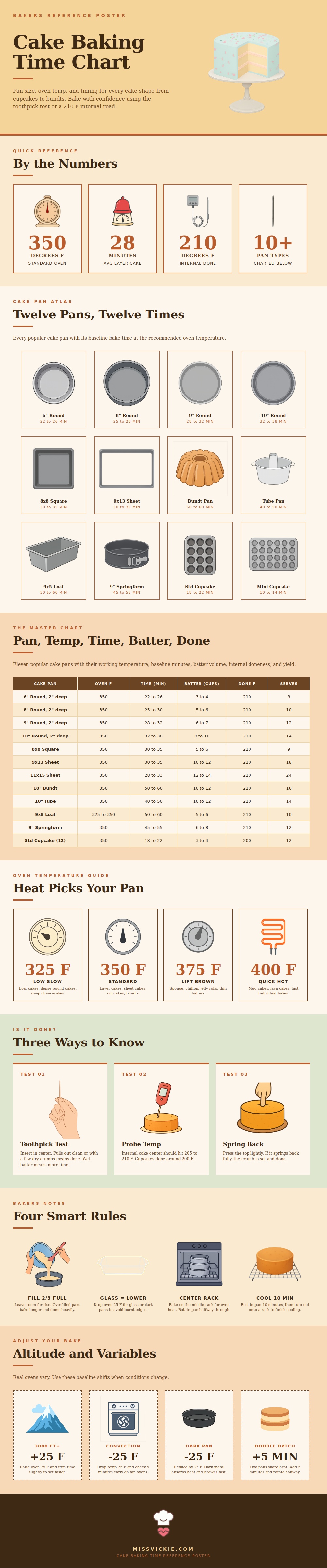
In order to master the art of baking cake, it is critical for an individual to understand the impact of pan size and oven temperature on the baking process. Pan size are important for two main reason. First, pan size will dictate the way in which heat travel through the cake batter.
Additionally, pan size will also determine the length of time in which the batter should remain in the oven. If the pan is too small for the batter, the batter may spill over the edges of the pan. If the pan is too large for the batter, the batter may bake in an even mannerly.
Pan Size and Oven Temperature for Baking Cakes
Therefore, it is critical to use a baking time chart to ensure that the individual is using a correct pan size for the correct baking time. A baking time chart contains the baking times for a variety of different pan, such as round pans, square pans, loaf pans, and bundt pans. A baking time chart accounts for the fact that thin batter will cook in a shorter period of time than thick batter.
For instance, it is likely that a six-inch round pan will take less time to cook than a loaf pan of the same type and batter, as the heat will travel to the center of the six-inch pan more quick. Additionally, baking time charts can indicate how many guests a pan will serve, allowing the baker to adjust the recipe to match the number of guests they intends to serve. Beyond pan size, another critical factor in baking is oven temperature.
Pan temperatures must be matched to the type of pan and batter being use when baking the cakes. Most often, people use 350 degrees Fahrenheit to bake layer cakes, sheet pans, and cupcakes. This oven temperature allow for the batter to rise evenly.
However, recipes like dense loaves or cheesecakes use 325 degrees Fahrenheit, as the slower baking process with the lower oven temperature will prevent cracks from form in the baked good. Airy sponge cakes may be baked at 375 degrees Fahrenheit, while mug cakes may be baked at 400 degrees Fahrenheit due to the need for the baking to occur at a faster rate to allow the batter to rise. Beyond oven and pan temperatures, pan shape and pan material can impact the baking process.
Round pans are generally predictable in that those with a smaller diameter will allow the center of the cake batter to cook through in a shorter period of time than large round pans. Pans that are square or rectangular in shape, like sheet pans, will generally cook more quick than deep pans. Tube pans use a center post to channel heat to the center of the pan, while springform pans allow for warm baking for items like cheesecake.
Additionally, pans made of glass or metal will absorb heat more quick than pans made of light metal. In these cases, the oven temperature must be reduced by 25 degrees to allow the pan to absorb the heat to prevent the bottoms of the cakes from burning. To ensure the cakes are properly baked, there is tests that can be utilized.
For example, a toothpick can be inserted into the cake batter. If the toothpick comes out with wet batter, it indicates that the cake is not yet baked; it should be returned to the oven for a period of five minutes. Additionally, an instant-read thermometer will display the internal temperature of the cake; 205 to 210 degrees Fahrenheit is the ideal range to indicate that the cake is done; however, cupcakes only require 200 degrees.
Finally, the spring-back test requires the baker to press lightly on the top of the cake; when it rebounds it is generally an indication of doneness. Beyond the factors mentioned thus far, there are a few others that will impact baking time and temperature. If an oven convection oven is used, 25 degrees can be reduced from the oven temperature settings because the fans in the oven will cook the items more quick.
If the cake is to be baked at altitudes of 3,000 feet or more above sea level, then 25 degrees can be increased in the oven settings because the air is thinner at higher altitudes. Finally, regardless of the type of pan being use, it should be placed on the middle rack within the oven; this rack will receive the most even heat distribution in the oven. By following these rules for properly baking cakes, cakes will be baked evenly, consistently, and successful.