Cake Baking Times by Pan Size
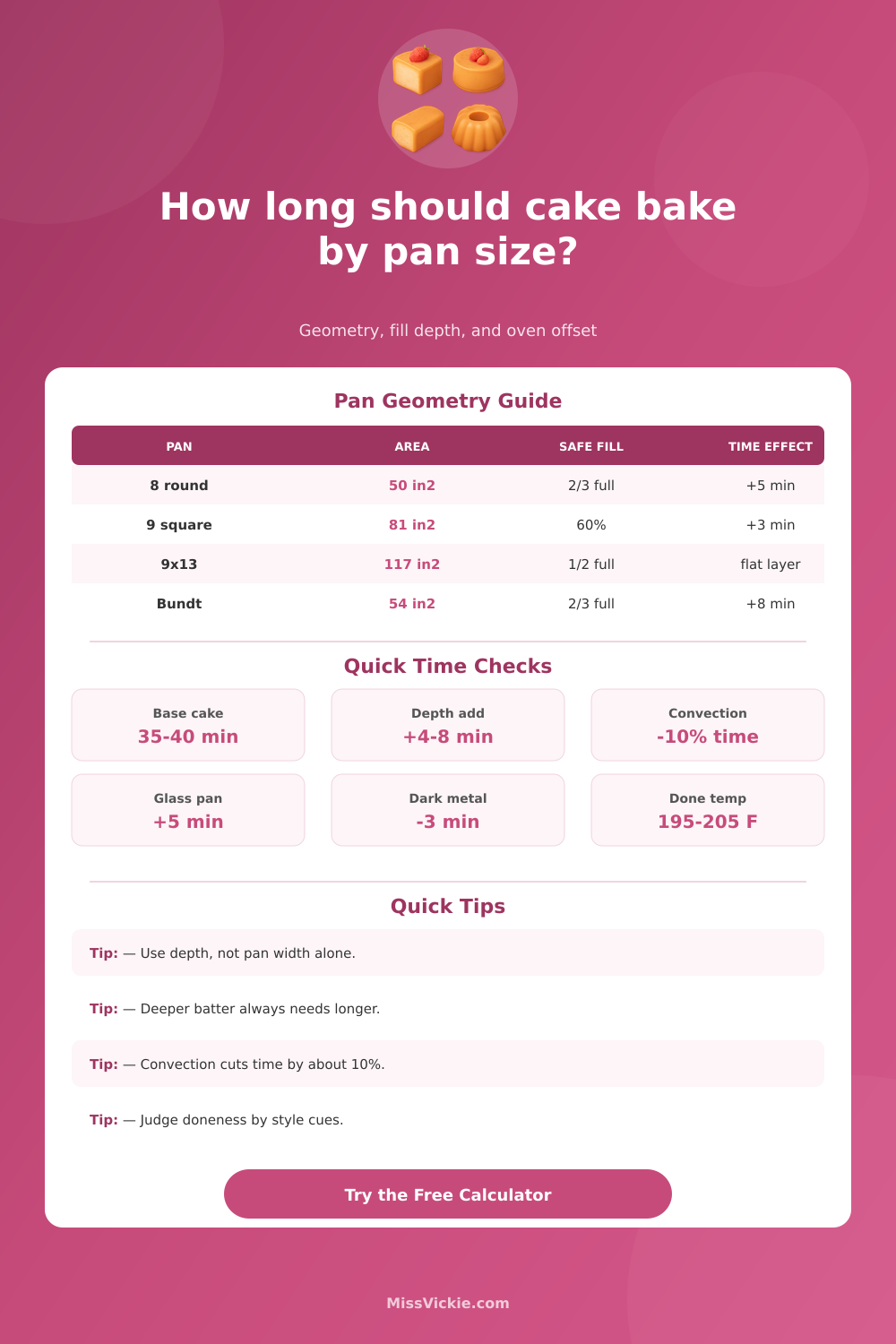
Convert pan geometry into bake time, then adjust for batter depth, oven type, pan material, and style-specific doneness cues.
Each preset loads a real cake scenario with a pan shape, fill depth, oven offset, and a style cue model so the calculator can run immediately.
Geometry and timing breakdown
These cards convert the pan into area, batter volume, safe fill depth, and a 9-inch round equivalent so you can compare shapes at a glance.
Each style uses a different doneness cue. Dense cakes need a cleaner skewer, while airy cakes are done sooner and may still feel springy.
| Cake style | Base time | Done temp | Doneness cue |
|---|---|---|---|
| Vanilla butter | 38-40 min | 200°F | Few moist crumbs |
| Chocolate fudge | 40-44 min | 200°F | Center springs back |
| Red velvet | 35-38 min | 198°F | Edges pull away |
| Carrot | 44-48 min | 203°F | Moist crumbs only |
| Sponge | 30-33 min | 194°F | Top rebounds fast |
| Chiffon | 34-37 min | 190°F | Barely jiggles |
| Pound | 52-58 min | 205°F | Deep crack, clean skewer |
| Oil cake | 36-39 min | 198°F | Few crumbs, not wet batter |
Use these formulas when a recipe gives pan dimensions, not a direct bake time. Smaller depth changes can matter as much as width changes.
| Shape | Formula | Safe fill | Time note |
|---|---|---|---|
| Round | pi x r² | 66% | Classic layer pan |
| Square | side² | 62% | Corners bake slower |
| Rectangle | L x W | 58% | Shallow and fast |
| Bundt / tube | outer - inner | 66% | Center tube helps heat flow |
| Loaf | L x W | 60% | Deep center needs more time |
| Cupcake | cavity x count | 50% | Small volume bakes quickly |
The offset model uses oven airflow and pan material together. A convection oven speeds heat transfer, while glass and insulated pans slow it down.
| Type | Time shift | Temp shift | Notes |
|---|---|---|---|
| Conventional | 0% | 0°F | Baseline timing |
| Convection | -10% | -25°F | Fast airflow |
| Fan-assisted | -12% | -25°F | Stronger circulation |
| Gas oven | -2% | 0°F | Watch for hot spots |
| Dark metal pan | -4% | -25°F | Browns faster |
| Glass pan | +5% | -25°F | Slower center heat |
| Insulated pan | +8% | 0°F | Adds insulation |
When baking a cake in a pan that is a different shape or size than what the recipe states, there are a few thing to know about how the shape of the pan can affect the way that the heat travel through the cake. For instance, the recipe may ask for two 8-inch round pans, but you may only have an 9-by-13-inch pan. Because of the difference in the pans, the way that the heat travel through the pan may cause the edges of the cake to become overbaked while the center of the cake is still liquid when the recipe say it should be done.
Heat from the outside of the pan must travel to the center of the cake, and the distance that the heat from the pan has to travel to the cake will impact how long the cake require to bake. One of the factor that impacts the baking time of the cake is the depth of the cake batter. If you move cake batter from a deep round pan to a shallow rectangular pan, the depth of the cake will cause the heat to reach the center of the cake more quick.
How Different Pans and Ovens Change Cake Baking
Thus, a shallow cake will require a shorter baking time than a deep pan of cake. Additionally, if you fill a cake pan too high with batter, the edges of the cake will set and overbake before the center of the cake has a chance to fully set. To avoid this issue, use the safe fill line on cake pans to avoid overbaking and spillover of the cake.
The material out of which the cake pan is made can also play a role in the baking of the cake. For instance, light-colored aluminum cake pans will reflect some of the heat from the oven, while dark metal pans will absorb that heat. Because the metal pans absorb the heat, dark pans will run hotter than light pans.
Thus, the edges of the cake may brown more fast on a dark pan than on a light-colored pan. Pans made of glass take longer to heat up than metal pans, but they retain the heat longer once they reach the baking temperature of the oven. Therefore, the bottom of the cake may begin to overbake when using glass pans.
The type of oven in which you bake your cake will also impact the baking process. Ovens that use a fan to circulate the hot air (called convection ovens) will remove the cold air that surround the cake. Consequently, the hot air will transfer to the cake at a faster rate than in a conventional oven.
Thus, using a convection oven will cause the cake to bake to the setting of your timer without adjustment to the temperature or the time that the cake is baked in the oven may result in the cake that appear to be finished baking when it may not be finished with the center of the cake remaining raw. To adjust for this, use a cake baking calculator to account for the difference in type of oven to bake your cake to doneness. The density of the cake batter will also play a role in the baking time of the cake.
For instance, sponge cakes contain alot of air bubbles that allow the cake to set quick. However, if you leave the cake in the oven after setting the sponge cake will become dry. Pound cakes, in contrast, contain more butter and sugar which create a more dense cake that requires more time to bake to reach the internal temperature required to consider the cake done.
Because of these difference, pound cakes cannot be baked in the same way as sponge cakes. Finally, to ensure the cake has baked to doneness, check the cake a few minute before the timer ends. One way to check if the cake is baked is to look at the edges of the cake to see if they appear to be pulling away from the sides of the cake pan.
Another way is to touch the center of the cake to see if it spring back when pressed. The most accurate means of testing whether the cake is baked to doneness is with a thermometer to ensure the cake has reached the correct internal temperature for that type of cake. Thus, by understanding how the heat of the oven, the material of the pan, and the depth of the cake batter impact the baking process, it is possible to successfully bake a cake in any pan that you may possess.