Buttercream to Fill Cake Calculator
Estimate buttercream for cake filling layers, buttercream dams, crumb coat coverage, side smoothing loss, tier count, serving style, and buttercream density.
Choose a common layer-cake build, then adjust the filling thickness, dam width, crumb coat, density, and side loss.
Buttercream Filling Breakdown
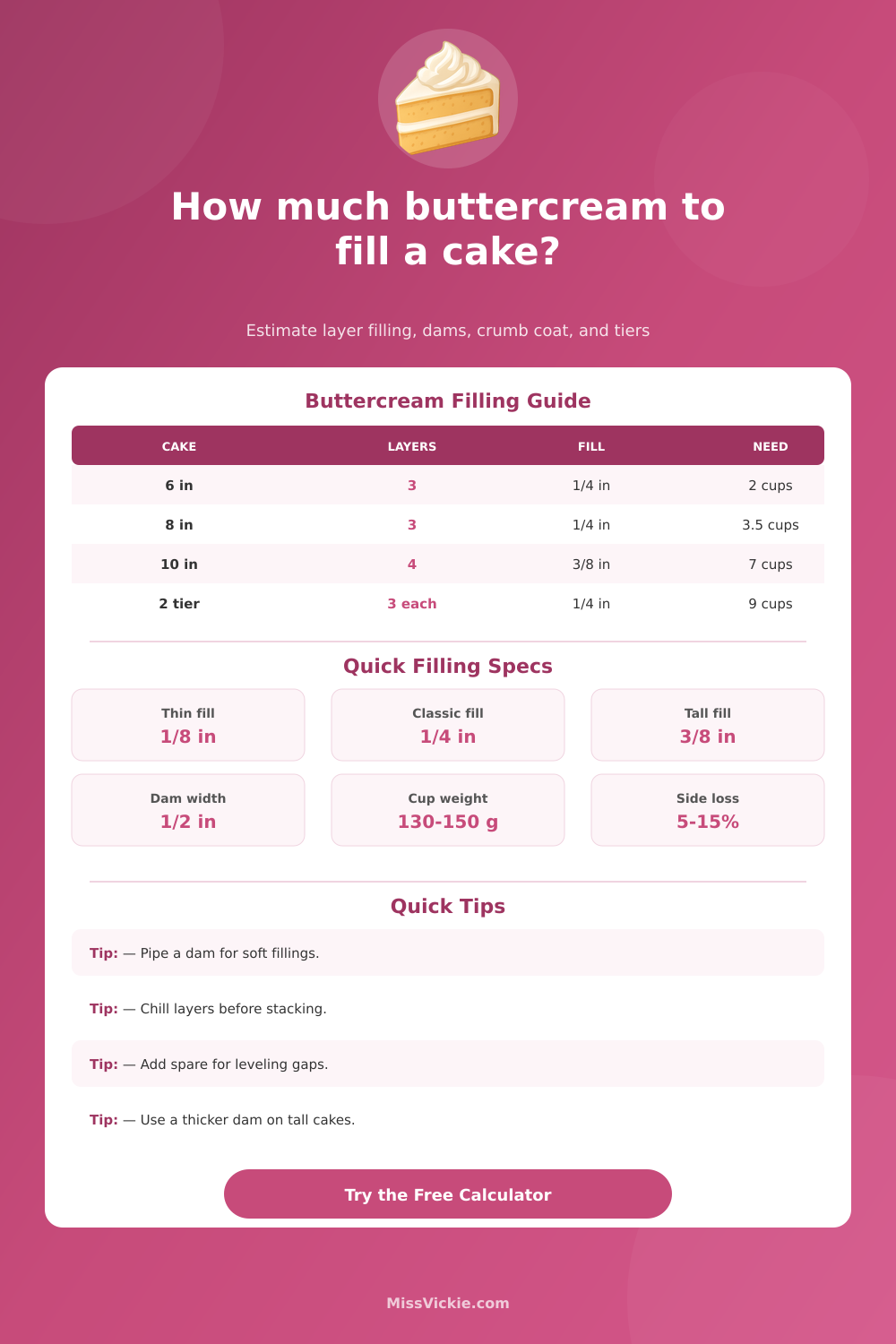
| Cake Build | Filling Seams | Dam Width | Filling Thickness | Typical Buttercream |
|---|---|---|---|---|
| 6-inch round, 3 layers | 2 seams | 3/8 to 1/2 in | 1/4 in | About 2 to 2.5 cups before crumb coat |
| 8-inch round, 3 layers | 2 seams | 1/2 in | 1/4 in | About 3 to 4 cups before crumb coat |
| 10-inch round, 4 layers | 3 seams | 1/2 to 5/8 in | 1/4 to 3/8 in | About 6 to 8 cups before crumb coat |
| Two-tier round stack | 4 to 6 seams | 1/2 in | 1/4 in | About 8 to 11 cups with side loss |
| Quarter sheet layer cake | 1 to 2 seams | 1/2 in border | 1/4 in | About 5 to 7 cups before crumb coat |
| Buttercream Type | Typical Density | Best Filling Use | 1 Cup Equals | Batch Note |
|---|---|---|---|---|
| Swiss meringue buttercream | 125 g per cup | Light, silky layers | 4.4 oz | Good for chilled stacks |
| American buttercream | 140 g per cup | Classic birthday cakes | 4.9 oz | Holds dams well |
| Cream cheese buttercream | 155 g per cup | Soft cakes and red velvet | 5.5 oz | Use a firmer dam |
| Chocolate buttercream | 165 g per cup | Rich bakery filling | 5.8 oz | Warm briefly before spreading |
How much buttercream go into a cake is more important than you’d think. If you have too little your layers will be dry or won’t hold together when you slice it. Too much? It’ll all go top heavy or the filling will squish out the sides as soon as you get your first slice in.
How thick is the layer between your cake? What about that dam around the outside? What about the crumb coat? The bit you lose when smoothing everything out? All those thing add up when you build your cake. And that’s the real question: How many cups do I need?
Why Buttercream Amount Is Important
The nature of the slice also depends on how thickly you fill it. If you use a thin layer the cake remain light and the sponge shines through. If you use a thick layer, it become more like a dessert sandwich with the buttercream as centerpiece. Once you’ve decided which kind of experience you’re aiming for, the calculator above take care of all the math for you.
All you need to know is this: the amount it gives you already accounts for the fact that a wide dam reduces the space you can fill. Why are dams good? Cake fillings tend to be softer than buttercreams, like pastry creams and jams, so the dam prevent leakage. The bigger your dam, the more buttercream you’ll apply, and the safer the cut will be. It’s a tradeoff to consider before you pick up your piping bag.
The same applies to the crumb coats. If you’re making a plain cake, some bakers just omit them. Others want to trap crumbs with a thin layer of icing first before applying top coat. You can select which approach most closely matches your practice in the calculator.
Another one that creeps up on folks is density: A cup of light, silky swiss meringue will weigh significantly less then a cup of dense chocolate buttercream. That all adds up quickly if you’re trying to reach a specific total weight or if you change amount of a recipe from what was originaly planned. This way, you can plan your batch sizes and convert grams to cups without guesswork.
Most people underestimate side loss. This is the amount of excess scraped off the sides, wiped away with your offset spatula, or filled in as a low spot. That’s all buttercream that won’t go on your finished cake. Loss isn’t wasted. You add just enough to cover what you’ll lose so you can finish the job stress-free instead of running out while you are still smoothing it.
And then there’s the question of tiers. Every tier have its own seam. How do you want to serve it? Do you want your guests to have a neat, small bite like they would at a wedding or a tall, dramatic slice from the bakery? The calculator takes this into account because no one wants the last piece of cake to be glaringly dry compared to the rest of the cake.
That’s why planning really pays off: you know that every single piece of cake, from first to last, will taste exactly as you wanted it to. It is the perfect blend of cake and filling, top to bottom. You should of planned for this so things look luxuruis.