🍰 Buttercream Between Cake Layers Calculator
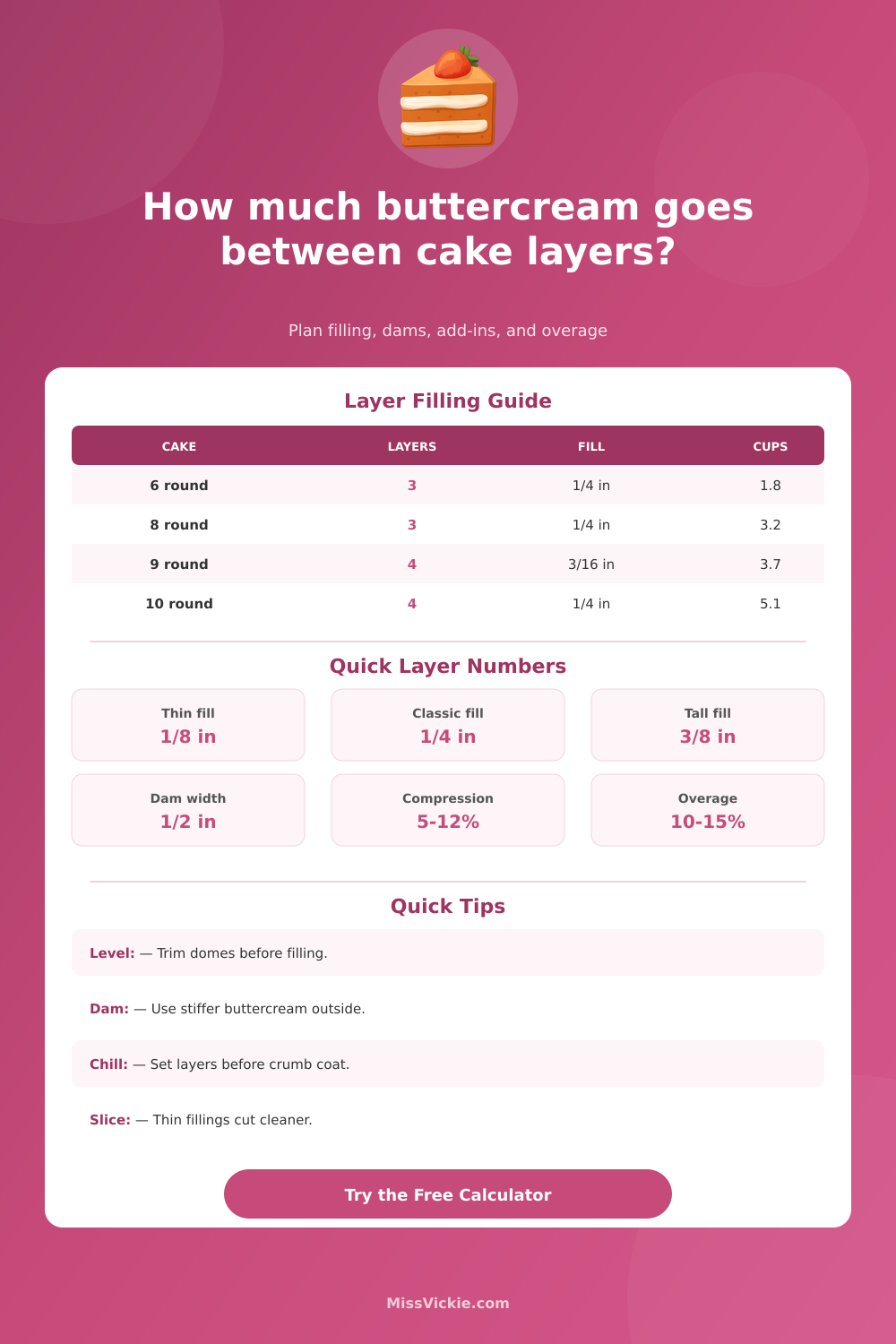
Estimate the buttercream filling and dam amount needed between cake layers using cake diameter, layer count, fill thickness, add-ins, compression, servings, and overage.
Use the diameter that matches one round layer. For square or sheet layers, choose equivalent diameter and use the table below to convert by surface area.
Buttercream Breakdown
Enough buttercream for flavor without pushing the layers apart.
Best for naked cakes, tall tiers, and very sweet buttercream.
Works for soft party cakes when layers are chilled and level.
Use a firmer ring when fruit, curd, caramel, or mousse is inside.
Round Cake Filling Amounts
| Diameter | 3 layers | 4 layers | Classic dam |
|---|---|---|---|
| 6 in | 1.6 cups | 2.4 cups | 0.4 cup |
| 8 in | 2.9 cups | 4.4 cups | 0.6 cup |
| 9 in | 3.7 cups | 5.5 cups | 0.7 cup |
| 10 in | 4.6 cups | 6.9 cups | 0.8 cup |
Fill Thickness Guide
| Thickness | Use | Slice feel | Risk |
|---|---|---|---|
| 1/8 in | Naked cake | Light | Low slip |
| 3/16 in | Tall tier | Moderate | Low-medium |
| 1/4 in | Classic cake | Balanced | Medium |
| 3/8 in | Party cake | Rich | Higher slip |
Buttercream Style Density
| Style | Weight | Firmness | Best gap |
|---|---|---|---|
| American | 8.2 oz/cup | Firm | 1/4 in |
| Swiss | 7.2 oz/cup | Silky | 3/16 in |
| Cream cheese | 8.5 oz/cup | Soft | 3/16 in |
| Ganache buttercream | 8.8 oz/cup | Dense | 1/4 in |
Add-In and Dam Adjustments
| Add-in | Buttercream | Dam need | Stack note |
|---|---|---|---|
| Jam or curd | Reduce 12% | Higher | Pipe firm ring |
| Berries | Reduce 18% | Highest | Drain very well |
| Cookie crumbs | Reduce 10% | Normal | Keep layer even |
| Caramel ribbon | Reduce 15% | Higher | Chill before stack |
Calculator results are practical baking estimates. Actual yield varies with how much air is beaten into the buttercream, layer trimming, spatula loss, and how firmly the cake is stacked.
The amount of buttercream that is used between the cake layer will affect the taste of the cake, the cake’s ability to remain together during transport, and the way the cake’s slice will look when they is cut. Using too little buttercream between the cake layers will make the cake taste dry, but using too much buttercream will cause the cake layers to slide when frosting the outside of a cake. Each of these factors must be considered when determining the amount of buttercream to use between cake layer.
The thickness of the buttercream will help to determine the character of the cake layer that is created when you cut the cake in half, and will also impact the ease with which the cake can be cut. Using a thin layer of buttercream will create a light cake layer, and will make it easy to cut the cake if the layer contains a very sweet filling. Using a thick layer of buttercream will add richness and moisture to the cake layers.
How much buttercream to use between cake layers
Additionally, thick buttercream layer are useful for providing guests with a large bite of cake when entertaining for a large number of guest. The thickness of the buttercream should be balanced to the firmness of the buttercream; soft buttercream will compress under the layers of the cake, reducing the amount of buttercream that will be used to create the finished cake structure. In contrast, stiff buttercream will provide structural integrity to the cake but may be too heavy if the layer contain a thick application of stiff buttercream.
A buttercream dam will help to prevent the soft filling from being forced out of the cake layers as new layer are placed upon the cake. Because the buttercream dam take up some of the space within the cake, the filling in the center of the cake is reduced in size. Additionally, any add-ins to the cake, such as jam or berry, will also reduce the available space for the cakes filling.
Therefore, the amount of buttercream that is used for the filling may be less if the cake also contains add-ins. After the cake layers are assembled, some of the filling may compress against the edge of each layer. This phenomenon is referred to as “compression.” Compression can occur as a result of either the weight of the layers placed upon the cake, or as a result of the cake sitting in the refrigerator for long period of time.
Some loss of the filling is to be expected as a result of these factor. Therefore, some extra buttercream should be prepared to account for the amount that may remain on the buttercream spatula, may be lost during testing of the buttercream thickness, and in case any touch-up of the cake layer is required after the cake has been chilled. Though these amount are small, they should be considered in order to prevent the buttercream from running out during the cakes assembly process.
The calculator will ask for a variety of different measurement of the cake to provide the mathematical calculation of the amount of buttercream that will be required. The diameter of the cake, the number of cake layer, the thickness of the buttercream, the width of the buttercream dam, the type of frosting, and any add-ins may be required for the calculator to provide the amount of each component of the cake. Additionally, increasing the thickness of the buttercream will increase the amount of buttercream required to cover the layer.
Adding fruit to the cake will reduce the amount of space for the filling but will increase the amount of buttercream required for the dam around the cake. Finally, the type of frosting will change the weight of the buttercream required, thus changing the calculation if weight of the buttercream is being used as the measurement. Due to the way in which cake often contain variables, such as not-level cake layer, differences in the amount of air in different batch of buttercream, and variable room temperature, the estimate from the calculator may not reflect the actual amount of buttercream that may be required.
Additionally, watching the cake during the baking process may reveal additional information about how to best adjust the recipe for future cake. For instance, if the filling appear as if it may push past the buttercream dam, chilling the layer prior to placing it upon the cake may be required. Additionally, if the amount of filling appear to be thin for the layer of cake already assembled, that same information can be recorded about the recipe to be used for future cakes.
Thus, using these calculator allows an individual to gain an understanding of how each component of the cake may impact the other component, and to be able to make adjustments according to these observation in the future.