Buttercream Food Coloring Calculator
Estimate how much gel, liquid, or powder food coloring to add to buttercream by frosting amount, buttercream style, base color, target shade, resting time, and stain tolerance.
Pick a common decorating job, then adjust the frosting amount, shade depth, rest time, and overage to match your batch.
Calculation Breakdown
| Buttercream | Approx Weight | Color Behavior | Best Shade Range |
|---|---|---|---|
| American buttercream | 190 g per cup | Opaque and sweet, takes gel color quickly. | Pastel to deep shades |
| Swiss meringue buttercream | 160 g per cup | High butter content warms color as it rests. | Soft pastels and muted tones |
| Italian meringue buttercream | 150 g per cup | Silky, lighter texture needs gradual additions. | Pastels and medium colors |
| Cream cheese frosting | 205 g per cup | Ivory base dulls cool tones unless corrected. | Warm colors and ivory |
| Ermine frosting | 175 g per cup | Cooked milk base gives a soft creamy tint. | Light to medium shades |
| White chocolate buttercream | 210 g per cup | Yellow undertone needs extra blue or violet. | Ivory, yellow, coral |
| Vegan buttercream | 180 g per cup | Plant fats can resist some water-based colors. | Gel and powder shades |
Best all-purpose choice for buttercream because it adds concentrated color without thinning the frosting much.
Works for light shades, but deep colors can soften buttercream because the tint is diluted with water.
Strong and dry, useful for dark shades when you want vivid color with less extra moisture.
Useful in fat-rich frosting or candy-style buttercream, especially when water-based colors bead or streak.
| Target Shade | Gel Starting Point | Recommended Rest | Decorator Note |
|---|---|---|---|
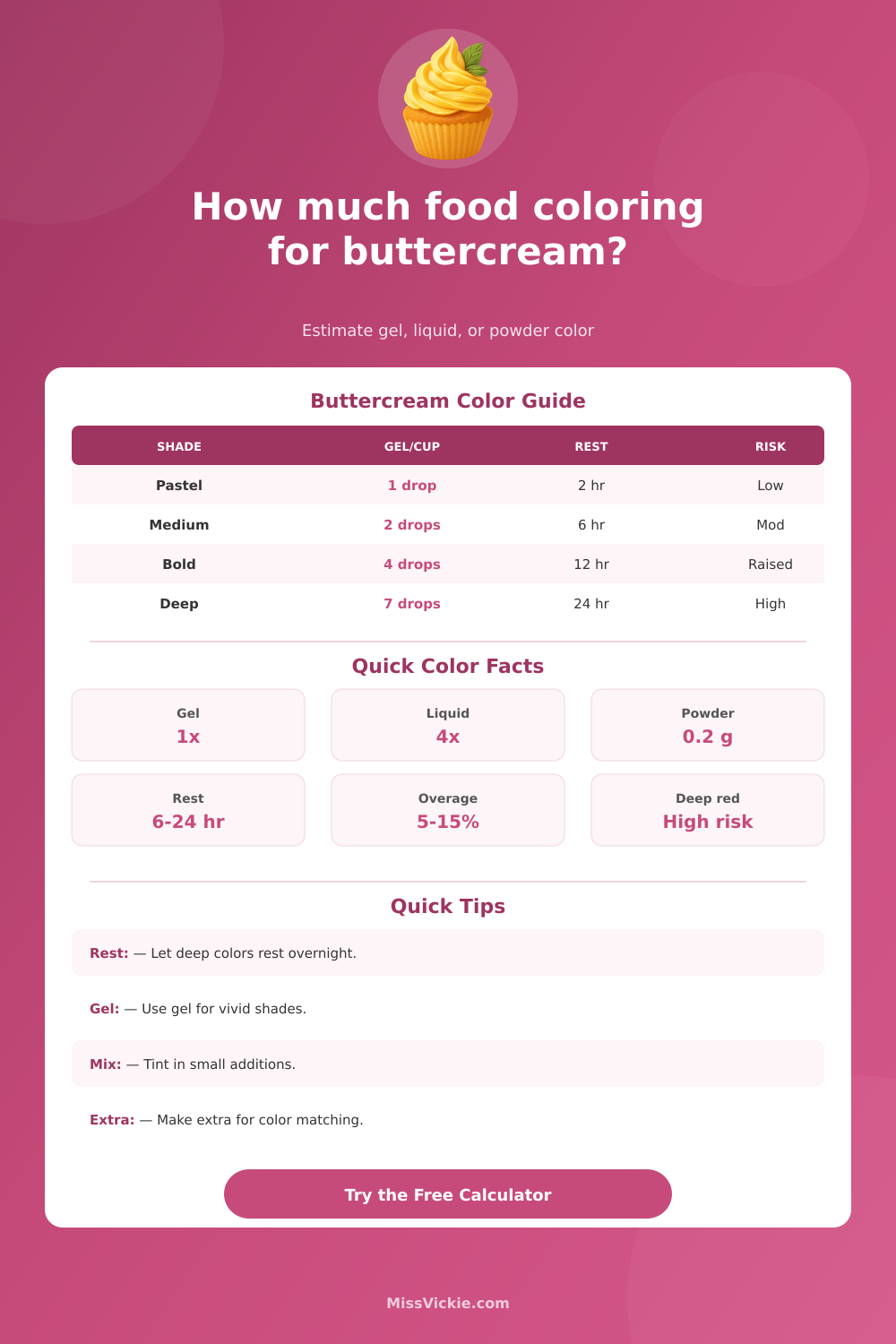
| Pastel pink, yellow, mint, or blue | 0.5 to 1 drop per cup | 2 hours | Add with a toothpick or tiny dot first. |
| Medium coral, green, lavender, or teal | 1.5 to 3 drops per cup | 6 hours | Beat, rest, then adjust after color blooms. |
| Bold red, royal blue, leaf green | 4 to 6 drops per cup | 12 hours | Use a starter base to reduce bitterness. |
| Deep navy, burgundy, black, emerald | 6 to 9 drops per cup | 24 hours | Rest overnight and avoid adding all at once. |
| Base or Intensifier | Helpful For | Color Effect | Use Carefully When |
|---|---|---|---|
| Bright white buttercream | Pastel and cool tones | Shows color cleanly with the least tint. | You need ivory or warm cream. |
| Off-white vanilla base | Pink, peach, yellow, and ivory | Adds warmth and may mute blue shades. | Making navy, gray, or lavender. |
| Pink starter for red | Red, burgundy, and coral | Red reaches depth with less colorant. | The final shade must stay cool. |
| Cocoa or black cocoa support | Black, brown, burgundy, navy | Darkens the base before color is added. | You need a pure vanilla flavor. |
| White base correction | Clean pastels and wedding white | Reduces yellow cast before tinting. | Using an already pale cool shade. |
| Purple neutralizer | Yellow butter bases | Cools yellow undertones in tiny amounts. | The target shade is warm yellow. |
| Decorating Use | Typical Frosting | Color Plan | Overage |
|---|---|---|---|
| 12 cupcake swirls | 2 to 2.5 cups | Pastel or medium gel color | 5 percent |
| 8-inch layer cake outside | 3.5 to 4.5 cups | One main color plus border shade | 10 percent |
| 9x13 sheet cake | 3 to 5 cups | Light base with darker accents | 10 percent |
| 3-tier wedding cake accents | 8 to 12 cups | Mix a master batch for consistency | 15 percent |
| Deep red or black piping | 1 to 3 cups | Rest overnight before final adjustment | 15 percent |
| Flower buttercream colors | 0.5 to 2 cups each | Small cups tinted separately | 8 percent |
Achieving the correct colors in your buttercream is essential when you are decorating a cake. The color of your buttercream, however, can be difficultly to predict because the color of the buttercream can change over time. Even if you prepares your buttercream according to the recipe, you may find that the color of the buttercream isnt as you had intended for a variety of different factor.
One of the factors that can contribute to the change in the color of your buttercream is the amount of buttercream that you prepare. Depending on the amount of buttercream that you prepare, you may need to use a different amounts of colorants to achieve the same desired color result. For instance, if you prepare a small amount of buttercream to use for piping decoration, you will need to use a different amount of colorant than if you were to prepare a large amount of buttercream to use to cover a cake.
How to Make Buttercream the Right Color
Another of the factors that can contribute to the color of your buttercream is the type of colorant that you use. For instance, gel paste colorant contain a high level of colorant in a small amount of liquid, so the colorant will have minimal effect on the texture of your buttercream. Liquid colorant can be helpful in preparing pale colored buttercreams, but if you use too much liquid colorant your buttercream may become too soft.
Powder colorants dont contain any liquid, so you can prepare deep colored buttercreams without diluting the buttercream. Each type of colorant will contain a different amount of strength, so you will need to use different amounts of each type of colorant to achieve the same result. The amount of time that your buttercream sits can also have an impact on its color.
Buttercream that is freshly prepare may appear lighter than the buttercream after it has sat for several hour; the pigments naturaly bloom within the buttercream while it sits. If you find that your buttercream is too pale when you prepare it, it may reach the correct color without the addition of more colorant; the colorant will bloom in the buttercream over time. Deep color, such as red and black, may require the buttercream to sit for at least overnight to allow for the colorant to bloom to its full strength.
Pastel colors, however, may not require the buttercream to sit for as long, such as a few hours. In either case, allow the buttercream to rest prior to using it for your decorations; if you add too much colorant to your buttercream it will be too strong. An additional factor to consider is the amount of extra buttercream to prepare in addition to the amount that you will need for your cake; this amount is refer to as overage.
You can prepare extra buttercream to ensure that you have enough buttercream to correct any mistake that you may make when decorating your cake. Extra buttercream that has been tinted allows for the piping bags to be refilled, or for any extra buttercream to be used later in the decorating process. The amount of extra buttercream that you prepare will depend upon the number of color that will be used on the cake, and how closely each color must match the others.
If you are simply icing a cake, you will need less overage than if you are icing a multi-tier wedding cake. Deep colors may stain your hands, clothing, or decorative tool. Since deep colors require more pigment to achieve their effect, there is a greater chance that the pigment will stain your skin or clothing.
Though some bakers may want to use such colors for their decorating projects, others may prefer using lighter colors to avoid the staining of their tools and their clothing. Finally, it is helpful to use a buttercream colorant calculator to determine how much colorant to use in your buttercream; the calculator will help you to determine the amount of colorant that you will need to prepare your buttercream to achieve the desired color. Though the calculator will not ensure the achievement of your desired color, it will allow you to start closer to your desired color.
Starting closer to your goal color will save you time and allow you to avoid wasting your buttercream.