Buttercream for Cake Pops Calculator
Estimate cake pop buttercream binder from cake crumb weight, cake moisture, pop diameter, pop count, buttercream style, chilling time, coating weight, crumb compression, stick size, and binder percentage.
Choose a batch style, then adjust the crumb weight, pop diameter, buttercream, compression, coating, and chill time before calculating.
Cake Pop Binder Breakdown
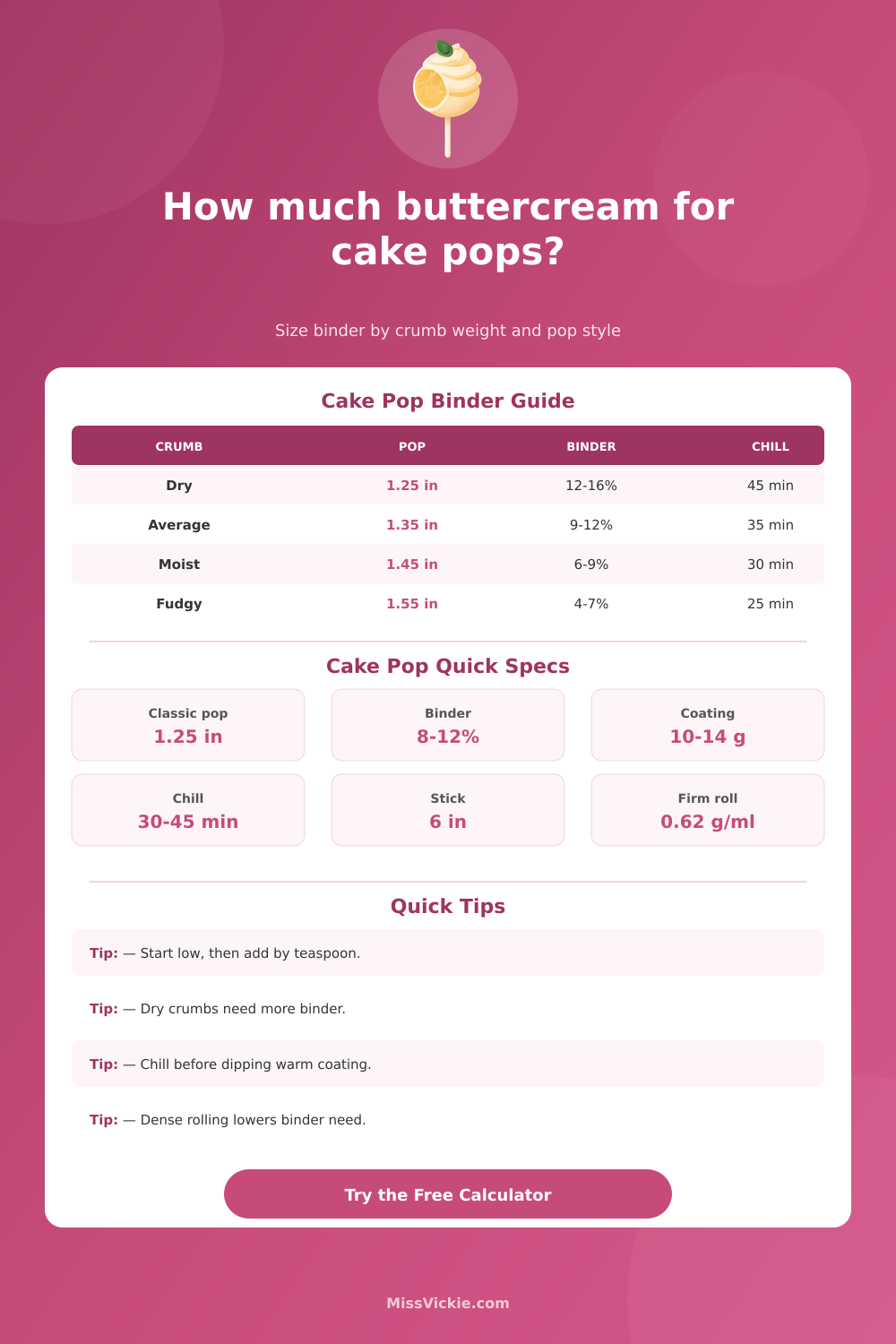
| Cake Crumb Condition | Usual Binder Range | Best Buttercream Style | Mixing Cue |
|---|---|---|---|
| Dry vanilla, trimmed edges, or day-old sponge | 12% to 16% of crumb weight | American or crumb-coat buttercream | Mixture should press together without dusty cracks. |
| Average butter cake or boxed cake crumbs | 8% to 12% of crumb weight | American, Swiss, or leftover buttercream | Roll a test ball; it should hold a clean seam. |
| Moist oil cake, red velvet, carrot cake, or filled layers | 6% to 9% of crumb weight | Cream cheese or Swiss meringue buttercream | Stop while the crumb still feels like soft dough. |
| Fudgy chocolate cake, brownie scraps, or ganache cake | 4% to 7% of crumb weight | Ganache buttercream or very light frosting | Use less binder so pops do not turn pasty. |
| Pop Size | Diameter | Center Weight | Stick Size |
|---|---|---|---|
| Mini cake pop or truffle bite | 1.0 to 1.15 in / 2.5 to 2.9 cm | 14 to 20 g before coating | 4 in or 10 cm stick |
| Standard party cake pop | 1.25 to 1.4 in / 3.2 to 3.6 cm | 24 to 34 g before coating | 6 in or 15 cm stick |
| Large bakery cake pop | 1.5 to 1.65 in / 3.8 to 4.2 cm | 38 to 52 g before coating | 6 to 8 in stick |
| Dense molded character pop | 1.4 to 1.8 in / 3.6 to 4.6 cm | 36 to 65 g before coating | 8 in or 20 cm stick |
Works for mini pops, very smooth coating, and careful tapping.
Good planning range for most 1.25 to 1.4 inch cake pops.
Use for thicker candy melts, drizzle, sanding sugar, or shaped details.
Firm enough to dip, but not frozen hard enough to crack coating.
| Batch Plan | Cake Crumbs | Buttercream Binder | Coating Needed |
|---|---|---|---|
| 24 standard pops from one small cake | 600 to 720 g crumbs | 55 to 85 g buttercream | 290 to 360 g coating |
| 36 standard pops for a dessert tray | 850 to 1050 g crumbs | 80 to 125 g buttercream | 430 to 540 g coating |
| 60 small wedding favor pops | 1250 to 1550 g crumbs | 115 to 175 g buttercream | 650 to 840 g coating |
| 72 mini truffle-style cake pops | 1050 to 1350 g crumbs | 95 to 150 g buttercream | 600 to 790 g coating |
The right amount of buttercream is important with cake pops since it will determine what they look like in the end. If there isn’t enough, the center won’t hold onto stick, but if there’s too much, they’ll be dense and/or they’ll fall off their sticks when dipped.
How hard or soft you roll them also plays into this along with size of your pops and what kind of cake you’re using. When you’re using cake crumbs instead of fondant, they differs in their dryness. A slightly-drier-than-normal vanilla cake requires a higher percentage of binder (like buttercream) compared to slightly-moist-brownie-crumbs. That’s why the calculator has an option that factors in the original cake moisture level and changes it accordingly. It also takes into consideration type of buttercream, as Swiss meringue is different from cream cheese frosting which is different than American buttercream.
Finding the Right Amount of Buttercream
And then there’s diameter: bigger pops has more volume, so that same percentage of binder extend over more cake. Because the ratio of surface area (the outside) vs. The ratio of surface area to center is higher with smaller pops, so the binder must do more to prevent them from separating. The tool adjusts this when you enter your desired final size; it also automatically adjust based off how tightly packed your mix was. Looser rolls contain more air, so they require a greater percentage, whereas denser pops could of get away with less.
The other variable is chilling time before dipping, which will be soft or mushy in the middle (coating pulls easier) or firm (you run risk of cracking shell if the coating is already too warm). Chill time is also part of final recommended time on the calculator. You won’t have to guess whether 30 minutes was long enough or if 45 minutes are better.
Stick length is one of the inputs used by the tool along with coating weight per pop. The other inputs are the Coating weight per pop and the stick length. Since more coating mean adding weight to the pop, this factors into what a pop feels like on stick. This holds true for larger diameter. So the tool will indicate the finished weight and amount of binder used so you can tell whether the pop will be balanced when completed.
After calculating how much binder to mix, most people begins with half the amount and then try just enough to pinch between their fingers. If it feels like a good consistency, holding its shape but not too sticky or breaking apart, you can slowly incorporate remainder. This helps avoid overmixing and ensures that texture remains light.
When you’re ready to scale up to make a few trays or for an event, the reference tables offers guides for various amounts and types of batches based on desired crumb condition. But even after setting the numbers, the true test is first roll. By feel, if it’s working well under your fingers, odds are remaining batch will be close to the same.