🧈 MissVickie butter math
Grams to Tablespoons Butter Converter
Convert butter grams into tablespoons, teaspoons, cups, and sticks using real butter types, spoon standards, and practical kitchen adjustments.
✨ Quick Butter Presets
These presets cover common kitchen jobs, from one tablespoon checks to full-stick baking math, and each one loads a real butter scenario before calculating.
🧇 Butter Converter Inputs
Choose the butter style, the way it is handled, and the spoon standard you want to use. The result cards keep tablespoons front and center while still showing the useful kitchen equivalents.
Imperial view keeps tablespoons and sticks easy to read, with metric equivalents in the cards.
🧈 Live Results
The result cards show the main spoon conversion first, then the teaspoon, cup, and stick equivalents so you can match the number to the recipe style you are using.
📈 Butter Gram to Spoon Chart
Use this chart for quick reference when the recipe gives you a gram number and you want a spoon amount without running the calculator every time.
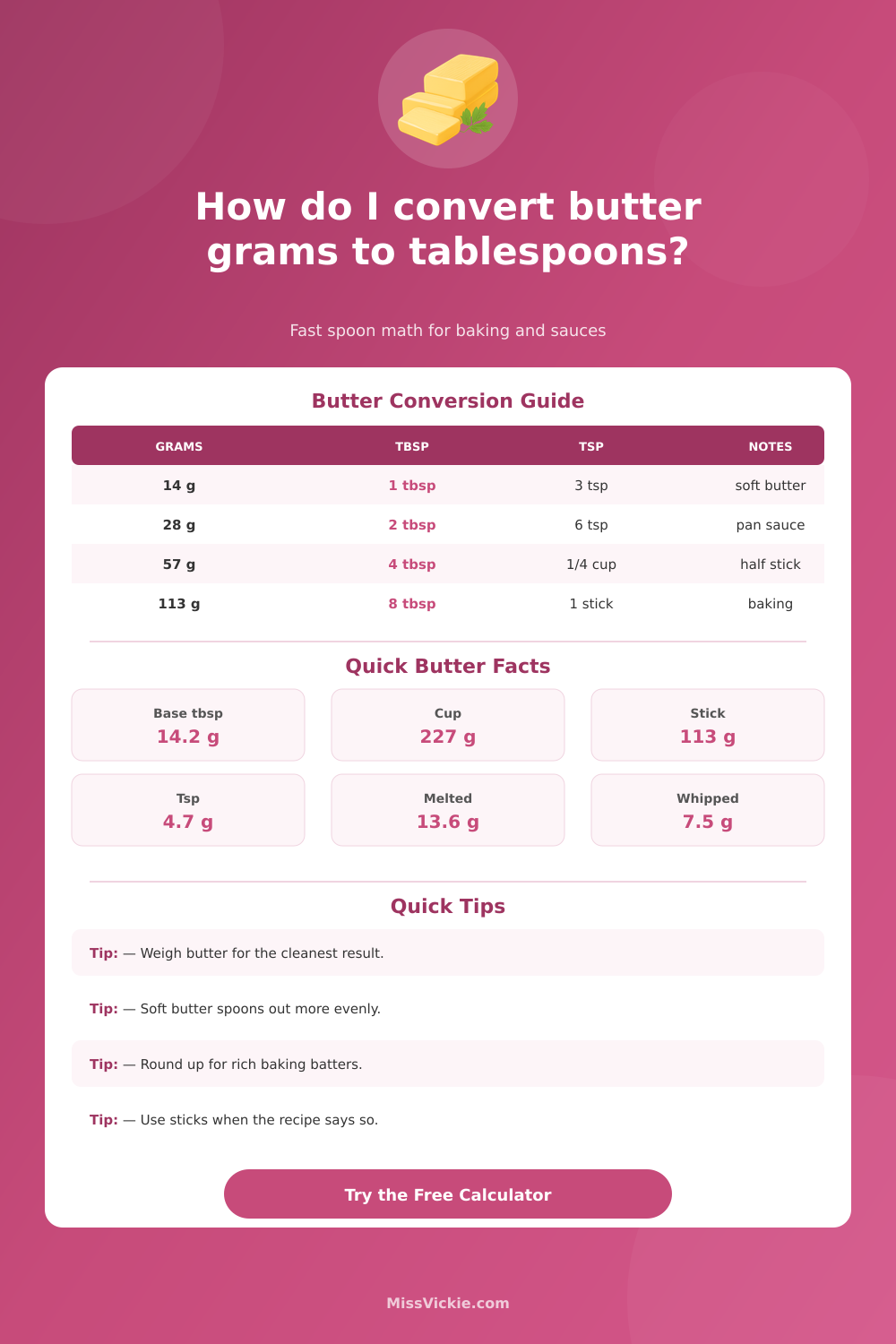
| Grams | Tablespoons | Teaspoons | Kitchen Note |
|---|---|---|---|
| 7 g | 1/2 tbsp | 1.5 tsp | tiny garnish |
| 14 g | 1 tbsp | 3 tsp | classic spoon |
| 28 g | 2 tbsp | 6 tsp | small sauce |
| 57 g | 4 tbsp | 12 tsp | half stick |
| 113 g | 8 tbsp | 24 tsp | one stick |
| 227 g | 16 tbsp | 48 tsp | one cup |
🧈 Butter Type Reference
The numbers below keep the calculator grounded in familiar kitchen values. Different butter styles can shift the spoon math a little, especially if the butter is whipped or clarified.
| Butter Type | g per tbsp | g per cup | Best Use |
|---|---|---|---|
| Unsalted | 14.2 g | 227 g | baking |
| Salted | 14.2 g | 227 g | everyday use |
| European-style | 14.4 g | 231 g | rich dough |
| Whipped | 8.0 g | 128 g | spreads |
| Melted | 13.6 g | 218 g | pan sauce |
| Clarified | 12.8 g | 205 g | high heat |
🧆 Butter Form and Use Comparison
Form matters because the same butter can pack, spread, or melt differently depending on how you handle it. Pick the form that matches the recipe, not just the number on the scale.
| Form | Factor | Behavior | Why It Helps |
|---|---|---|---|
| Cut from block | 1.00 | solid pieces | clean baseline |
| Chilled cubes | 1.01 | firm edges | nice for grating |
| Softened butter | 1.00 | spoonable | easy to level |
| Grated butter | 0.96 | loose shreds | airy, fast melt |
| Whipped texture | 0.85 | airy and light | spreadable |
| Melted butter | 0.98 | liquid and smooth | good for sauces |
🍽 Common Recipe Amounts
These common amounts show how butter often appears in recipes. They are handy when you want to sanity-check a label, a note card, or a partially remembered measurement.
| Recipe Amount | Tablespoons | Sticks | Typical Use |
|---|---|---|---|
| 14 g | 1 tbsp | 1/8 stick | toast finish |
| 28 g | 2 tbsp | 1/4 stick | quick sauce |
| 57 g | 4 tbsp | 1/2 stick | small bake |
| 113 g | 8 tbsp | 1 stick | cookie base |
| 170 g | 12 tbsp | 1.5 sticks | pie crust |
| 227 g | 16 tbsp | 2 sticks | one cup |
📊 Butter Conversion Comparison Grid
This comparison grid helps you decide which output to trust most when you are cooking fast. The calculator gives all four views at once, so the right number is already nearby.
Best when the scale is open and you want the cleanest, most repeatable measurement.
Best for recipes that speak in spoons and need a quick kitchen translation.
Best for tiny finish amounts, sauces, and careful adjustments in the pan.
Best for baking sheets, cookie dough, pie crusts, and pantry planning.
To convert gram of butter into tablespoons, one need to understand the impact of the state of the butter. Recipes will require a certain number of grams of butter. However, measuring spoon may be the only tools available to measure the butter.
The density of the butter change with the state that it is in. For these reasons, one gram of butter in a tablespoon may not weigh as same as another gram of butter in another tablespoon. The temperature of the butter will have a primary influence on the weight of the butter per tablespoon.
How to Convert Grams of Butter to Tablespoons
A tablespoon of cold butter will weigh approximate 14 grams. However, the weight of softened butter may not be the same as weight of the cold butter. Melted butter and butter in a solid state has different densities for each state of matter.
Whipped butter contains air in the substance that will make the weight of the butter per tablespoon more less than solid butter. The form in which the person use the butter may also change the weight of the butter per tablespoon. If the butter is grated, it will be fluffy such that the weight of the grated butter will be less than butter that are solid.
Chilled butter cube will occupy more space in a tablespoon such that the weight will be more than that of the other form of butter. Softened butter can be easyley level in a spoon. However, the cook may press the butter into the tablespoon with more force.
Furthermore, the type of butter may impact the weight of each tablespoon of butter. European style butter have a higher percentage of fat than American butter. Therefore, the weight of the tablespoons will vary depending on the type of butter use in the recipe.
It is necessary to be specific and precise with the conversion of grams to tablespoons of butter. Using too little butter will produce baked goods that are dry and crumbly. Using too much butter can make the baked goods grease to the touch.
To avoid these scenarios, it is best to use a scale to measure the grams of butter required for the recipe. Using tablespoons is only needed as an alternative if the recipe dont include a scale. In this scenario, it is important to level the tablespoons.
A leveled tablespoon refer to a tablespoon of butter that is leveled on the top. A heaped tablespoon contain more butter than a leveled tablespoon. The standard measurement of butter will help with the conversion of grams into tablespoons.
One stick of butter weigh 113 grams. One stick of butter contains eight tablespoon. Therefore, one tablespoon of butter weigh 14 grams.
Two stick of butter weigh 227 grams. Two sticks of butter contain one cup of butter. In order to measure butter accurate, the following rules can be followed:
Use a scale for weighing the grams of butter required in the recipe.
Use leveled tablespoons for baking recipes that require accuracy in the recipe. Use heaped tablespoons for adding butter to savory dishes. Account for the different densities of butter when use different forms of butter.
By understanding how the state of the butter change the weight of the butter per tablespoon, it is possible to accurately convert the grams to tablespoons. Understanding the different state of butter and the effect on the weight of each state will aid in the cooking and baking process.