Burgers Per Pound of Ground Beef Calculator
Plan how many burger patties you can make from ground beef, or switch modes to find how many pounds you need for a target burger count.
🍔 Burger Planning Presets
Choose a real cookout scenario, then adjust patty size, beef blend, cooked yield, guests, backup patties, and bun fit.
⚖ Ground Beef and Patty Details
Burger yield plan
Enter your ground beef and patty size to see burger count, pounds needed, cooked yield, and portion coverage.
Calculation Breakdown
Cooking and Portion Notes
📋 Quick Burger Yield Grid
📊 Reference Tables
| Raw Patty Size | Burgers From 1 lb | Best Use | Typical Bun | Cooked Size Note |
|---|---|---|---|---|
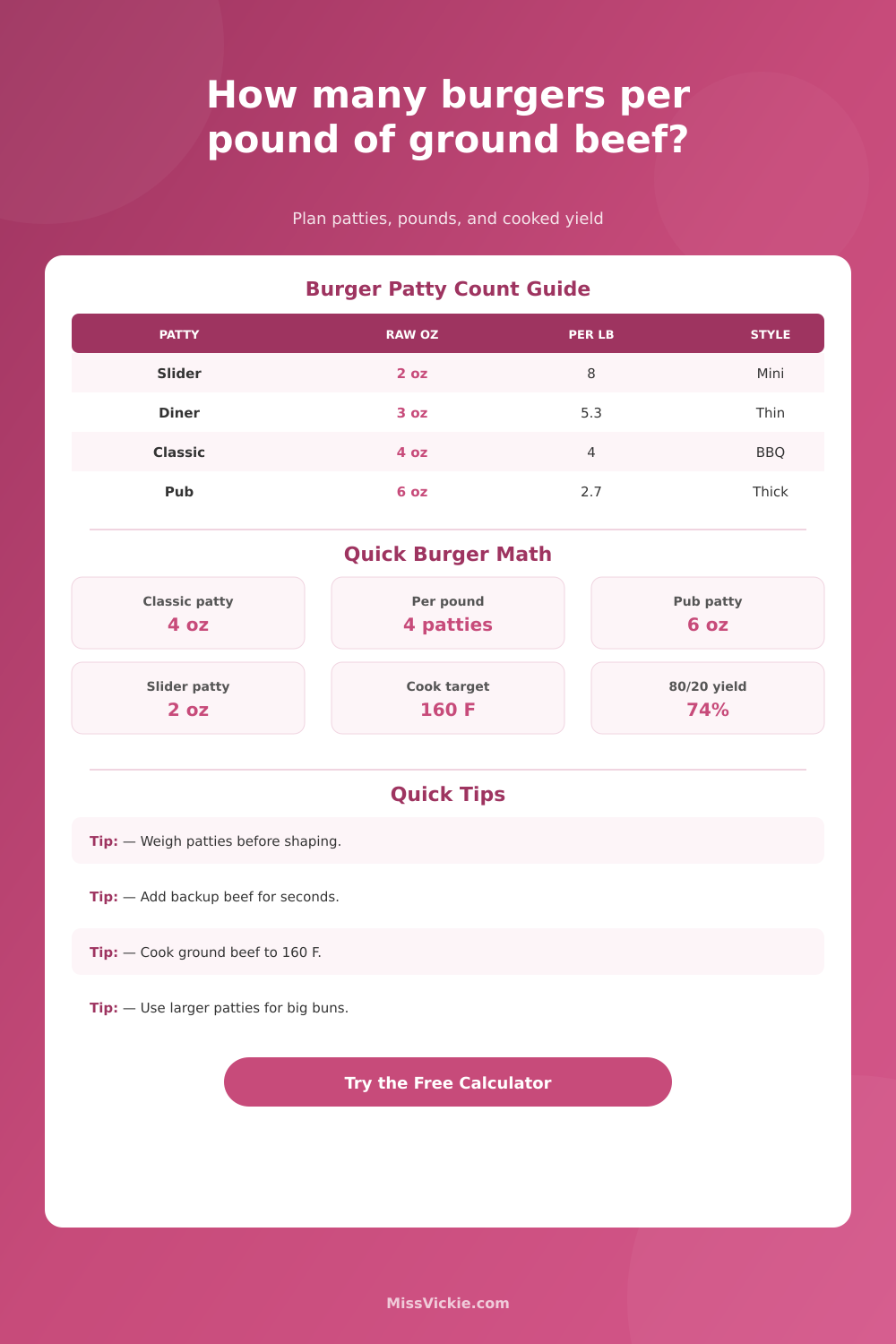
| 2 oz / 57 g | 8 full sliders | Slider trays, kids plates, appetizer burgers | 2.5 to 3 inch buns | Expect a small 1.5 oz cooked patty with 80/20 beef. |
| 2.67 oz / 76 g | 6 school-size patties | Cafeteria-style burgers or small cookout portions | 3 to 3.5 inch buns | Useful when stretching a pound into six neat burgers. |
| 3 oz / 85 g | 5 full patties plus 1 oz left | Thin diner burgers and griddle patties | 3.5 to 4 inch buns | Thin patties cook quickly and lose less height. |
| 3.2 oz / 91 g | 5 smashburger balls | Double-stack smashburgers or crisp-edge griddle burgers | 4 inch buns | One pound makes five balls, or about two double burgers plus one extra patty. |
| 4 oz / 113 g | 4 quarter-pound patties | Classic backyard hamburgers | 4 inch buns | The easiest mental math: one pound equals four raw quarter-pounders. |
| 5.33 oz / 151 g | 3 third-pound patties | Large BBQ burgers and hearty adult portions | 4.5 inch buns | Shape wider and thinner so the center cooks evenly. |
| 6 oz / 170 g | 2 full patties plus 4 oz left | Pub burgers, stuffed burgers, thick patties | 4.5 to 5 inch buns | Cook gently enough to reach the center without scorching the crust. |
| 8 oz / 227 g | 2 half-pound patties | Steakhouse burgers or oversized sharing burgers | 5 inch buns | Best for thick-burger fans; use a thermometer every time. |
| Blend or Burger Mix | Estimated Cooked Yield | Cooked Weight From 4 oz Raw | Typical Burger Result | Food Safety Note |
|---|---|---|---|---|
| 70/30 ground beef | About 62% | 2.5 oz / 70 g cooked | Very juicy but highest shrink; best for thin diner patties. | Cook ground beef patties to 160°F / 71°C. |
| 75/25 ground beef | About 68% | 2.7 oz / 77 g cooked | Rich grill flavor with visible drip loss. | Use a thermometer; color can mislead. |
| 80/20 ground beef | About 74% | 3.0 oz / 84 g cooked | Classic burger balance and a common planning baseline. | USDA cooking-yield tables list 80/20 patties near 74% cooked yield. |
| 85/15 ground beef | About 77% | 3.1 oz / 87 g cooked | Leaner but still workable for grilled burgers. | A little added moisture or gentle handling helps texture. |
| 90/10 ground beef | About 80% | 3.2 oz / 91 g cooked | Less shrink, firmer bite, easier meal-prep portions. | Do not overcook; lean patties dry quickly. |
| 93/7 ground beef | About 82% | 3.3 oz / 93 g cooked | Very lean burger or macro-focused patty. | Use seasoning and avoid pressing juices out. |
| Ground turkey mix | About 78% | 3.1 oz / 88 g cooked | Milder burger with poultry texture. | Cook poultry burgers to 165°F / 74°C. |
| Plant-based mix | About 85% | 3.4 oz / 96 g cooked | Less fat drip and often less shrink. | Follow the package target temperature. |
| Cookout Size | Light Slider Plan | Classic 4 oz Plan | Hearty 6 oz Plan | Planning Note |
|---|---|---|---|---|
| Family dinner for 4 | 1 lb for 8 sliders | 1 lb for 4 burgers | 1.5 lb for 4 pub burgers | Add 0.25 to 0.5 lb if teenagers or seconds are likely. |
| Backyard meal for 8 | 2 lb for 16 sliders | 2 lb for 8 burgers | 3 lb for 8 pub burgers | Quarter-pounders are the cleanest count for mixed guests. |
| Game day for 12 | 3 lb for 24 sliders | 3 lb for 12 burgers | 4.5 lb for 12 pub burgers | Sliders work well with several side dishes. |
| Tailgate for 25 | 6.25 lb for 50 sliders | 6.25 lb for 25 burgers | 9.4 lb for 25 pub burgers | Round up by at least one pound for uneven shaping and seconds. |
| Large cookout for 50 | 12.5 lb for 100 sliders | 12.5 lb for 50 burgers | 18.75 lb for 50 pub burgers | Make test patties first so every batch matches the target weight. |
| Patty Shape | Raw Diameter vs Bun | Starting Thickness | Best Patty Weight | Shaping Cue |
|---|---|---|---|---|
| Slider | About 0.25 inch wider than bun | 1/3 to 1/2 inch | 2 to 2.67 oz | Keep edges loose; tiny patties toughen if packed hard. |
| Thin diner burger | About 0.5 inch wider than bun | 1/4 to 1/3 inch | 3 to 3.2 oz | Shape thin or smash once; season after shaping. |
| Classic grill burger | About 0.5 to 0.75 inch wider than bun | 1/2 to 3/4 inch | 4 to 5.33 oz | Press a shallow dimple in the center before grilling. |
| Pub burger | About 0.75 to 1 inch wider than bun | 3/4 to 1 inch | 6 to 8 oz | Cook over moderate heat and verify the center with a thermometer. |
🍞 Burger Style Comparison
Best when guests graze, plates include many sides, or kids need smaller portions.
Good for griddle cooking, crisp edges, and double-stack builds without huge patties.
The simplest cookout ratio: one pound of ground beef makes four quarter-pound burgers.
Choose this for thick, substantial burgers where one patty is the whole meal.
💪 Nutrition Snapshot Per 4 oz Raw Patty
Nutrition varies by brand, grind, fat percentage, seasoning, and cooked drip loss. The calculator estimates per-patty nutrition from common 4 oz raw-label values.
💡 Burger Planning Tips
One pound of ground beef. It’s a familiar scene: You’ve got this pack of ground beef on the counter, and it reads “one pound.” How many burger does that mean? Do you even have enough buns? Yeah, us too.
That’s why we built this burger calculator (above), to do all the math for you. Just enter weight of your meat and what size patties you want, and voila! The calculator convert ounces into pounds and factors in the shrinkage on the grill for you.
How to Use the Burger Calculator
Heated meat doesn’t weigh the same as cold. A pound of ground beef isn’t a pound of anything. You’re purchasing a combination of protein, fat, and water by the pound. For example, your butcher may use an eighty-twenty mix of beef, which is eighty percent lean and twenty percent fat. However, the fat cooks off, and so does some of the water. So that quarter pounder (four ounce) raw patty might look like a three ounce cooked burger. That’s a twenty five percent decrease. And if you don’t plan on that reduction, you could be looking at three full burgers and four disappointed diners.
It is a small detail. But it can matter when you want people to leave happy. The problem in real life is most folks eyeball the patties and go at it with a handful hoping it’s consistent enough. That’s where the real world math fails. Grabbing a pound of uneven balls means you may end up with one huge burger (raw in the middle) and then four little burgers all dried out like hell.
You can’t treat a two-ounce slider the same as a six ounce pub burger. The latter need shaping wide and cooked until it is done in the middle before the outside burns. The slider should be light and airy. The tool takes into account the difference by adjusting for cooking methods and buns. So you can see the difference and know that your patty needs to start out wider than your bun…because you know it will shrink.
The equation changes when you choose the right blend. While leaner burgers shrinks less, they tend to be both crumbly and dry. For this reason, an eighty twenty mix is the sweet spot; there’s just enough fat to make it juicy without falling apart. With a leaner blend such as ninety ten, you’ll want to be gentle with the meat. Adding more seasonings, or even a binder, can help compensate for the missing fat. Your chosen blend tell the calculator how much fat is in your burger, which in turn affects the yield estimates, giving you a better idea of what you’ll actualy have on your plate.
A good host plans for seconds. Better to be left with some leftover meat than none at all. For a more casual get-together, a ten to fifteen percent buffer should of been enough. If you’re feeding a crowd of folks with hearty appetites, maybe increase that a bit more. You can adjust this cushion in the tool; it will tell you how much additional beef to add so that nobody goes home hungry. This is an easy tweak that saves you from the awkward moment of scrambling to make one final burger from whatever scraps remain.
Control is key when it comes to cooking burgers: controlling factors that wish to escape you. You must control the heat, the fat-to-meat ratio, the shrinkage, and the hunger of your diners. Taking just a moment to think through these variables before you ever step foot near the grill removes any guess work from the equation. Before you pull those patties off the flames, you know precisely how many you’ve got and whether they will fit on your buns. Not the panic, but the prep, is what gives you the confidence.