🍽 How Much Buffet Food Per Person
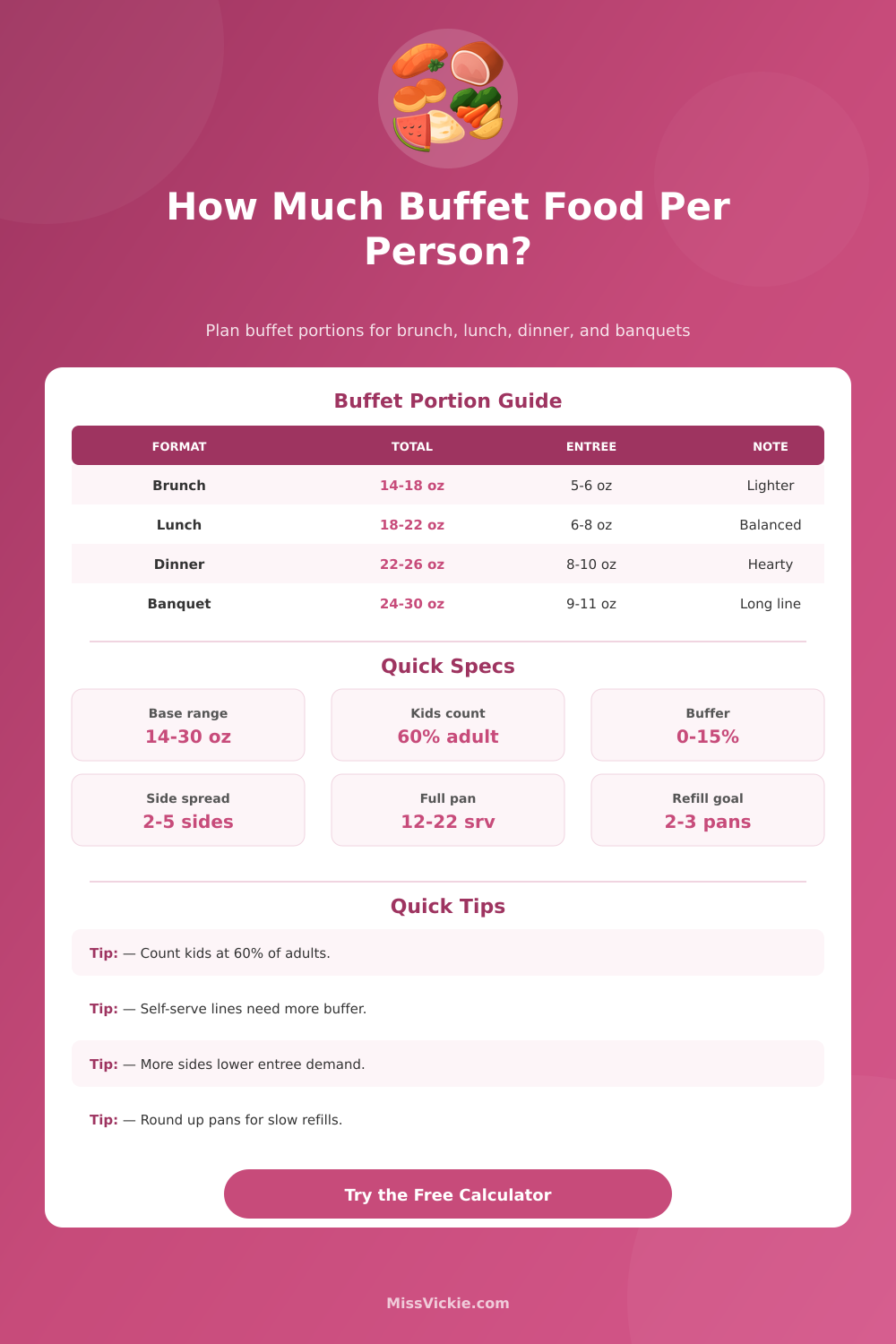
Estimate total buffet weight, split the menu into entrees, sides, and sweets, then translate it into pans for brunches, lunches, dinners, weddings, and open-house lines.
| Buffet Format | Total Food / Adult | Entree Target | Typical Use |
|---|---|---|---|
| Brunch Buffet | 14-18 oz | 5-6 oz | Eggs, casseroles, fruit, pastry |
| Light Lunch Buffet | 18-22 oz | 6-8 oz | Sandwich trays, salads, soup |
| Backyard BBQ Buffet | 20-24 oz | 7-9 oz | Pulled pork, chicken, slaw |
| Taco Bar Buffet | 18-22 oz | 6-7 oz | Protein plus tortillas and toppings |
| Pasta Buffet | 20-24 oz | 7-8 oz | Pasta, sauces, vegetables, bread |
| Dinner Buffet | 22-26 oz | 8-10 oz | Two mains with hearty sides |
| Holiday Buffet | 24-30 oz | 9-11 oz | Turkey, ham, dressing, desserts |
| Appetizer Reception | 12-16 oz | 4-5 oz | Small bites over longer service |
| Factor | Adjustment | Impact | When to Use It |
|---|---|---|---|
| Staffed Portions | 0.94x | Lower total | Servers control scoop size |
| Moderated Self-Serve | 1.00x | Baseline | Most mixed gatherings |
| Open Self-Serve | 1.08x | Higher total | Guests build larger first plates |
| Open House Grazing | 1.12x | Higher total | Flow-in, flow-out events with repeats |
| Light Crowd | 0.90x | Smaller plates | Early breakfast or tea-style menus |
| Hearty Crowd | 1.12x | Bigger plates | Evening meals or outdoor events |
| Feast Crowd | 1.22x | Largest plates | Celebrations where seconds are likely |
| Pan Type | Protein Servings | Side Servings | Good For |
|---|---|---|---|
| Full 2-inch pan | 12-14 | 18-22 | Dense proteins and casseroles |
| Full 4-inch pan | 18-22 | 28-36 | Bulk starches or mixed entrees |
| Half 2-inch pan | 6-7 | 9-11 | Secondary proteins or premium sides |
| Half 4-inch pan | 9-11 | 14-18 | Salads, vegetables, baked dishes |
| Guest Count | Lunch Total | Dinner Total | Holiday Total |
|---|---|---|---|
| 25 guests | 30-34 lb | 36-41 lb | 40-47 lb |
| 50 guests | 60-68 lb | 72-82 lb | 80-94 lb |
| 75 guests | 90-102 lb | 108-123 lb | 120-141 lb |
| 100 guests | 120-136 lb | 144-164 lb | 160-188 lb |
Brunch
Lunch
Dinner
Banquet
These planning ranges assume a balanced buffet with refills available. Large carved stations, premium proteins, or plated desserts can reduce the self-serve buffet weight slightly.
When you are planning a buffet for your guest, you must calculate the amount of food that is required to feed each guest. Calculating the amount of food that is required for an buffet can prevent you from either not having enough food for all of your guests, or from having too much food that can sit on the plate of your guests and become uneaten. You can determine the amount of food that you should provide for each guest by considering the type of your guests, the style of service that you will provide, the time of day that the buffet will be served, and the type of dishes that you will serve at your buffet.
The types of guests that you have will change the amount of food that you need to prepare. For example, young children will generaly eat less than adults, so you can calculate for each child as 60% of an adult portion. On the other hand, some teenagers may have more appetite than adults, so you may have to consider this when you are calculating the number of portion of protein that will be needed.
How Much Food to Serve at a Buffet
The style of service that you provide will also impact the amount of food that you need to prepare. At a staffed buffet, staff will scoop portions of food for the guests, so there will be less food needed than if the buffet was self-serve. At a self-serve buffet, the guests will determine how much food of each category they would like to eat, so there will be more food needed at a self-serve buffet than at a staffed buffet.
Additionally, if the buffet will be an open-house buffet, meaning that the guests will be able to dine on the buffet for an extended length of time, you will need to provide more food for the same reason that self-serve buffets require additional food to be prepared. The time of day that you serve your food will determine the amount of food that you need to prepare. For example, if you are having a brunch, you can expect your guests to eat between 14 and 18 ounces of food.
Dinner portions should be between 22 and 26 ounces. For holiday dinner, however, you should prepare between 24 and 30 ounces of food per person. Additionally, you should also consider the protein portions that will be served during the meal.
For brunch, provide portions of protein that are between 5 and 6 ounce per person. For dinner, however, the protein portions should be between 9 and 11 ounces. The types of side dish that will be provided also affect the amount of protein that you will need to prepare.
If you provide only two side dishes, the guests will eat more protein. If you provide four or five side dishes, the guests will eat less protein. The side dishes can also impact the total amount of food that will be required for the buffet.
If you serve many vegetable-heavy side dishes, the total amount of food will be less than if you provide many heavy side dishes like macaroni and cheese. Additionally, if you provide a dessert table at your buffet, more ounces of food will be required for the buffet than if the dessert offering will be much lighter. You should also provide some food as a buffer for your guests.
A buffer includes food that is prepared to ensure that there is enough food for all of your guests. A buffer can be 0 to 15% of the total amount of food for the buffet. Use a larger buffer for self-serve buffets since each self-serve buffet portion will require more food than a staffed buffet.
Use hotel pans to measure the food for your buffet. A full 2-inch hotel pan will serve approximately 12 to 14 portions of protein, or 18 to 22 portions of side dish. Many people make mistake when calculating the amount of food for a buffet.
For example, they may ignore the impact that side dishes will have upon the amount of protein that is needed. People may also not consider how long the buffet will last. For example, a buffet that will last for 60 minutes will require less food than one that will last for 180 minutes.
Additionally, self-serve buffets will generaly require 6 to 10% more food than is calculated for the number of guests at the buffet. Finally, the layout of the buffet can impact the amount of food that each guest will eat. For example, if there are long line of customers waiting to dine at the buffet, they will eat more of the food on their first plate.
If they have short lines, they will eat more of the food on the second plate. Finally, outdoor buffets may have increased appetites due to the weather, or the physical activity that is required to attend such an event. Serving premium item at the buffet can reduce the amount of food that is needed.
For example, if you serve items like carved meats at your buffet, your guests will eat those items and may not eat as much of the other food on the buffet. However, you must make sure that the buffet will not contain only these item. Additionally, side dishes can be used to manage your budget.
For example, if you provide more side dishes, you can provide less protein. Providing more side dishes is one way to prepare budget-friendly meats for your buffet. For example, if your guests have large appetites, provide more expensive meats for those who will eat the most.
For example, if the guests have light appetite, include more vegetables at the buffet than protein. By using these method to calculate the amount of food that will be needed at your buffet, you can ensure that you prepare the correct amount of food for each of your guests.