
As anyone who cracks open a fresh-laid egg knows, there’s something about it, a certain size, that makes you pause in doubt: Is this one big enough for my dish? It’s not exactly a major concern, but collectively, all those little hesitations add up over time.
If you’re keeping chickens in your back yard, or if you’d rather source from home than buy them at the grocery store, knowing what your hens produce can be important. And when it comes to the dependable quality of its eggs, Buff Orpington deserves its reputation as a sort of gentle giant of the coop. They are calm, cold-hardy birds whose fluffy feathers behaves more like a winter coat than just a pretty layer. But they have another advantage for many homesteaders: Their eggs is consistently sized and high-quality.
Why Buff Orpingtons Are Great for Your Backyard
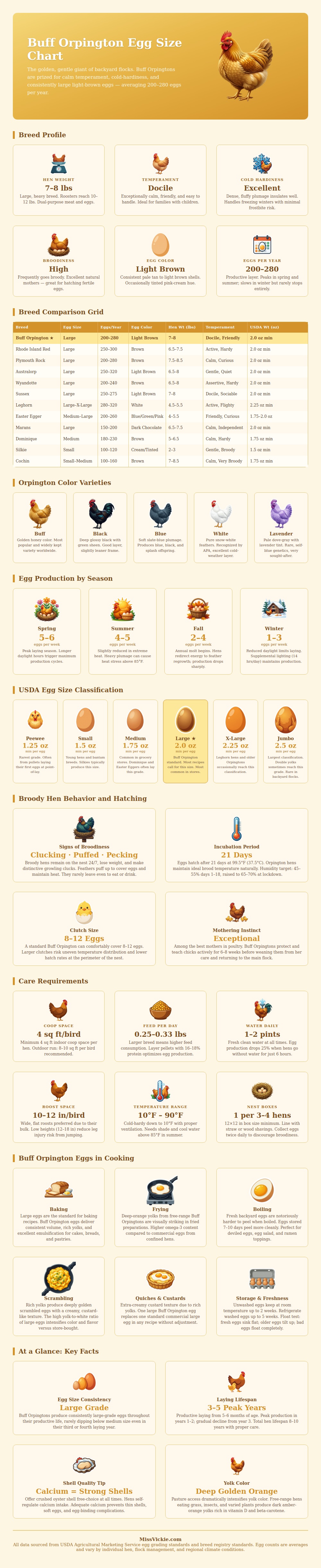
For comparison, here’s how they stack up against some of the more popular chicken types in terms of production volume and size (the chart above). According to the USDA, Buff Orpingtons reliably hit large grade standard, which matters because most commercial baking recipes are calibrated for large eggs. Why does that matter? Most commercial recipes calls for large eggs, not extra-large and certainly not medium.
If you know all your egg are going to be the same size, there’s no need to adjust anything when you’re whipping up a custard tart or a sponge cake. And what about those mornings when a quick egg sandwich or scrambled eggs is on the menu? Knowing your eggs will be the right size every time makes life easier. Not many backyard flocks enjoys such consistency, as hens come in various sizes and ages.
Finally, there’s the egg-laying pattern you should of be aware of: The spring months are prime. More daylight means maximum productivity, and you’ll find up to six eggs weekly when it’s bright out. Because they’re pretty hefty creatures, summer heat (above eighty-five degrees) stresses them and puts a damper on things. Think of their thick coats combined with the hot weather. Provide cool drinking water and a shady area.
In fall comes the yearly molt, when the birds shed their old feathers and start growing new ones; but egg production take a nosedive in the process. As winter sets in, shortening days slow down production even more (but supplemental light helps keep some going). So be patient and don’t get frustrated; it’s all part of nature’s pattern.
Keeping these birds is also behavioral. Because of their very strong brooding instinct, they often desire to nest and hatch out a group of chicks. To prevent this, remove the eggs (twice a day) if you just want eggs. But if you like the idea of nature’s hatching process, know that their mothering instinct is the best. Even after a couple of weeks with active protection, they will leave their offspring alone and reintegrate into the main flock. That makes it more challenging from a management standpoint, yet it offers a teachable moment for families interested in seeing new life being born.
The quality of the yolk and shell are also affected by nutrition. Because they’re bigger birds, they need more food than smaller birds such as Silkie or Leghorn types. Providing layer pellets and crushed oyster shell freely allows them to control how much calcium they gets. If you’ve ever had soft-shelled eggs or experienced realy thin shells on some of yours, it’s because your chickens didn’t have enough minerals.
When they do, they end up with a deep golden-orange yolk (assuming the birds get some pastured time where they can feed on bugs and grass). Pastured eggs are richer in vitamin D and beta-carotene and therefore make your fried or scrambled eggs more nutritious than what you’ll find at the grocery store.
One last little thing is storage. Because backyard eggs have a natural bloom (protective coating on the eggshell), they’re safe on the counter for up to two weeks if unwashed. Once washed, they must be refrigerated for freshness. To know the age of any egg, use this easy float test: The fresher ones will sink flat on their belly; the older ones will float up (tilted) or even totally float. Easy food-saver trick… Less waste, more food.
The Buff Orpington provides a well-rounded package for the backyard keeper. You receive a hardy, friendly bird that can withstand frigid winter weather but still be handled easily. Matched by that is a big, dependable egg that fits every cooking use. The flipside is that you have to contend with their broodiness (unless you desire chicks) and they eats more feed than some other breeds. However, in terms of both table output and behavior, it’s difficult to compete with them. Start out with the simple desire to have eggs for breakfast and wind up with a group that will become a part of your daily routine.