Bruschetta Per Person Calculator
Plan bruschetta by guest count, appetizer or meal role, baguette slice size, tomato topping yield, moisture drain, basil and garlic intensity, olive oil drizzle, toast loss, platter buffer, and serving duration.
Pick a real serving situation, then adjust the slice size, topping style, moisture drain, herbs, garlic, oil, toast loss, and refill buffer.
Bruschetta Plan
Your sliced bread, tomato topping, herb, garlic, oil, and refill plan will appear here.
Serving Math
Ingredient Breakdown
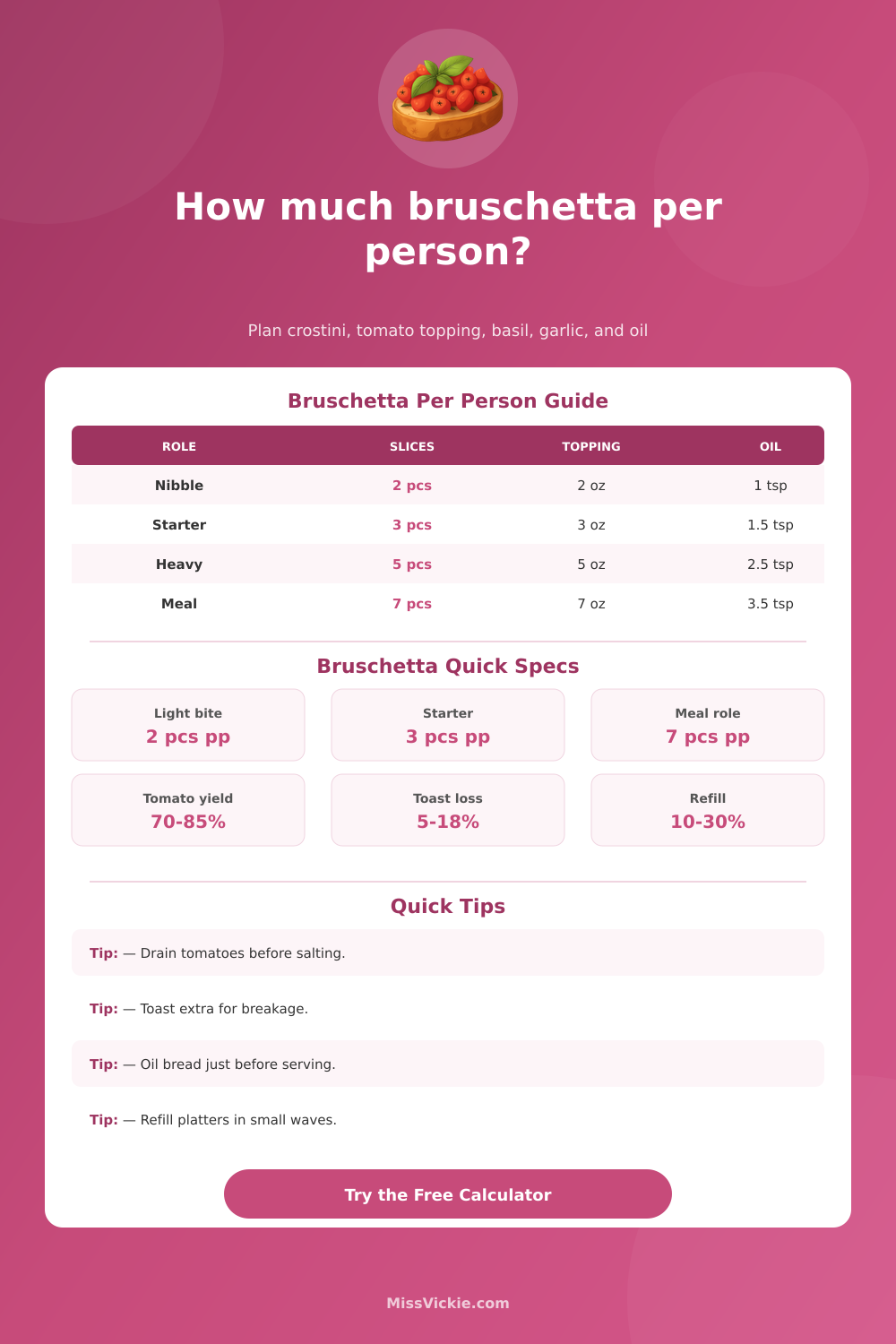
| Serving role | Pieces per person | Topping per person | Best use |
|---|---|---|---|
| Light nibble | 2 pieces | About 2 oz | Before a full dinner |
| Appetizer tray | 3 pieces | About 3 oz | Classic starter platter |
| Heavy appetizer | 5 pieces | About 5 oz | Party table with several bites |
| Cocktail hour | 3 pieces | About 2.5 oz | Passed bites or small trays |
| Grazing table | 4 pieces | About 4 oz | Refilled spread over time |
| Meal plate | 7 pieces | About 7 oz | Bruschetta as the main item |
| Slice size | Typical width | Pieces per baguette | Topping per slice |
|---|---|---|---|
| Mini passed bite | 1/3 inch | 32 to 36 | 0.45 oz |
| Small crostini | 1/2 inch | 26 to 30 | 0.55 oz |
| Standard baguette | 3/4 inch | 20 to 24 | 0.75 oz |
| Large rustic slice | 1 inch | 16 to 18 | 1 oz |
| Ciabatta square | 2 inch square | 18 to 22 | 0.9 oz |
| Hearty meal slice | 1 1/4 inch | 12 to 15 | 1.25 oz |
| Tomato style | Raw-to-topping yield | Flavor note | Drain behavior |
|---|---|---|---|
| Cherry tomatoes | 82% | Sweet, firm, colorful | Low seed water |
| Roma tomatoes | 78% | Classic, meaty, reliable | Moderate drain |
| Beefsteak tomatoes | 70% | Juicy and mild | Needs more drain |
| Heirloom tomatoes | 74% | Bright and seasonal | Variable moisture |
| Canned diced tomatoes | 68% | Useful off-season | Drain very well |
| Mixed tomatoes | 76% | Balanced color and texture | Medium drain |
| Group size | Starter tray | Heavy spread | Meal plate |
|---|---|---|---|
| 4 guests | 12 pieces | 20 pieces | 28 pieces |
| 8 guests | 24 pieces | 40 pieces | 56 pieces |
| 12 guests | 36 pieces | 60 pieces | 84 pieces |
| 25 guests | 75 pieces | 125 pieces | 175 pieces |
| 40 guests | 120 pieces | 200 pieces | 280 pieces |
| 50 guests | 150 pieces | 250 pieces | 350 pieces |
Best when other appetizers are plentiful or guests are standing.
The flexible default for family starters and party trays.
Good for seated meals, but plan extra topping per piece.
Add refill buffer when trays sit out for more than two hours.
The calculator uses common culinary planning yields: one cup of diced tomato topping weighs about 5.3 oz, olive oil is scaled by teaspoon drizzle, and baguette counts include slice loss.
Now imagine yourself having run out of food while your guests has barely finished their initial glasses of wine. Uh-oh, they’re perplexed. There’s no more food to eat. Why? Because you planned according to gut instinct rather then volume. Rather than relying on the calculator to work out figures for you, you must learn to understand them.
What’s it going to be measured in? It’s not necessarily going to be how stuffed everyone says they was prior to attending your event. How many? It depends on how the bruschetta fit into the meal. Is it just a little something before dinner? Or is it a centerpiece at a heavy appetizer buffet, when bruschetta are the star?
How to Plan Your Bruschetta Amounts
If it’s the latter, then you’re going to need several slices per guest (seven). And if it’s the former, then one or two will suffice. Don’t guess about whether or not three slice will do; the calculator has those preset options.
Why do most host underestimate? Because they fail to remember that standing guests tend to consume food more often than their seated counterparts. After locking down your slice count, it’s time to determine what bread you’ll be using. Depending on how thinly or thickly you’re slicing, one baguette might gets you roughly twenty slices of thick toast, or almost thirty thin crostinis.
To compensate for uneven cutting and inevitable breakage, you should of incorporate a toast loss percentage into your ingredient list. Until you’ve had to scrounge around for remnants of burnt crusts while under pressure to serve, it doesn’t seem like much. Having planned for an eight percent loss will save you from frantic searches for stray bits of bread and come crunch time.
Bruschetta gets soggy when wet. Moisture from tomatoes ruin the crispness and wrecks your recipe. It also depends a lot on tomato variety. A beefsteak releases much more water than a cherry or a firm Roma type. You’ll want to buy more weight of the raw ingredient if you’re using juicy ones in order to end up with as much usable topping.
Draining it properly provides structural engineering for your snack. Drain the juice pool on the plate and your texture is ruined. The calculator adjusts your purchase weight based off how much moisture you expect to lose during prep.
The key to turning ordinary toast into something worth remembering are in the herbs and the olive oil. Garlic can run from whisper-soft to slap-you-in-the-face-while-it-rubs-your-toes-on-the-floor and basil can go from just a touch of garnish to overgrown-garden-patio-party-strong. Be sure to keep them both in mind as distinct flavors.
If you run out of oil before you’re done preparing, you’ll end up with lifeless tomatoes atop lifeless bread, neither ingredient forgive such mistakes lightly. You should use refill buffers because the initial tray goes fast for longer serving windows. Guests fill up early, come back later and want food again but are now hungrier and less picky.
It’s impossible to provide a static quantity that will work for 3 hours like it is for a 10 course meal. The tool provides a buffer for consumption over time. Now you’ve got fresh toppings waiting to be assembled at need. On the page, it has a handy reference table that shows the interaction between serving style and group size.
An intimate dinner party for four guests will be very different than a potluck for twenty five guests. It’s not always as simple as scaling upwards. Service dynamics shift when you have more people to feed; so do amounts of waste. Anticipation helps remove all the anxiety out of process.
Bruschetta is simple but it’s all about getting the right textures at the right time. Cool tomato against warm bread. Soft inside against crispy outside. The aroma of herbs greeting you before you take a bite.
And then there is the planning for how much, enough for everyone, but not so much that your friends are distracted from the conversation by wondering where the bruschetta went. If you get the math correct, you can blend into the party, too. You can know that the platter will never run dry until the final guests leaves.