🐔 Broiler FCR Calculator
Measure raw and corrected feed conversion from bird count, feed intake, mortality, and growth period
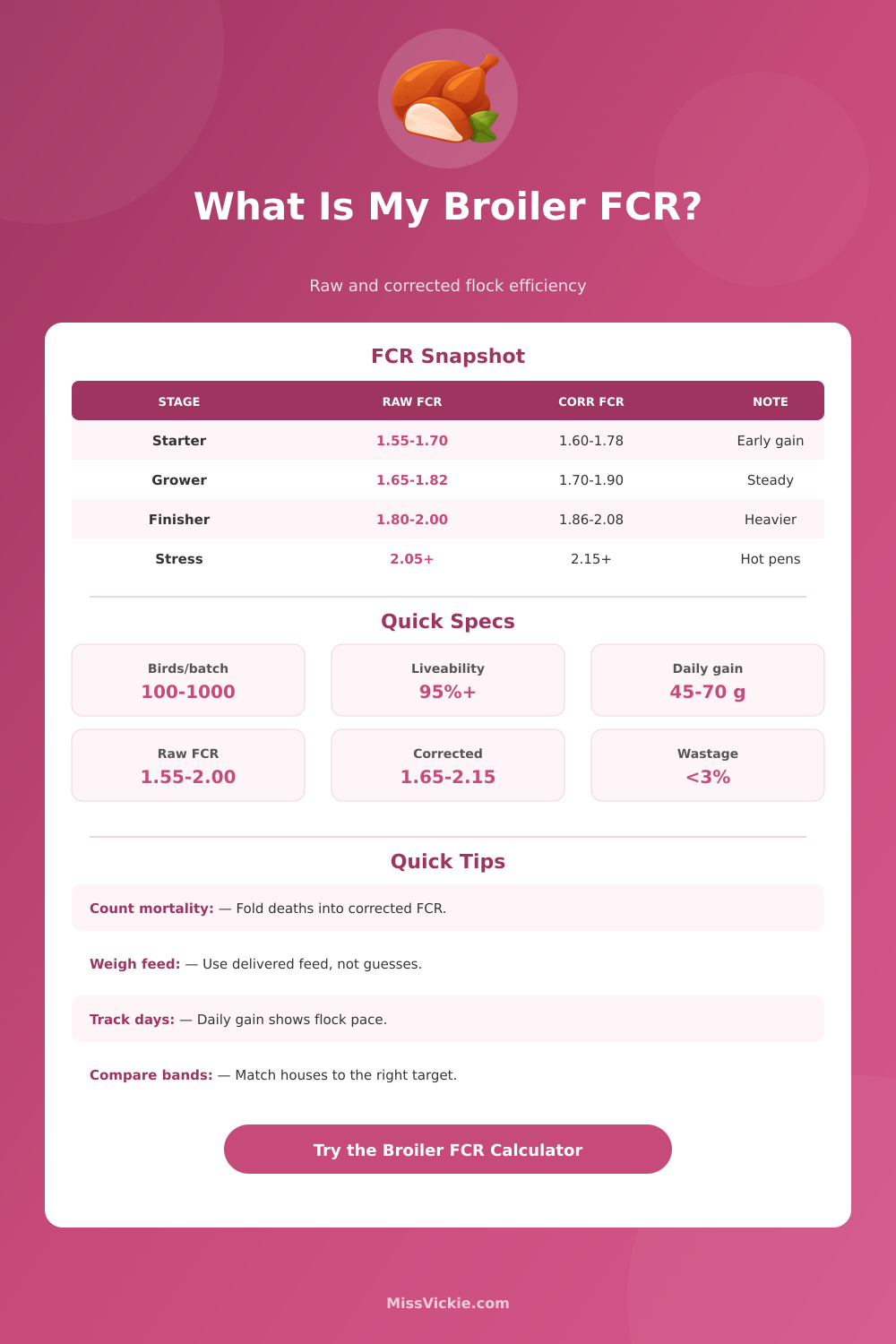
| Stage | Raw FCR | Corrected FCR | Typical issue |
|---|---|---|---|
| Starter | 1.55-1.70 | 1.60-1.78 | Chill or crowd |
| Grower | 1.65-1.82 | 1.70-1.90 | Weigh drift |
| Finisher | 1.80-2.00 | 1.86-2.08 | Feed spill |
| Stress | 2.05+ | 2.15+ | Heat load |
| Wastage | Feed lift | FCR lift | Note |
|---|---|---|---|
| 0% | Base | None | Clean bins |
| 2% | 1.02x | +2% | Minor spill |
| 5% | 1.05x | +5% | Loose troughs |
| 10% | 1.10x | +10% | Serious waste |
| Mortality | Survival | Gain factor | Effect |
|---|---|---|---|
| 0% | 100% | 1.00x | Baseline |
| 2% | 98% | 1.02x | Small lift |
| 5% | 95% | 1.05x | Clear hit |
| 8% | 92% | 1.09x | Large lift |
| Final wt | Days | ADG | Feed / bird |
|---|---|---|---|
| 1.8-2.0 kg | 35-42 | 40-50 g | 3.0-4.0 kg |
| 2.0-2.2 kg | 38-45 | 45-55 g | 3.4-4.6 kg |
| 2.2-2.5 kg | 42-49 | 50-60 g | 3.8-5.2 kg |
| 2.5-2.8 kg | 49-56 | 55-70 g | 4.8-6.4 kg |
Feed conversion ratio, or FCR, are used to determine the efficiency of broiler farming. Specificly, the FCR measure the amount of feed that is required to obtain a specific amount of live bird weights. Additionally, the FCR can be used to compare the amount of feed consume by the birds to the total weight gain of those birds.
Finally, the FCR help to determine if the feed that the broilers use creates the amount of meat that is expected from that feed. The FCR can be calculated in two different way: raw FCR and corrected FCR. Raw FCR is calculated by taking the total amount of feed that the broiler flocks used and dividing it by the total weight gain of that flock.
What is FCR and How to Improve It
Corrected FCR is calculated in the same way as raw FCR, but it is corrected for the mortality of birds within the flock during the growing period of the broilers. Corrected FCR is useful in that it help to determine the true FCR of the broilers that survived the growing cycle. Raw FCR should of be used to determine the total feed that the farm used, while the corrected FCR should be used to determine the efficiency of the surviving broiler bird.
Two factor that can impact the FCR of the broiler farm in such a way that makes the FCR too high are feed wastage and bird mortality. Feed wastage occur when feed spills from the birds feed areas or when the feed is wasted in providing water to the birds. If feed is wasted, the total amount of feed used will increase, leading to a more less efficient feed conversion ratio.
Bird mortality is another factor that impacts feed efficiency; if some of the birds die during the growing cycle, the total weight gain of the birds will decrease, leading to a less efficient FCR. To calculate an accurate FCR, the farm must record the total amount of feed that was delivered to the farm and the total number of birds that died. The growth stages of the broilers can impact the FCR.
Broilers may require different amount of feed at different growth stages. For example, at the starter phase, broilers requires specific types of feed to grow and develop their feathers, and the feed efficiency during this period is typically around 1.6. During the finisher phase, though, they require more feed to increase their body frames, which change the FCR during this phase.
Another factor that can impact the FCR is heat stress. If the broiler houses become too hot for the birds, the birds will eat more feed to maintain their body temperature without gaining any significant amount of weight. This will impact the FCR to increasing.
The FCR can be improved in various way. For example, the farm can ensure the water lines for the broilers are not clogged and the ventilation systems in the broiler houses can be regularly cleaned and inspected to ensure that they are working correct. Additionally, the farm can keep the litter in which the broilers stand dry and the crowding of the broilers within the houses can be prevented.
If the broilers become too crowded with each other, there will be a decrease in the number of birds that survive the growing cycle and a decrease in the total weight of the birds, which will increase the FCR of the farm. Therefore, the farm should regularly weigh the feed in the broiler houses and the farm should record the number of birds that die each day. By comparing the FCR of different batches of broilers that are raised on the farm, the poultry farmer can determine whether or not the FCR is increasing or decreasing.
By calculating the corrected FCR for the current batch of broilers compared to the previous batch of broilers, the farmer can determine whether or not the efficiency of the broiler farm have declined. If the FCR increases, the feed efficiency of the farm and the profit margins that the farm can earn from these birds will both decrease. Therefore, keeping track of the FCR of the broiler farm is a necessary practice to manage it’s cost and profits.