Broccoli Cooking Time Calculator
Estimate broccoli cooking time for fresh or frozen florets, stem pieces, steaming, boiling, blanching, roasting, air frying, microwaving, batch size, water level, doneness, and altitude.
🥦 Broccoli cooking presets
Choose a real broccoli setup, then adjust the floret size, stems, batch weight, method, steam or water level, and doneness target.
⚖ Broccoli timing inputs
Broccoli cooking result
Enter your broccoli size, method, stems, and batch details to estimate the cooking window.
Timing breakdown
Yield and handling
Cooking cues
📊 Live broccoli batch snapshot
About one generous cooked side serving.
Selected size sets the heat path.
Dry heat loses more water than steam.
Moist heat changes most at elevation.
⏲ Broccoli method timing table
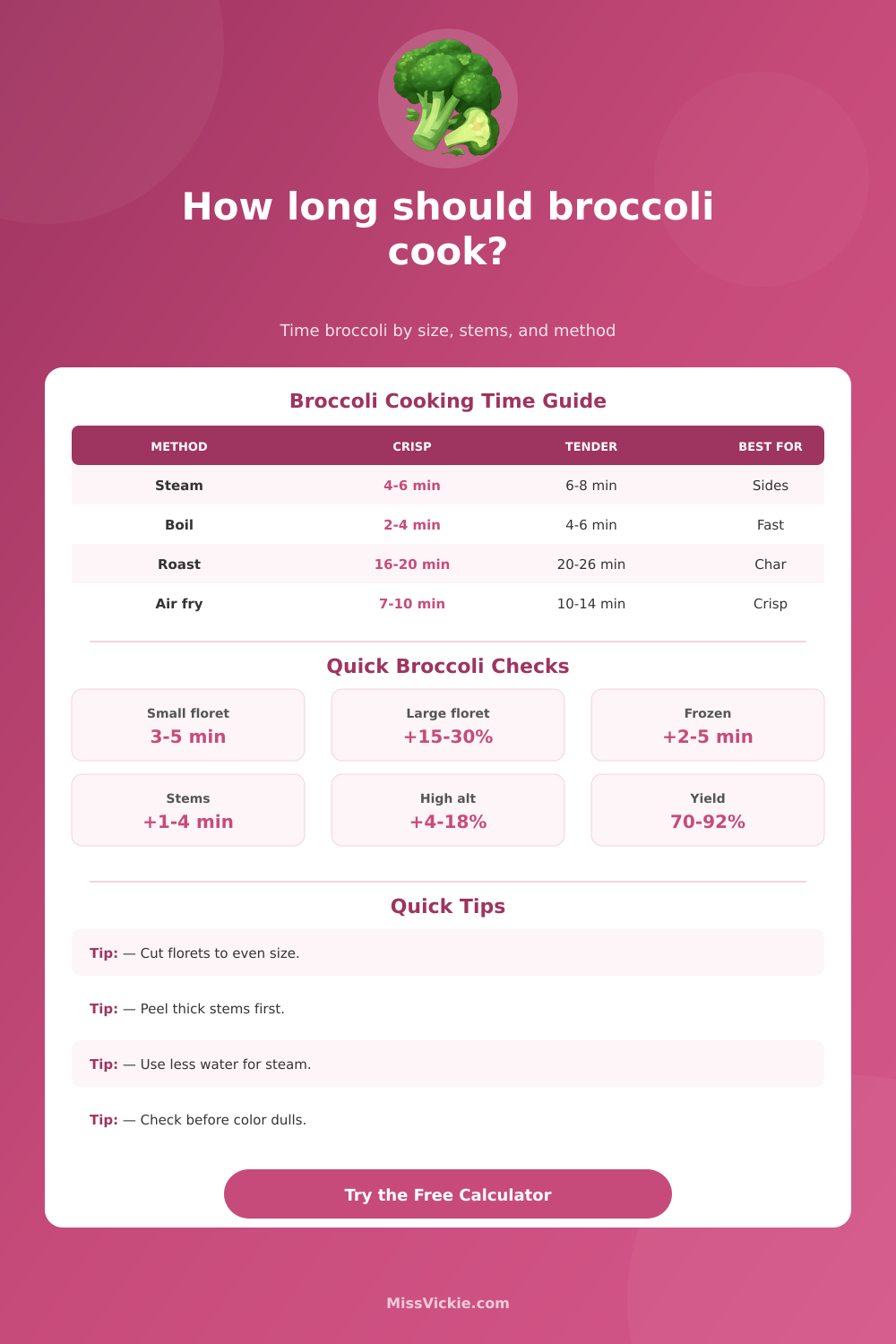
| Method | Medium fresh florets | Frozen florets | Best timing cue |
|---|---|---|---|
| Steamer basket | 4 to 7 minutes | 7 to 10 minutes | Stem pierces with slight resistance and buds stay vivid green. |
| Boiling water | 2 1/2 to 5 minutes | 5 to 8 minutes | Drain early because submerged florets soften quickly after bright green. |
| Quick blanch | 1 1/2 to 3 minutes | 3 to 5 minutes | Shock in ice water when the color peaks for salads or prep. |
| Microwave covered bowl | 3 to 6 minutes | 5 to 8 minutes | Rest covered 1 minute so steam finishes thick stems. |
| Skillet saute-steam | 5 to 9 minutes | 8 to 12 minutes | Add a splash of water, cover, then uncover to glaze or brown. |
| Oven roast at 425 F | 16 to 24 minutes | 20 to 30 minutes | Edges brown and stems turn tender when flipped halfway. |
| Air fryer at 375 F | 7 to 13 minutes | 11 to 17 minutes | Shake once; tips brown faster than the stems soften. |
These are starting ranges for medium florets. The calculator adjusts them with stem thickness, batch load, doneness, frozen state, heat, and altitude.
🔪 Floret and stem adjustment table
| Cut style | Timing effect | Yield effect | Kitchen note |
|---|---|---|---|
| Tiny florets | About 20% faster | More tender edges | Great for rice bowls, kids plates, and quick blanching. |
| Small florets | About 10% faster | Even yield | Good default when broccoli must mix into pasta or stir-fry. |
| Medium florets | Baseline | Best balance | Use this for everyday steamed or roasted side dishes. |
| Large florets | 15% to 25% longer | Juicier centers | Split any pieces with stalks thicker than your thumb. |
| Long spears | 25% to 40% longer | More stem chew | Peel stems or start them 1 to 2 minutes before the crowns. |
| Halved crowns | 35% to 60% longer | Highest moisture | Best roasted, grilled, or steamed with the cut side exposed. |
💧 Steam, water, and batch load table
| Setup | Timing effect | Yield effect | Best fix |
|---|---|---|---|
| Strong steam, tight lid | Baseline | High yield | Keep water below the basket and avoid peeking early. |
| Low water or weak steam | 10% to 20% slower | Uneven | Use a tighter lid or add enough water to maintain steam. |
| Fully submerged boil | Often faster | More leaching | Drain as soon as the stems test tender. |
| Shallow covered pan | Slightly slower | Good glaze | Use 2 to 4 tablespoons water, then uncover to finish. |
| Crowded steamer or basket | 12% to 28% slower | Patchy texture | Stir once or split into two batches. |
| Dry roast or air fry | Heat dependent | More shrinkage | Use oil and space so steam can escape. |
⛰ Altitude adjustment table
| Altitude | Moist heat add | Dry heat add | Cooking note |
|---|---|---|---|
| 0 to 1000 ft | 0% | 0% | Use normal steam, boil, roast, and air fryer timing. |
| 2000 to 3000 ft | 4% to 8% | 1% to 3% | Boiling water is cooler, so stems need a little more time. |
| 4000 to 6000 ft | 10% to 16% | 3% to 5% | Keep the lid tight when steaming and test the stalks. |
| 7000 ft and up | 18% to 28% | 5% to 8% | Use smaller florets or start thick stems early. |
🔀 Method comparison grid
Best for vivid side-dish broccoli when florets are even and the lid stays tight.
Fast and predictable, but drain early because submerged broccoli can pass tender quickly.
Ideal for salads, meal prep, and stir-fries because an ice bath locks in color.
Highest shrinkage, deepest browning, and the best method for thick crowns or dry edges.
💡 Broccoli cooking tips
The key is that broccoli must be cooked just right: not undercooked (too crunchy), but also not overcooked (so it turns soggy and tastes like wet cardboard). The tricky part is that there’s only a narrow band of doneness where it taste good. The variables are the veggie’s density, how fast it absorbs heat, and how much heat being applied.
A good starting point is valuable, especialy for most home-cook who go by some sort of hazy memory. Once you’ve established your starting conditions, the calculator will handle all those other tricky variable.
How to Cook Broccoli Perfectly
For example, it knows that broccoli hold heat; fresh broccoli has less than frozen broccoli. Because of this, it tacks on additional minutes to cook frozen florets, since their ice first needs to melt before they can cooks. Yes, there’s a physics problem hiding in your dinner prep. And yes, it matters whether your veggies are fridge-cold or room temperature. While it might not seem like much, that initial “cold shock” affect how fast the interior cook through into tenderness. They’re not interchangeable without accounting for this difference.
Another big variable is size. How far does it have to go? Heat doesn’t take as long to get through a tiny floret compared than a big ol’ crown of broccoli. This adjustment are automatic in the tool.
If you want to keep the stem on, it’s thicker than the buds. So those will lag behind. That is why there is a mixed-cut option in the presets, as well as one for peeled stems. Broccoli has thick stalks that is fibrous and dense. They’re not as delicate as the florets, so they needs more time to soften. Cook them all at once without making that difference and what do you get? Chewy bottom/tops, mushy middle. The calculator divide them into separate components, so you can make a batch that come out even.
Unlike other dry-heat cooking methods (like air frying or roasting), moist-heat methods such as boiling or steaming change how food cook. For example: Steaming preserves chlorophyll so that veggies remains very bright in color. Boiling will leach out nutrients into the water, not a big deal if you don’t plan to use all of the liquid anyway, but it does affect the flavor a bit. Air-frying and roasting both caramelize the surface edges, but because of lack of moisture, they shrinks the veggies quite a bit. A quick reference table breaks all of this down based off cooking method. It outlines what happens at each step and how long to increase/decrease your time depending on whether you’re after charring or crunchiness.
Pick your desired texture outcome ahead of time. Then cook accordingly. For crunchy, pull early. For super-soft (as in, puree-ready) let things go longer.
For those of us who live at altitude, that’s where thing get interesting. Air pressure decreases with elevation, so water also boils at a lower temperature. Moist heat take longer to transfer energy to your food. If you’re cooking at high altitudes (like in Denver), the calculator increase the time frame slightly to account for this. It’s not a huge change, but it keeps the final product from feeling like raw wood inside.
Also: Crowded pots don’t work as well. Because the steam from a tightly packed steamer basket can trap itself inside circulation isn’t great. If you have a big batch, try splitting it up into two smaller ones instead of one long cook time; you’ll likely see an improvement.
Instead, you are given a window, not just one number, to work with, taking into account the variable nature of your kitchen appliances. Maybe your oven cooks hotter; maybe your burner isn’t strong enough. With the range, you’ll have some leeway between too soft (collapsed) and just right (tender), ensuring you’re working at the safe end of the scale.
When you poke it with a fork, it should give slightly, and the color should also deepen. Don’t worry about waiting until the green dissapears, as that’s an indicator of overcooking. Get close with the tool; use your eyes to make the call. The math brings you to the door; your senses allow you inside.