Brisket Smoking Time Calculator
Estimate brisket smoking time for whole packers, flats, and points using raw weight, smoker temperature, wrap style, stall plan, trim, target tenderness, rest, warm hold, and serving time.
📌Brisket presets
Choose a brisket scenario, then adjust the cut, weight, pit heat, wrap, stall, trim, tenderness, rest, and holding plan. The calculator gives a schedule window; the final call is always probe tenderness in the thick flat.
⚙Smoking time inputs
Your brisket smoke plan
Adjust the inputs to build a schedule around your pit and serving time.
Timing breakdown
Serving breakdown
- Stage schedule will appear after calculating.
📊Brisket quick reference
🔥Cut, weight, and temperature table
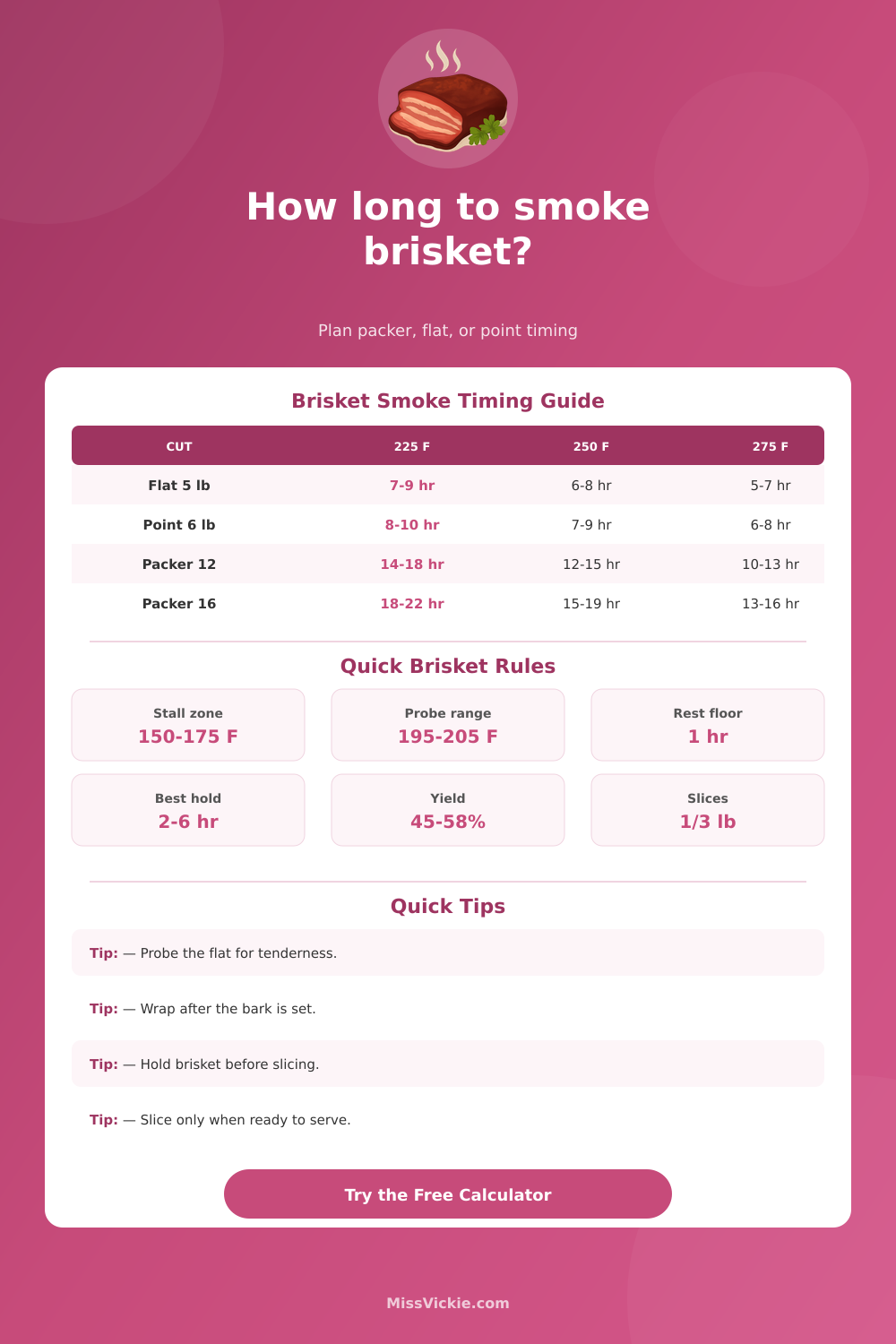
| Brisket cut | Typical raw weight | 225 F planning range | 250 F planning range | 275 F planning range |
|---|---|---|---|---|
| Small flat | 3 to 5 lb | 5.5 to 8.5 hours | 4.5 to 7 hours | 4 to 6 hours |
| Full flat | 5 to 8 lb | 7 to 11 hours | 6 to 9 hours | 5 to 8 hours |
| Point only | 4 to 7 lb | 7 to 10.5 hours | 6 to 9 hours | 5 to 7.5 hours |
| Whole packer | 10 to 14 lb | 13 to 18 hours | 11 to 15 hours | 9 to 13 hours |
| Large packer | 15 to 18 lb | 17 to 23 hours | 14 to 19 hours | 12 to 16 hours |
Ranges include normal brisket variation, stall behavior, and a moderate wrap. Very lean flats and very large packers can land outside the table.
📦Wrap and stall comparison table
| Wrap plan | Timing effect | Bark texture | Best use | Calculator adjustment |
|---|---|---|---|---|
| Foil wrap | Fastest through stall | Softer bark | Hot fast cooks and firm deadlines | Shortens stall 12 to 18 percent |
| Butcher paper | Moderate speed | Bark stays drier | Classic sliced brisket | Small reduction after bark set |
| Foil boat | Moderate finish | Top bark remains exposed | Fat-side-up finishing | Speeds bottom and keeps top open |
| No wrap | Longest stall | Firmest bark | Maximum crust and relaxed schedule | Adds stall and drying allowance |
| Late wrap | Only helps finish | Strong bark | Bark-first cooks that run long | Adds early stall, trims final time |
🌡Tenderness and hold table
| Target | Probe range | Feel in the flat | Rest and hold plan | Serving style |
|---|---|---|---|---|
| Competition slices | 195 to 201 F | Soft but still structured | Vent briefly, hold 2 to 4 hours | Clean slices with slight tug |
| Backyard slicing | 198 to 203 F | Probe slides with light resistance | Rest 1 hour, hold 2 to 6 hours | Balanced slices and moist point |
| Extra soft | 202 to 207 F | Very little resistance | Long hold can soften further | Family platter or chopped edges |
| Burnt ends point | 200 to 208 F | Point jiggles and renders | Cube, sauce, return to pit | Point cubes and rich bites |
🍴Yield and serving table
| Raw brisket | Likely cooked yield | Light servings | BBQ plate servings | Heavy servings |
|---|---|---|---|---|
| 5 lb flat | 2.2 to 2.8 lb | 8 to 11 | 6 to 8 | 4 to 5 |
| 8 lb flat | 3.6 to 4.5 lb | 14 to 18 | 10 to 13 | 7 to 9 |
| 12 lb packer | 5.4 to 6.8 lb | 21 to 27 | 16 to 20 | 10 to 13 |
| 16 lb packer | 7.2 to 9.2 lb | 28 to 36 | 21 to 27 | 14 to 18 |
🧭Smoking style comparison grid
Longest window, deep smoke, steady rendering, and the widest stall allowance for large packers.
Balanced timing for paper-wrapped brisket with dependable bark and a flexible warm hold.
Useful for deadlines, especially with foil, but needs closer checks once the flat gets tender.
Best for maximum bark when the meal time is flexible and the brisket has enough fat cover.
💡Brisket timing tips
If this is your first time smoking a brisket, then you probably approached it as if it were a math equation: weigh the meat, divide by an hourly rate found on a forum, and set a timer for eight hours later. The number you find online somewhere becomes your hour and eight hours after you start, voila! Dinner’s ready.
Except on round two, you figure out that physics don’t gives a damn about your dinner plans. Briskets stalls, sweat, and won’t exactly glide from one temperature zone to another. It fights back. It takes longer, and shorter, when you least expect it, so planning (not accuracy)… Becomes most important in the battle of biology against human will.
Why Brisket Cooking Is More Art Than Science
You need a framework that factors in the things you can do without controlling the actual meat itself, which you can never do exactly right. The timer is important but most of us pay too much attention to it and don’t pay enough attention to what’s happening with the meat itself. Once you know your specific cut and condition of the meat in the pit, plug that into the calculator above. It does the math for you, so you don’t have to guess how an unexpected stall or a heavy fat cap will impact your time. What it forces you to do is think more about the order of events, not just how long they take.
A whole packer brisket isn’t going to behave the same as a lean flat. You’ll need to wait to render all that intramuscular fat in the point, then risk over-drying the flat if you push it too hard. If you ignore this distinction, you may end up pulling a tough piece of brisket because you got distracted by thermometer instead of listening to how the probe feels. That’s where most timelines go to hell.
Evaporative cooling sets in when your grill reaches that terrible hundred-and-fifty zone inside. It seems as though meat isn’t cooking at all. Your options are to either wrap early (foil helps accelerate things) or hang on (butcher paper will help maintain a drier bark). Both options affects the overall cook time and final texture.
If you choose to wrap, you’ll gain an hour or two but lose some of your crust. If you leave it naked, you get better bark but need to be patient and willing to be home for quite a while. The tool’s reference tables spells out these trade-offs nicely. They show you how various wraps affects the cooking time. Then you must decide which factors is most important to you for the particular meal you’re making. Is it texture? Speed?
The other trap is temperature: Lots of cooks freak out trying to reach two hundred exactly, and tenderness isn’t one number. Tenderness is a range from when the collagen melts into gelatin until before the muscle fibers tightens back up. So let the temperature go lower if needed; just remove the meat when you think it’s tender. Even if it shows on thermometer as being below your desired level. And that’s what some folks do wrong, because they believe the machine and not their thumb.
When the probe goes in, it should slide easily, as though you’re pushing it through warmed butter. If there’s any resistance, smoke away. If it slides right in, it’s done. The meato-meter will tell you approximately when to test, but your fingers make the decision.
After pulling the brisket: It’s not finished yet. You need to let it rest not just so juices can redistribute, but also so the carryover heat can do its thing before the outside gets cooked past perfect. Keeping it in a properly held insulated container ensures that it will be tender and safe to eat for hours on end. This is the difference between a relaxed cook and a stressful one.
You can rest it four hours ahead if you’re finished early or wait too long to start resting and it’ll lose some of that texture. Plan out your rest time just like your smoke time and when things inevitably go sideways, you have some breathing room. You should of planned better.
So in summary: Brisket smoking is really more art than science; it’s less recipe-following and more time and energy management. The meat tell you what to do, and you manipulate the environment and the heat source to get there. Letting go of who’s in charge here takes some of the worry out of cooking. Understanding why the stall happens and how wrapping affects your bark turns those strict deadlines into useful markers. What you’ll have then is something better than the timeline implied because instead of checking the clock you’re reading the meat.
The process can be difficultly if you dont know what to look for. It makes it more moddern to use tools based off facts rather then guessing. You shouldnt let a single mistake dissapear your confidence in the cook.