Brisket Smoke Time Calculator
Estimate brisket smoking time from raw weight, trim, cut style, smoker temperature, stall and wrap choice, probe tenderness target, rest time, and serving schedule.
Choose a real barbecue setup, then adjust the brisket weight, trim, smoker heat, wrap plan, tenderness target, and rest. Time is for planning; final doneness comes from probe feel.
Food safety note: This calculator estimates timing for barbecue planning. Use a reliable probe thermometer, keep hot-held brisket above 140°F, and judge final doneness by tenderness in the thick flat and point.
Your Brisket Smoking Plan
Calculated from your selected brisket setup.
Timing Breakdown
Brisket Details
| Raw Brisket | 225°F No Wrap | 250°F Paper | 275°F Foil | Best Use |
|---|---|---|---|---|
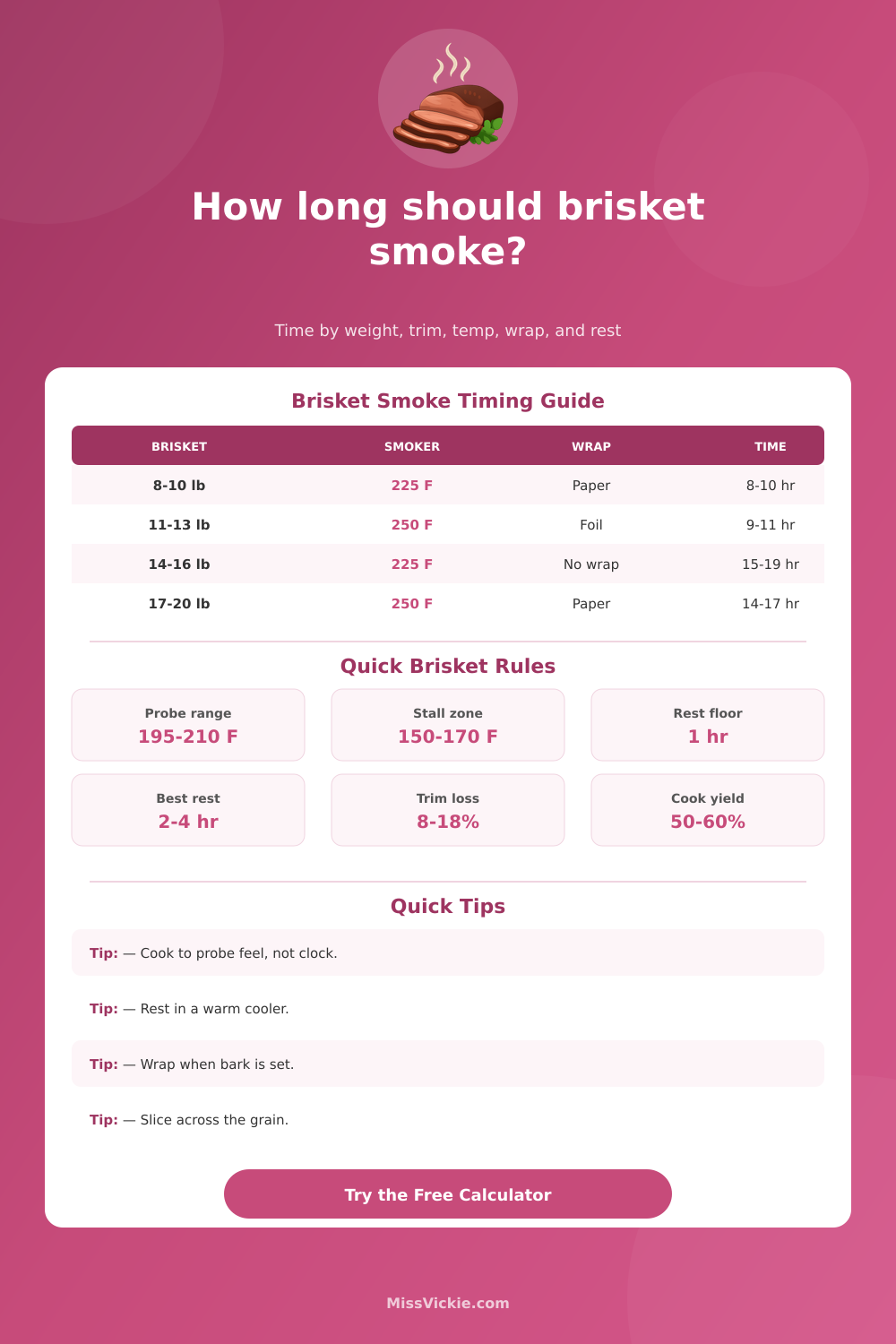
| 5 to 7 lb flat | 7 to 10 hr | 6 to 8 hr | 5 to 6.5 hr | Small family dinner, lean slices |
| 8 to 10 lb packer | 10 to 14 hr | 8 to 10.5 hr | 6.5 to 8.5 hr | Backyard cook with moderate rest |
| 11 to 13 lb packer | 13 to 17 hr | 9.5 to 12 hr | 8 to 10 hr | Classic overnight brisket |
| 14 to 16 lb packer | 15 to 20 hr | 12 to 15 hr | 10 to 12.5 hr | Party brisket or long hold |
| 17 to 20 lb packer | 18 to 24 hr | 14 to 18 hr | 12 to 15 hr | Large event with early start |
Table estimates assume a steady pit, average thickness, and a rest after cooking. Very thick flats, cold weather, or repeated lid openings can add time.
| Choice | Timing Effect | Bark Effect | Moisture Effect | When To Use |
|---|---|---|---|---|
| Untrimmed brisket | Adds 5 to 10% | Fat shields bark | Protects lean flat | Long backyard cooks |
| Close competition trim | Often 5% faster | Cleaner seasoning bite | Less fat insulation | Judged slices or tight boxes |
| Butcher paper | Shortens stall moderately | Keeps bark textured | Moderate moisture hold | Classic Central Texas style |
| Foil wrap | Fastest stall push | Softens bark more | Strong moisture retention | Late cooks or lean flats |
| No wrap | Longest cook | Firmest bark | More surface drying | Bark-first barbecue plans |
| Warm cooler rest | Adds no cook time | Sets crust gently | Redistributes juices | Best serving insurance |
Good bark, moderate stall reduction, and reliable moisture for whole packers.
Pushes through the stall quickly, helpful for flats or a schedule that is slipping.
Protects the bottom while leaving the top bark exposed for a drier surface.
Builds strong bark, but needs a larger time window and careful moisture management.
| Target Style | Likely Temp | Probe Feel | Best Slice | Rest Suggestion |
|---|---|---|---|---|
| Firm sliceable | 195 to 200°F | Slight resistance | Flat slices for sandwiches | 1 to 2 hr |
| Classic tender | 200 to 205°F | Warm butter feel | Flat and point slices | 2 to 4 hr |
| Extra soft | 203 to 208°F | Very loose feel | Rich dinner slices | 2.5 to 4 hr |
| Burnt ends point | 200 to 210°F | Soft point cubes | Sauce and reset cubes | 30 to 90 min before cubing |
| Catering hold | 198 to 203°F | Tender but not fragile | Long-held slices | 3 to 6 hr warm hold |
A brisket is a difficult food to time because the brisket itself determines its own cooking time. Briskets do not follow the clock in the kitchen, so cooks cant solely rely upon the clock to determine when the brisket is finish cooking. Briskets may experience a stall in the cooking process that can last for many hour.
The point of the brisket may cook at a different rate then the flat of the brisket. The temperature of the smoker can have an impact on the smoking process of the brisket, which is why cooks should utilize a brisket smoke time calculator prior to placing the brisket into the smoker. Such a calculator will allow cooks to account for the variable in the smoking process to determine the time at which they should remove the brisket from the smoker.
What Affects Brisket Smoke Time
The weight of the brisket is one variable that will impact the cooking of the brisket. For example, a brisket that weigh twelve pounds and has trimmed to a quarter inch of fat will cook differently than a brisket that weighs the same but has a heavy fat cap on the brisket. The amount of fat that is trimmed will impact both how the brisket cooks and how much weight the brisket loses while cooking.
A brisket smoke time calculator will ask for the trim level of the brisket because this variable will impact the weight of the brisket both before and after the smoking process. Furthermore, cooks must plan for how much brisket will be yield from the smoking process to ensure that there will be enough meat for the individuals that will eat the brisket. Smoker temperature is another variable that will impact the brisket.
For example, if cooks runs the smoker at 225 degrees, the brisket will take longer to cook than if the smoker is running at 275 degrees. However, cooking at 275 degrees presents more opportunities for mistakes during the smoking process. Additionally, cooking at either temperature will impact the length of the stall period that the brisket will experience.
The inclusion of smoker temperature in the brisket smoke time calculator reflect the understanding of how smoker temperature can impact cooking time. The choice of wrap in which the brisket is wrapped will also impact the brisket. For example, using butcher paper will allow the brisket to develop its bark yet shorten the stall period.
Using aluminum foil will speed up the cooking of the brisket yet result in a soft crust on the brisket. Choosing not to wrap the brisket at all will result in the brisket developing a thick crust yet require more patience when cooking the brisket. A brisket smoke time calculator will allow cooks to choose the method in which the brisket will be wrapped so that the smoking time estimate is reflective of that certain cooking method.
The tender feel of the brisket is an indication to cooks of when the brisket is done. For example, while the smoke time calculator will provide an estimated cooking time and an expected level of tenderness, cooks will need to use a meat probe to determine if the brisket is done. Some brisket cut will feel soft with the probe at 203 degrees while other cuts may feel firm at 198 degrees.
Therefore, while the smoke time calculator will help cooks to find the best time range to cook the brisket, cooks will have to make the final decision regarding doneness. Another variable to consider with cooking brisket is rest time. The brisket can be removed from the heat yet allowed to rest for several hours in a warm cooler.
During this resting period, the juices in the brisket will redistribute throughout the cut of meat. If the juices are allowed to redistribute, the brisket will develop a bark that will set and the slices of brisket will hold together. Thus, another variable that should of been considered in the brisket smoke time calculator is rest time, which is another essential part of the timeline that the cooks must consider in the preparation of the meal.
Finally, although cook experience will allow cooks to somewhat anticipate the time that the brisket will take to cook, there are many factors that may alter that estimated time. For instance, the weather outside the smoker can have an effect upon the time that it takes for the brisket to cook. Additionally, the bag of wood pellets that is used to cook the brisket may have a different moisture content than the previous bag of brisket smoker pellets.
Therefore, a brisket smoke time calculator may include a risk adjustment for the frequency at which the smoker’s lid is opened or for the impact of the wind or water pan use on cooking time. Such risk adjustments will allow cooks to plan the time at which the brisket can be served. Two tables are provided within the brisket smoke time calculator that show the effect that different weights and different temperatures can have upon the cooking time of the brisket.
While these tables are not rules that cooks in the kitchen must be followed, they do help cooks to understand the range that cooking times may have. For instance, the table may show that a brisket that weighs 14 pounds and is cooked at 250 degrees will take between 12 and 15 hour to cook while a brisket that weighs 14 pounds cooked at 225 degrees will take more than 18 hours to cook. Although a brisket smoke time calculator may be helpful to cooks in planning the cooking of a brisket, the cook must have some degree of judgment of when the brisket is done.
For instance, the thickness of the brisket vary and the marbling of the brisket can vary. Thus, the point portion of the brisket may reach the level of tenderness required for cooking before the flat portion of the brisket reaches that same level of tenderness. The brisket smoke time calculator will help cooks to arrive at the correct cooking time yet cooks must still utilize their understanding of brisket to determine when the brisket has reached the level of doneness that the cooks require.
Thus, while cooks may plan their cook with the smoke time calculator, cooks should always begin with a time that allows for the brisket to cook yet not cook too quickly to allow for the collagen in the brisket to fully relax.