Equilibrium Brine Calculator
Calculate an equilibrium brine from the total weight of food plus water. Get exact salt, sugar, optional Cure #1, starting brine strength, estimated time by thickness, and a serving sodium estimate.
Choose a brining preset
Presets fill practical starting values for common foods. Edit any field after choosing one.
Brine inputs
Your equilibrium brine plan
Salt, sugar, brine strength, and timing update from the form.
Formula breakdown
Serving and safety notes
Salt volume and batch helpers
Volume measures are included for cross-checking only. For equilibrium brining, weigh salt and sugar because crystal shape changes teaspoons dramatically.
Equilibrium brine comparison grid
Reference tables
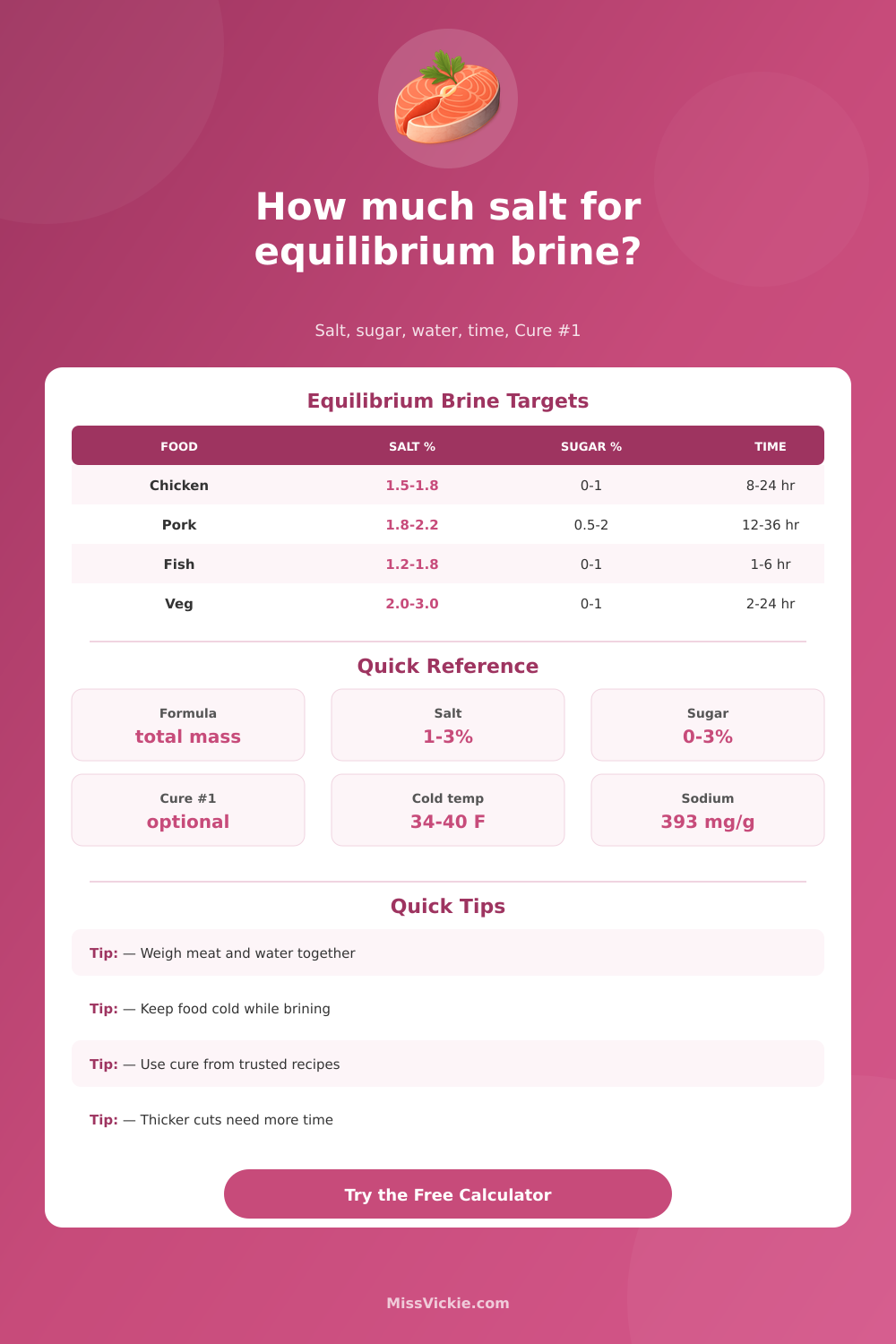
Suggested salt targets
| Food | Typical % | Notes |
|---|---|---|
| Chicken breast or thighs | 1.5 to 1.8% | Balanced seasoning for grilling, roasting, or meal prep. |
| Whole poultry | 1.4 to 1.7% | Large cavities and bones need time; avoid excess water. |
| Pork chops or loin | 1.8 to 2.2% | Lean pork benefits from sugar and a full chill period. |
| Fish fillets | 1.2 to 1.8% | Shorter time and lower salt protect texture. |
| Vegetables | 2.0 to 3.0% | Pickles and ferments often run higher than meat brines. |
Salt volume conversion
| Salt type | Approx g per tsp | Best use |
|---|---|---|
| Table salt | 6.0 g | Dense crystals; easy to oversalt by volume. |
| Fine sea salt | 5.7 g | Close to table salt, but brands vary. |
| Morton kosher | 4.8 g | Medium density kosher salt. |
| Diamond Crystal kosher | 2.8 g | Large flakes; teaspoons look much larger. |
| Pickling salt | 5.9 g | No anti-caking agents; dissolves quickly. |
Thickness and timing guide
| Thickest point | Meat or poultry | Seafood |
|---|---|---|
| 1 cm / 0.4 in | 2 to 4 hr | 20 to 45 min |
| 2.5 cm / 1 in | 8 to 18 hr | 1 to 3 hr |
| 5 cm / 2 in | 24 to 48 hr | 3 to 6 hr |
| 8 cm / 3 in | 2 to 4 days | Use caution |
| Whole bird | 24 to 72 hr | Not typical |
Sodium reference per 100 g food
| Final salt % | Sodium | Use case |
|---|---|---|
| 1.25% | 491 mg | Light fish or shrimp brine. |
| 1.50% | 590 mg | Mild poultry seasoning. |
| 1.75% | 688 mg | Everyday chicken target. |
| 2.25% | 884 mg | Pork, pickles, or stronger seasoning. |
| 3.00% | 1179 mg | Vegetable ferment planning. |
Two brining tips
Food safety note: This calculator is a kitchen math tool. Keep meat and seafood cold, avoid cross-contamination, and use Cure #1 only with a trusted curing recipe and applicable food-safety guidance.
Equilibrium brining is a method of seasoning foods using a specific mathematical approach. With traditional brining, people typically boil food in salt water to season the food. With this traditional method, however, the salt level often end up being too weak or too salty.
With equilibrium brining, though, the food and the water is treated as a single total mass. You can calculate the salt according to the total mass of the food and water. As a result, the seasoning of the food with this method will be consistencies each time.
How to Do Equilibrium Brining
To use equilibrium brining, first determine the total mass of the food and water to be used. Based off that total mass, calculate the percentage of salt that will be used. Add that amount of salt to an container of water.
This method is more accurate than traditional brining in that traditional method typically dont account for the weight of the water that will be used in the brining process. If more water is added to cover the food, for instance, the total mass increase. If the total mass increases without increasing the amount of salt that you add to the water, though, the concentration of salt will decrease.
Thus, it is important to include the weight of the water in the calculation. Two factors that impact equilibrium brining are the temperature of the food and the thickness of the food. The process by which salt move into the food is called diffusion.
Cold temperatures slows the rate of diffusion of salt into the food. Thus, meat and seafood should be stored in a refrigerator throughout the equilibrium brining process. Additionally, the thickness of the food also impact the time required for equilibrium brining to occur.
Foods that are thin, like shrimp, will take less time to achieve equilibrium then thick food, like a whole chicken. Equilibrium brining may fail if you use the density of the salt as a means of measuring the salt for the recipe. Salt has different density; table salt is more denser than kosher salt.
Thus, if you use the density of the salt to measure the salt for equilibrium brining, it is possible to add too much or too little salt to the food. Thus, it is best to use a scale to weigh out the amount of salt that is need for equilibrium brining. While there may be volume estimate for the salt on the sides of the tools used for equilibrium brining, the weight of the salt is the only measurement that is essential for achieving the accurate salt concentration required for equilibrium brining.
Cure number one is a specific ingredient that differ from regular salt. Cure number one contains nitrites that allow for the food to retain its color and safety. Because of the role of nitrites in this ingredient, the amount of cure number one is not calculated based on the total mass of the food to be brined.
Instead, you calculate the amount of cure number one based only upon the weight of the food. Only use cure number one if the recipe for the food specifically call for it. Equilibrium brining can also be used for vegetables.
Vegetables, however, often contain different percentages of salt than meat do. Many recipes that use vegetables also require higher percentage of salt than recipes for meats do, as many vegetable projects use brining as a means of preparing the vegetables for fermentation. Additionally, many vegetable projects do not require the food to remain refrigerated after equilibrium brining.
Still, equilibrium brining methods must be used for vegetables. The vegetables and water must be weighed to determine the total mass of the equilibrium brining process, and that total mass are used to calculate the amount of salt to be used. Equilibrium brining also allow for the recipes to be easily scaled to any quantity of food.
Simply double the weight of the food and the weight of the water to double the recipe. The percentage of salt will remain the same. Thus, equilibrium brining is useful for cooking large meals.
Each type of protein can be prepared in the same way using the equilibrium brining method, and the results can be repeat without variation in the results of the process. The serving sodium estimate will show the amount of sodium that will be in each portion of the food after equilibrium brining. This number is useful for individuals who need to limit their sodium intake, and it is also of use in comparing the amount of salt of different equilibrium brines.
While not the same as a nutrition label, the sodium estimate is a helpful tool in understanding how much salt is in the food that will be prepared using equilibrium brining. Thus, using equilibrium brining to season proteins allow for the control of the salt in the food, and using the sodium estimate allow for the understanding of the salt content of the prepared meal.