Postpartum stage, nursing frequency, pumping, body stats, activity, goals, and meal split
Breastfeeding Calorie Calculator
Estimate daily calories while breastfeeding from postpartum age, direct nursing sessions, pumped milk, height, weight, activity level, weight goal, macro pattern, meals, and snacks.
Choose a starting scenario, then adjust every field to match your feeding pattern and your care team's guidance.
Calculation Breakdown
Frequent feeds, supply still building, recovery and hunger vary widely.
Common full-supply planning range when most nutrition is breast milk.
Partial breast milk often needs a smaller add-on than exclusive feeding.
Older baby or toddler nursing may need a modest, very individual add-on.
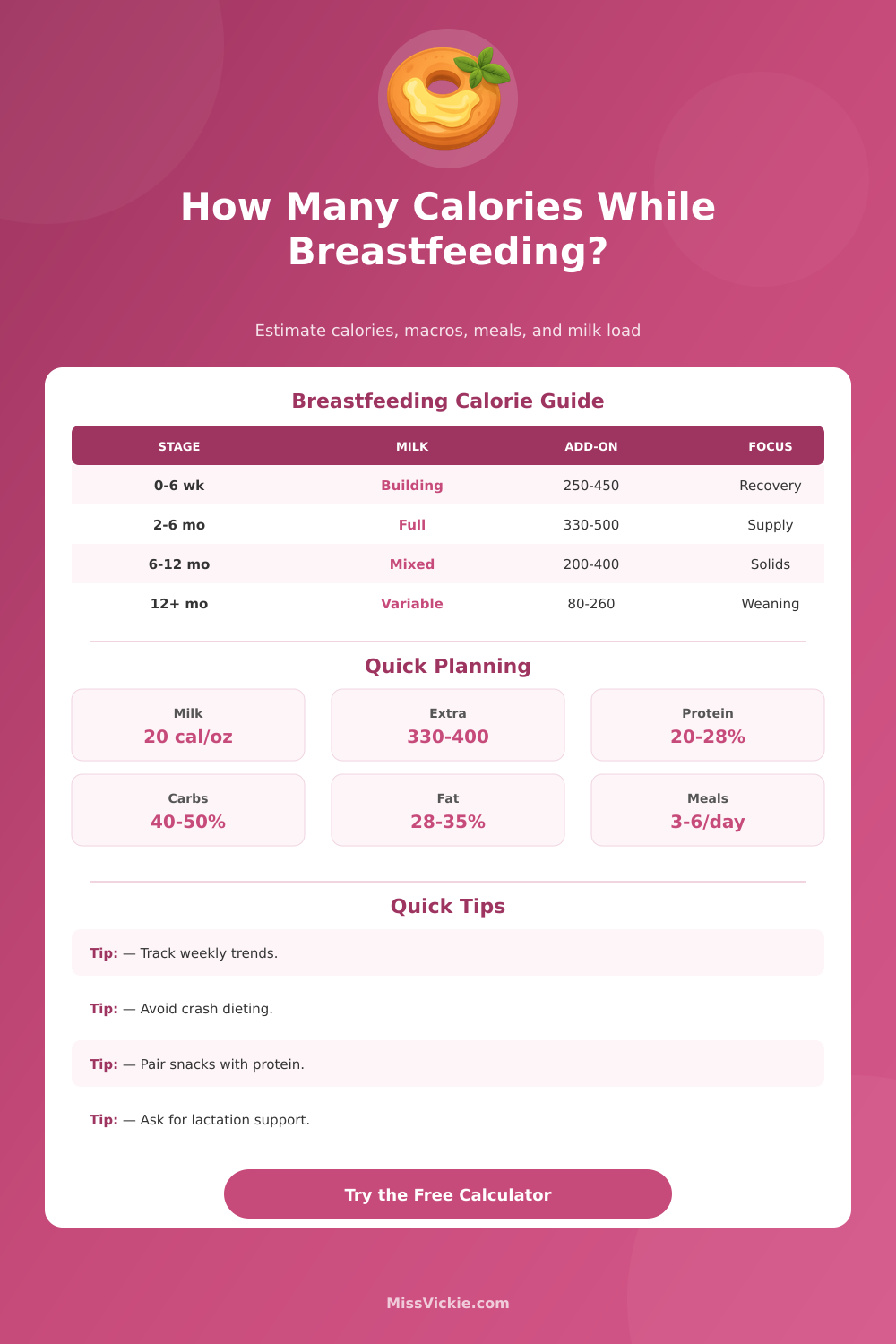
| Postpartum Stage | Typical Feeding Pattern | Calculator Add-On Range | How It Is Used |
|---|---|---|---|
| 0-6 weeks postpartum | Supply building, cluster feeds common | About 250-450 calories/day | The calculator softens the estimate because intake, recovery, and milk volume are still changing. |
| 7-26 weeks postpartum | Exclusive or near-exclusive milk feeds | About 330-500 calories/day | Full milk load usually gives the largest food add-on in this calculator. |
| 27-52 weeks postpartum | Breast milk plus solids or mixed bottles | About 200-400 calories/day | The estimate tapers as solids, formula, or fewer milk feeds reduce average milk demand. |
| 12 months and beyond | Toddler nursing or gradual weaning | About 80-260 calories/day | Use the nursing and pumping fields because needs vary from comfort feeds to substantial milk intake. |
| Feeding Scenario | Input Pattern | Milk Load Estimate | Planning Note |
|---|---|---|---|
| Direct breastfeeding, established supply | 7-10 nursing sessions, 0-6 pumped oz | Often 22-32 oz/day | Common full-supply scenario; watch hunger, supply, and infant growth cues. |
| Exclusive pumping | 0 nursing sessions, 20-35 pumped oz | Pumped amount is counted directly | The pumped field drives the milk-load estimate because direct transfer is zero. |
| Combo feeding | 3-6 nursing sessions, 0-8 pumped oz | Often 10-22 oz/day | The calculator reduces the dietary add-on when breast milk is about half of intake. |
| Solids or toddler nursing | 1-6 nursing sessions, variable pumping | Often 4-20 oz/day | Postpartum stage lowers typical transfer per session as milk is no longer the only food. |
| Pattern | Protein | Carbs | Fat And Fluid |
|---|---|---|---|
| Balanced lactation plate | 22% calories, with a weight-based floor | 45% calories | 33% fat; fluid rises with milk load and activity |
| Higher protein recovery | 28% calories | 40% calories | 32% fat; useful for more filling meals |
| Plant-forward higher carb | 20% calories | 50% calories | 30% fat; plan beans, grains, nuts, and seeds |
| Steady-energy snacks | 24% calories | 44% calories | 32% fat; spreads calories across snacks |
| Higher-fat satiety | 22% calories | 40% calories | 38% fat; may fit smaller, energy-dense meals |
| Meal Pattern | Meal Share | Snack Share | Best Fit |
|---|---|---|---|
| 3 meals, 0-1 snack | Large meals carry most calories | 0-14% of daily calories | Works when appetite is steady and meals are predictable. |
| 3 meals, 2-3 snacks | Each meal gets a moderate share | About 22-30% split across snacks | Often helpful for overnight nursing hunger or busy postpartum days. |
| 4-5 meals, 1-3 snacks | Smaller meals spread through the day | About 16-28% split across snacks | Useful when large meals feel uncomfortable or time is fragmented. |
| Supply support day | Keep meals steady | Add a protein snack or hunger buffer | Use during growth spurts, cluster feeding, or higher pump-output days. |
Breastfeeding changes the energy requirements of a persons, as well as the way in which that person plans their meal. Besides the body recovering from the birth itself, the body must produces milk for the baby to drink; milk contains around 20 calorie per ounce. The number of calories that a person need to consume while breastfeeding includes various factor, such as how many weeks since the birth of the baby, how often the baby nurses from the breast, whether the person is pumping breast milk, and the activity level of the person while breastfeeding.
The calorie calculator for breastfeeding women utilizes each of these variables to calculate the number of calories that a person should consume daily while breastfeeding. The calculator first calculates the resting energy that a person should consume based off their age, height, and weight. The calculator adds the calories that are calculated for milk production to this number, as are the calories that are consumed based upon the activity level of the person.
How the Breastfeeding Calorie Calculator Works
Additionally, there is a goal modifier that is applied to ensure that there is enough milk supply as well as enough recovery of the body after birth. The number of weeks since the birth of the baby is utilized to calculate these calories; in the early weeks after birth, the body is recovering from the birth itself and establishing a milk supply, so fewer calories is calculated. However, after the baby begins to consume solid foods, the body’s demands change and the number of calories shifts accordingly.
The person can enter the number of ounces that are consumed through direct nursing sessions as well as pumped breast milk into the calculator. The calories that are calculated for the breast milk that is pumped is included in the total calories that are calculated for the person, as is the number of calories that are consumed if the person begins to consume bottles of breast milk. In addition to the number of calories, the calculator also provides suggestion for macronutrients.
There is no specific ratio suggested for carbohydrates, protein, and fat; instead, there are suggestions for each macronutrient. For instance, the ratio of protein can be increased if the body’s needs for protein are recognized; the person needs protein as well as for the milk supply that is being made. Amino acid are used both in the production of breast milk as well as in the repair of the bodys tissues.
The body is provided with a floor for the amount of protein that it should consume based upon its body weight. The remaining calories are allotted to either carbohydrates or fat. The number of meals that a person consumes each day can also be entered into the calculator.
For instance, if the person nurses the baby overnight, suggesting eating three meals and three snacks to the body to prevent feelings of hunger at around 2 a.m. However, if the body is able to eat meals throughout the day, four meal and one snack may be suggested. If the person has weight goals for themselves, those can also be entered into the calculator. For instance, if the person wishes to maintain their current weight while breastfeeding, the number of calories will be set to the number that is required for that person to maintain their weight plus the calories for milk production.
If the person wishes to lose weight gentle, a small calorie deficit will be calculated for the body; however, this setting is only for after the body has established its milk supply. An aggressive loss goal will also be tempered by the number of weeks since the birth of the baby; too aggressive of a loss goal too early in the postpartum period could lead to too low of a calorie intake for the bodys recovery. Finally, a custom field is provided for individuals who have been instructed by their physician of the number of calories that should be consumed daily while breastfeeding.
Because the daily life of the breastfeeding woman changes, the appetite of the woman may change as well. For instance, the baby may go through growth spurt that lead to cluster feeding after which the woman may feel a need to eat more foods than normal within a week. The hunger buffer function allows for these changes in appetite to be accounted for in the body.
Additionally, the trends of appetite each week are more important than the appetite that is experienced on any given day; thus, revisiting the calculator each week is recommended. Beyond the suggestions that are provided by the calculator, the woman can implement additional suggestions into her diet. For instance, eating snacks that contain protein will help to prevent the drop of the energy level of the woman during breastfeeding.
Similarly, having food options that are easily consumed visible in the kitchen will ensure that the breastfeeding woman does not drop in the amount of food that she consume. While the calculator acknowledges the needs of the body and the baby, it does not account for factors like sleep, stress, or the thyroid status of the breastfeeding mother. Thus, the suggestions of the calculator are only estimates of the caloric needs of the breastfeeding woman.
It is possible that a woman will feel hungry during the first few weeks after the birth of the baby, even according to the calorie calculator. The body is rebuilding its blood vessel, repairing its tissues, and establishing a supply of breast milk. However, after the baby begins to consume solids, the demands on the body change and the body may feel as if the required calories are too high for the woman to consume daily.
Finally, the suggestions from the calculator can help to reveal certain pattern in the life of the breastfeeding woman that can be discussed with her lactation consultant or dietitian. While the calculator helps provide a map of the needs of the body and the baby, the body and the baby are that which provide the terrain that must be traveled. The goal is for the body to remain energetic, continue to produce sufficient breast milk for the baby, and for the body to recover from the birth itself.
Thus, the calculator helps remove some of the guesswork in determining how many calorie and ounces of milk the breastfeeding woman should consume each day.