🍞 Salt in Bread Calculator
Calculate the exact salt amount for any bread recipe by flour weight, bread type, and batch size
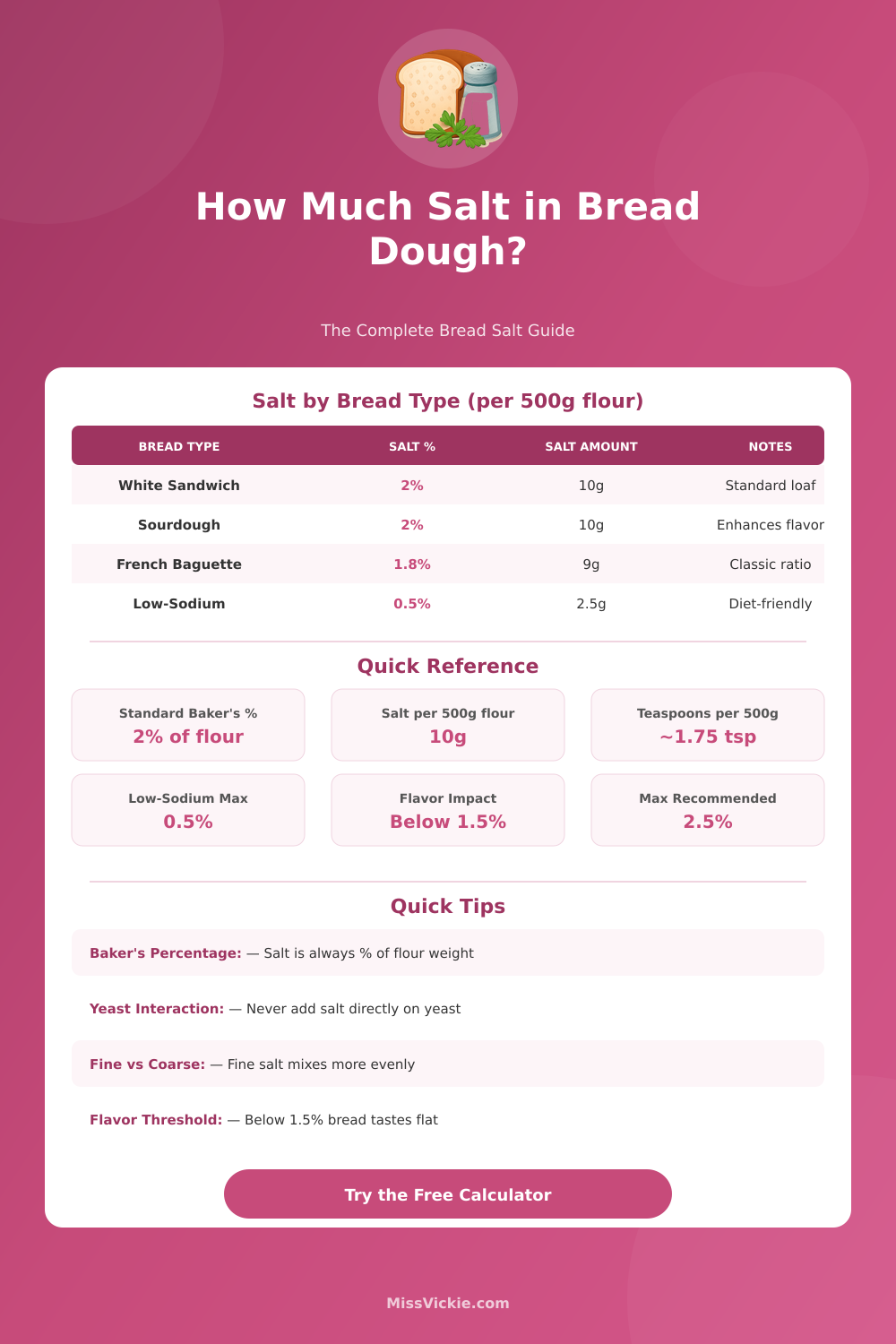
| Flour Weight | 1.5% Salt | 2% Salt | 2.2% Salt | 2.5% Salt |
|---|---|---|---|---|
| 250g (about 2 cups) | 3.75g / 0.6 tsp | 5g / 0.8 tsp | 5.5g / 0.9 tsp | 6.25g / 1 tsp |
| 400g | 6g / 1 tsp | 8g / 1.3 tsp | 8.8g / 1.5 tsp | 10g / 1.7 tsp |
| 500g (about 4 cups) | 7.5g / 1.25 tsp | 10g / 1.75 tsp | 11g / 1.8 tsp | 12.5g / 2 tsp |
| 600g | 9g / 1.5 tsp | 12g / 2 tsp | 13.2g / 2.2 tsp | 15g / 2.5 tsp |
| 750g | 11.25g / 1.9 tsp | 15g / 2.5 tsp | 16.5g / 2.75 tsp | 18.75g / 3.1 tsp |
| 1000g (1kg) | 15g / 2.5 tsp | 20g / 3.3 tsp | 22g / 3.7 tsp | 25g / 4.2 tsp |
| Salt Type | Weight per tsp | Equivalent to 1 tsp Fine | Notes |
|---|---|---|---|
| Fine Sea Salt / Table Salt | 6g | 1 tsp | Most accurate for baking |
| Kosher Salt (Diamond Crystal) | 2.8g | 2 tsp | Lightest, flakiest |
| Kosher Salt (Morton) | 4.8g | 1.25 tsp | Denser than Diamond Crystal |
| Coarse Sea Salt | 5g | 1.2 tsp | Grind before measuring |
| Himalayan Pink Salt | 6g | 1 tsp | Same as fine sea salt |
| Salt Level | Baker's % | Flavor Effect | Texture Effect |
|---|---|---|---|
| No Salt | 0% | Bland, tasteless | Weak gluten, sticky |
| Under-salted | 0.5–1.4% | Flat, lacks depth | Slightly soft crust |
| Optimal Low | 1.5–1.8% | Mild, clean flavor | Good structure |
| Standard (ideal) | 1.8–2.2% | Full, balanced flavor | Best crust and crumb |
| High (specialty) | 2.3–2.5% | Salty, distinct | Dense, tighter crumb |
| Over-salted | Above 2.5% | Unpleasantly salty | Yeast inhibited, poor rise |
Bread… Simple mix of water, flour and yeast, finds itself on tables everywhere in the world but it is especially important in Europe and the Middle East. During thousands of years it feeds folks, so it belongs to the most old human creations.
Even now millions of folks eat it daily, without noticing its basic role. What started as everyday food in old civilizations, stays like this until today.
What Bread Is and How to Bake It
The advantage of bread from grains, like wheat or rye, is that it eases digestion for our bodies. And the nicest? After baking it becomes portable, simple food, that does not require preparation.
Everywhere exist thousands of kinds of bread, each with its own history and cultural story, and tasts good.
For white bread you do not require special gear. Standmixer help to save time, but really a bowl, wooden spoon and your hands work. Beginners find wonderful the crusty artisan loaf, only four ingredients, without need of special molds or tools.
Best: it does not require strong kneading or precise shaping, and a lot does itself.
Except baguettes, the basic mix flour-water-yeast-salt gives many possibilities. In regular molds you bake loafs for sandwiches, prepare dough for pizza or roll it for pita bread. Hot French roll perfectly matches with almost every meal, drizzled with olive oil, in gravy with potatoes, beside pasta or soups, or made in garlic slices.
Hardly struggle with the proofing? Here everything becomes tricky. The dough must rise in warm place before entering the oven, which mostly lasts at least one hour.
Problems in the finished bread commonly come from uneven density during the second rise and shaping.
Home loafs surpass bought ones more often than not, if you escape typical mistakes. Genuinely crisp, chewy sourdough is something unique, although starter require patience to grow. Recall only: eat the bread inside some days, otherwise it grows mold or turns into bricks.
Chocolate chips and cocoa powder make banana bread richer and moist. Pineapple gives pleasant tartness and keeps it fresh, but escape one common trap during adding. Really you mix almost anything…
Nuts, vegetables, meat, cheese, fruits, purees, jams. Even toasted wheat bran and germ alter the texture in interesting ways.
Baking is the moment, when hours of work and waiting ultimately fruits, converting dough inreal bread.